








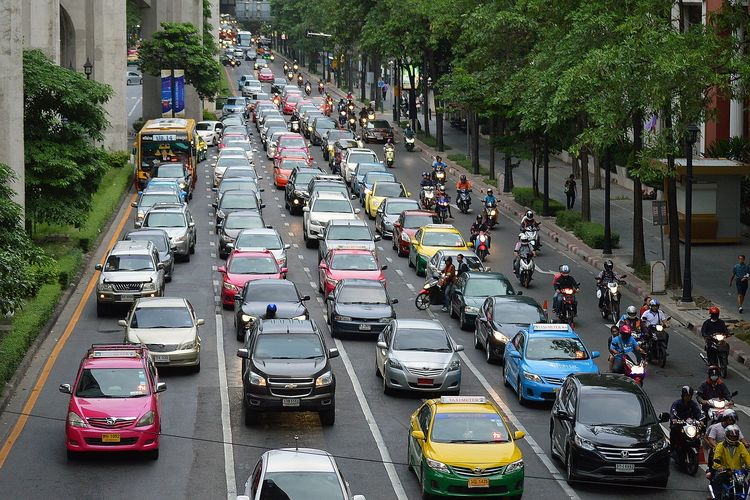
City arteries full of cars stuck in miles-long traffic jams, exhaust fumes pouring from tailpipes, traffic moving at 5 km/h, frustrated drivers, the sound of horns – this is the daily reality for many people trying to get to work in the morning or return home in the afternoon. The situation changed for a moment due to the coronavirus pandemic. About a year and a half ago, with the first lockdown, employees switched to remote work. Traffic decreased noticeably, and traffic jams disappeared. However, we are slowly returning to normal, and with it, problems with urban street capacity, accidents, and road incidents are returning. Technology provides solutions. Intelligent monitoring systems are capable of effectively supporting urban traffic management.
Migration from smaller centers to cities continues unabated. Almost every modern metropolis gains population every year. More residents crowded into a small space means more traffic jams, which creates new challenges related to traffic management. The coronavirus pandemic further exacerbated the phenomena of city center depopulation and suburbanization, i.e., settling in less crowded suburban areas, which generates more traffic on bypasses and access roads to the city. We are therefore stuck in traffic jams not only in the center but also on the outskirts. How to remedy this?
Intelligent traffic management solutions
Urban traffic management centers operate 24 hours a day, 7 days a week – they supervise traffic and monitor road throughput. Many of them already use advanced monitoring systems that can quickly identify incidents and support traffic flow management processes. A network of cameras provides a view of all major city intersections, roundabouts, and points where congestion, dangerous accidents, or abnormal situations occur.
– Thanks to this, operators can immediately identify problems and react in real-time – by sending appropriate services to the scene or adjusting traffic light settings. Intelligent solutions and vehicle counting devices collect traffic volume data, which can later be used when planning repairs, detours, or the construction of new infrastructure – says Konrad Badowski from Axis Communications.
Innovations for more sustainable cities
Constantly growing traffic problems affect millions of people every day – we are talking about air pollution, smog, or noise, for example. However, there are already many innovations on the market that can be a remedy for typical urban problems. Modern monitoring systems can be equipped with sensors measuring air quality or decibel levels. Additionally, they can be easily integrated with other devices and urban systems, e.g., a notification system that generates automatic alerts about traffic incidents, particulate matter concentration, or congested streets. One synchronized system will provide a fuller picture of the situation.
Data-driven management
The brain of intelligent traffic management systems is analytics. It helps combine data from many sources, which enables the creation of models, the prediction of bottlenecks, and precise planning. Appropriate analytical software, based on artificial intelligence (AI) technology and using deep learning mechanisms, enables real-time data processing. Metadata of strategic importance is sent to the traffic management center on an ongoing basis. All these functions allow for a better understanding and prediction of the behavior of road users. This directly translates into a reduction in the number of traffic incidents and accidents.
– This facilitates the work of not only traffic management operators but can also effectively support the actions of paramedics, technical and maintenance crews, or finally, city authorities, who can make better decisions based on hard data. Data-driven management is slowly becoming a standard in municipal companies. In a few to a dozen or so years, all offices and municipal services will operate according to this model – adds Konrad Badowski.
Optimal performance in all conditions
The question also arises as to how external conditions can affect the performance of network video solutions. Thermal cameras are increasingly being used to monitor streets at night, as they are able to recognize people or objects almost flawlessly in all lighting conditions. Urban network systems are additionally equipped with cameras and sensors resistant to difficult weather conditions, damage, or acts of vandalism. Appropriate housings ensure maximum durability for the cameras and extend their service life. Device manufacturers are constantly working on improvements that will allow cameras and sensors to work even more efficiently and effectively.
– A key function of any network traffic management system is its ability to provide operators with high-quality, reliable data on the current situation on the roads. For such a system to fulfill its task, it must also be easily integrable and compatible with other urban systems. Cameras and other network devices should work even in the most difficult lighting and weather conditions. It is therefore worth investing in equipment from a proven manufacturer – argues Konrad Badowski.
Source: Axis Communications
Read also about urban transport:
– ITS will improve air quality in our cities
– Volocopter and DB Schenker test VoloDrone
– Will pre-metro solve transport problems in Krakow?
– Solaris buses in another Spanish city
– Cargo bikes in urban logistics. Ephemera or the future?
– The first city in Poland with a hydrogen bus