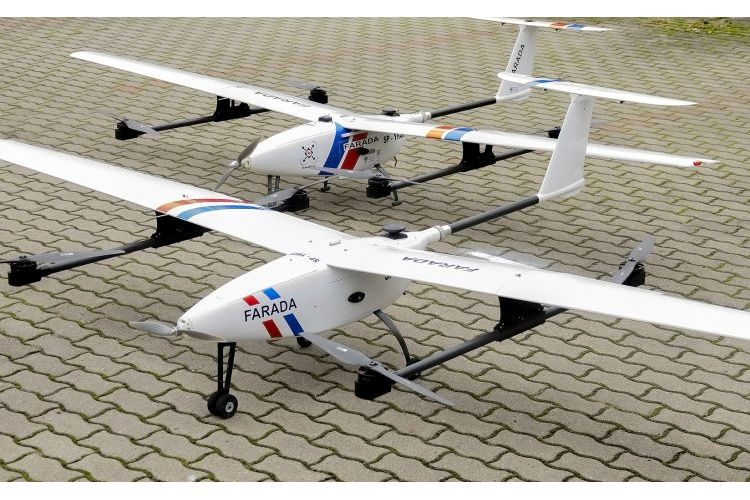
Between December 14-21, a series of test transport flights were carried out by the Polish company Farada in cooperation with the Polish Air Navigation Services Agency (PANSA). Flying through a dedicated air corridor and at a maximum speed of up to 90 km/h, the drone delivered medical packages on average twice as fast as road transport.
The flights took place on routes between Warsaw and hospitals in Pułtusk, Sochaczew, and Otwock. A dozen or so flights of an unmanned vertical take-off and landing aircraft were carried out on these three routes. The 14 kg drone takes off vertically to a height of 50 m, and then, similar to a typical airplane, covers the route at an altitude of 100 m to 120 m above the ground. The Unmanned Aerial Vehicle covered the routes to Pułtusk and Sochaczew, each approximately 60 km long, in an average of 45 minutes. The flight from the center of Warsaw to Otwock took less than 15 minutes.
– This is the most operationally complex project using a low-altitude transport drone that PANSA has dealt with so far. The series of tests once again confirmed PANSA’s readiness to handle this type of flight – said Maciej Włodarczyk, head of the unmanned aerial vehicle operations management department at PANSA.
PANSA’s actions consisted of securing the routes with specially designated corridors (zones), which made it possible to ensure the safety of all airspace users. Importantly, Farada’s aircraft emitted their own transponder signal, making them visible to other flying units.
– Farada’s mission is to build a safe and efficient logistics network based on modern unmanned platforms. The first area we are focusing on is medical transport. Thanks to our solutions, we can already shorten the waiting time for medical test results and increase the quality of transport, and ultimately even improve the condition of transplanted organs in Poland. We have innovative software developed by our company for managing both shipments and a fleet of drones by a single operator – said Szymon Kupaj, CEO of Farada.
The involvement of the Polish Air Navigation Services Agency enabled the implementation of another project of this type. In November of this year, the first medical loads for laboratory tests were successfully transported. A drone from the company Spartaqs covered the 7.5 km route between the hospital at the National Stadium and the Central Clinical Hospital of the Ministry of Interior and Administration in 12 minutes.
The foundation and a key element for achieving this goal is the PansaUTM system, which enables electronic coordination of UAV flights and digital management of applications and permits for flights in the airspace.
Source: PANSA
Read also about air transport using drones:
– New rules for using drones
– Drones will enable flights to Earth orbit even every 3 hours
– Innovative book delivery network
We write more about the transport of the future in the magazine Logistyka 4/2020.
The e-edition of the magazine is available in our offer!