








The past year, 2023, for the transport industry resembled a rollercoaster rather than a straight, wide road. A weak economic climate, broken supply chains, the armed conflict in Ukraine, followed by protests at the eastern border, unfavorable legislative changes, and finally, falling rates, heavily impacted the entire industry. Carriers are therefore entering the new year, above all, with the hope of an improvement in the situation. Will they succeed?
The state of the transport industry can be considered a litmus test for the situation in the entire economy. As soon as production and consumption levels fall and costs rise, the demand for transport services decreases. Consequently, rates also fall. The situation in 2023 was so difficult that, as data shows, for the first time in years, spot rates fell below contract rates. This unequivocally proves an oversupply of vehicles on the market. One of the reasons for this was the increased activity of carriers from Ukraine, who, after the market was liberalized, are estimated to have performed 1.2 million transports in the EU in 2023, which is 7.5 times more than the pre-war quota of permits. As a result, many, mainly smaller carriers, decided to protest and blockade the eastern border. In addition to economic and geopolitical problems, new legislation in the transport sector emerged. The ban on overtaking in Poland, the increase in tolls in Germany, and new Mobility Package regulations are just some of the changes that have strongly influenced the road transport industry in Poland.
Fortunately, 2023 is behind us, and as experts predict, 2024 will bring a slight, yet noticeable, improvement in the condition of transport. This gives us the opportunity to forget about economic and political issues for a moment and look at road transport from the perspective of technology. – The transport industry is facing many challenges and at the same time fascinating opportunities. In the context of road transport, 2024 will bring many innovations that will revolutionize the way goods and people are moved – assumes Adrian Gradowski, International Forwarding Manager at FM Logistic.
A year for innovation
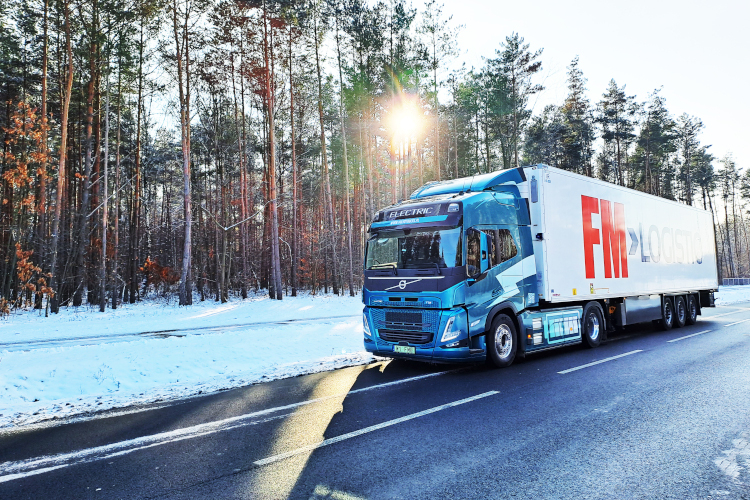
As the expert notes, one of the most visible trends in 2024 will be the continued growth in the level of fleet electrification. This is dictated on one hand by increasingly stringent regulations, and on the other by the desire of more conscious companies to reduce their environmental impact. Key domestic carriers were already testing various possibilities last year. FM Logistic, together with its clients, tested a delivery vehicle for local distribution and a truck dedicated to medium distances. Initial conclusions show that what technology providers must focus on is range. – The introduction of increasingly efficient batteries and the development of charging infrastructure will increase the distances available for electric vehicles. Then nothing will stand in the way of truck and delivery vehicle fleets becoming increasingly electrified – notes Adrian Gradowski. Refining the technology and finding solutions that satisfy carriers will mean not only reducing transport-related emissions but also reducing vehicle operating costs. However, sustainable transport development is not just about electrification. As the FM Logistic expert adds – In 2024, we can expect innovative solutions, such as hydrogen-powered vehicles. Obliged by regulations, transport companies will actively strive to reduce the carbon footprint of their operations and look for various options. This will influence the faster development of new technologies and logistics strategies.
Technology behind the wheel
In the face of a still insufficient number of professional drivers, the technology of autonomous vehicles is becoming increasingly interesting. Undoubtedly, we will not see driverless trucks in regular traffic on the streets in 2024, but we can expect a greater number of large-scale tests. Omitting the human factor in transport can improve safety, increase efficiency, and shorten delivery times. However, ethical and technological doubts arise. – We need to answer questions regarding cybersecurity and ethical issues related to decisions made by artificial intelligence in critical situations. Although experts have been working on this for a long time, there is still no proper solution – says Adrian Gradowski. Will it appear in 2024? It is difficult to predict.
Artificial intelligence in charge
As the past year has already shown, artificial intelligence is storming into our lives, including in professional activities. As the expert announces, in 2024, AI-based logistics platforms will become an integral part of the transport industry. Operations will be managed by algorithms operating on the basis of digitized data.
– Demand forecasting, route optimization, fleet management, and monitoring of transport conditions will soon be handled by artificial intelligence. This will allow transport companies to manage their resources more effectively. Data integration and predictive analysis will enable more precise route planning, which in turn will contribute to reducing operating costs – explains Adrian Gradowski, International Forwarding Manager at FM Logistic. Tools based on the Internet of Things will have an equally large impact on transport management. Solutions that allow tracking cargo, monitoring vehicle status, or controlling transport conditions are already in operation. In the near future, however, they will be much more advanced and will allow for even more precise management of delivery logistics. This, in turn, will contribute to improving the quality of customer service.
– The year 2024 in the road transport industry will bring numerous changes, both in terms of technology and society. Electrification, autonomous vehicles, artificial intelligence, sustainable transport, and IoT will become key elements that will shape the new reality of this sector. Companies that will be able to adapt to these trends will gain a competitive advantage, creating more efficient, safe, and sustainable transport solutions – concludes the FM Logistic expert.
Source: FM Logistic Central Europe