








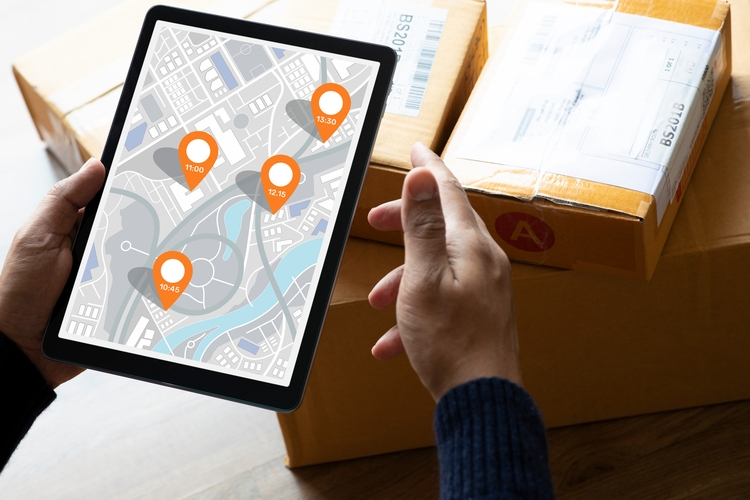
The market for delivery fulfillment is constantly changing. Customers purchasing products and services through online stores and B2B platforms want faster and cheaper transport, while fleet maintenance costs are not decreasing. Efficient delivery is no longer just an advantage – it is becoming essential to compete with the offers of other companies. Digitalization is a necessity forced by the market, which is why we are seeing a growing demand for software for fast and efficient route planning among transport and delivery companies.
How does a route planning and optimization system work?
A route optimizer is software that, thanks to the use of artificial intelligence, enables the rapid determination of efficient routes with multiple stops. However, the process is much more complicated than it might seem. The efficiency of a trip can be calculated based on parameters such as: route length, time, cost, or profit achieved. Furthermore, the application takes into account many conditions such as time windows, vehicle capacity, pickup / delivery options, or traffic situations. The system provides full control over the entire process related to last-mile delivery. Its tasks are carried out on three key lines: the work of the dispatcher, the work of the driver, and communication with the client.
Reduction of operating costs – the main goal of using the system in an organization
Last-mile logistics is one of the most expensive stages of order fulfillment. Additionally, due to rising inflation and fuel prices, fleet expenses are starting to grow to unprecedented levels. Companies looking for ways to reduce costs are increasingly choosing technological solutions. It is noted that organizations that switch from manual route planning to an automated process can reduce transport costs by 10–30%, while achieving a quick return on investment. Such a high level of cost reduction is the result of efficient resource utilization, including:
- reducing kilometers traveled,
- increasing the number of completed tasks,
- shortening delivery times,
- eliminating or reducing delays.
Route optimization as a tool to increase customer service quality
Reducing fleet costs is not the only reason why companies decide to use a route optimizer. One of the increasingly important, but also difficult aspects of logistics is transparency and communication with the customer at the delivery stage. Customers expect not only speed of order fulfillment, they want to be properly informed and know the estimated delivery time. ETA (Estimated Time of Arrival) is becoming an increasingly important parameter in the TSL industry. Thanks to the use of advanced technologies for route optimization, fleet companies can offer timely deliveries with accurate ETA.
Possibility of concluding an SLA agreement
An SLA (Service Level Agreement) is a document signed between a service provider and a client that contains provisions on the guarantee of cooperation terms. As a result of properly organized logistics processes, a company performing deliveries or other transport services can guarantee potential clients a specific level of service throughout the duration of the contract. Route optimization allows you to accurately understand the capabilities of your own fleet and plan actions in detail so that they are performed on time and without errors.Presenting a high OTIF ratio
Route optimization allows you to increase and maintain fleet efficiency at a constant, high level. The efficiency of a vehicle fleet can be calculated using the OTIF (On Time in Full) ratio. It shows the percentage ratio of delivered and complete orders that reached customers on time. Planning routes using a dedicated optimizer allows you to increase the OTIF ratio and keep it at values close to 100%. Presenting high ratio values to clients will show the company in the right light and help contractors make a decision to enter into cooperation.Regular and automatic data collection
The route optimizer works based on real-time maps. Because of this, the coordinator managing the team’s activities can react quickly and effectively to crisis situations and is perfectly informed about the status of tasks being carried out. At the same time, while working on the tool, it collects data for reports and analysis. The software has a function for generating automatic reports, and consequently, provides insight into real and current data on fleet operation. Based on this, detailed analyses can be carried out and, consequently, processes can be constantly improved, areas for savings can be found, and increasingly better service can be offered to your customers.
Technology at your fingertips
Logistics and fleet companies should respond to the constantly changing needs of customers. Currently, the use of the latest technologies and customer-centric business models are the domain of TSL industry leaders. However, it turns out that the use of a route planning and optimization system is not reserved only for the largest companies. The availability of the solution in the SaaS model and the ease of working with the system make it much simpler to implement compared to other industry solutions, e.g., TMS.
Do you want to learn more about the capabilities of the route optimizer and how it can improve the operation of your vehicle fleet? We encourage you to contact the experts at Routimo and take advantage of a free 7-day trial.