








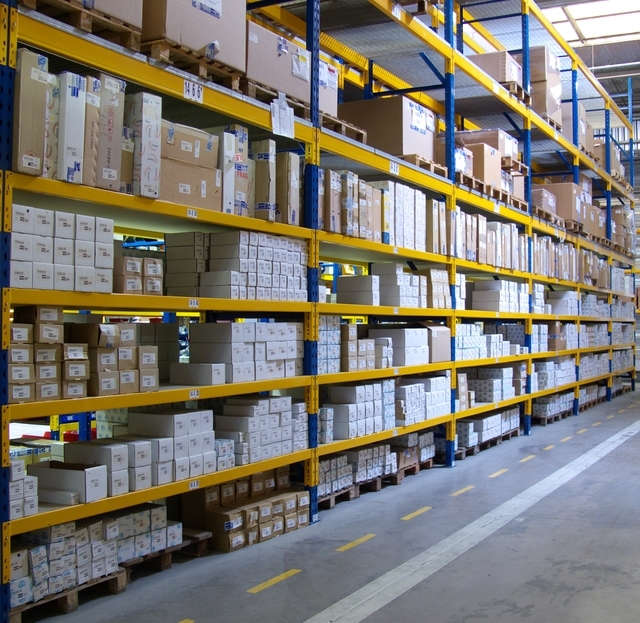
Warehouse racks are devices constantly subjected to two dangerous forces: gravity, which pulls on the enormous mass of the loads stored on them, and the tests they are often put through by careless forklift operators. Therefore, warehouse racks are safe only if (firstly) they have been correctly designed and installed and (secondly) they are supervised by appropriately qualified specialists.
In every enterprise where steel warehouse racks are used, a person responsible for storage equipment safety (PRSES) should be designated. This requirement is specified by the standard PN-EN 15635 Steel static storage systems – Application and maintenance of storage equipment.
Although the aforementioned standard is not a document with the status of a generally applicable administrative legal act, due to the lack of other implementing regulations, it is the only source of guidelines and rules for the safe operation and maintenance of storage equipment. Actual examples confirm that supervisory bodies (e.g., the National Labour Inspectorate) often refer to the provisions of the PN-EN 15635 standard during inspections of an enterprise regarding its compliance with health and safety and labor law requirements.
As the name of the function suggests, a PRSES is a person responsible for safety in the warehouse, which is based on four pillars:
1. Aware employees who report any noticed irregularities and damage on an ongoing basis.
2. Periodic inspections aimed at identifying and classifying potential damage.
3. Immediate replacement of damaged structural elements of the racks.
4. Drawing conclusions from existing threats and preventing them in the future.
Aware warehouse employees
The PRSES is responsible for receiving information from warehouse employees regarding damage and other problems related to work safety. For this duty to be fulfilled, every warehouse employee (and in particular forklift operators) should be trained by the PRSES in the safe operation of racks. During such internal training, emphasis should be placed on two issues.
Firstly, rack users should be aware that any (even the smallest) damage to a structural element of the rack reduces the load-bearing capacity (permissible load) of the entire structure. Continued operation of damaged warehouse racks, whose actual load-bearing capacity does not reach the values specified by the manufacturer, results in their permanent overloading. In extreme cases, the effect of such conduct may be the total destruction of the rack structure, and consequently, endangering the life and health of warehouse employees as well as enormous property damage resulting from the destruction of stored loads.
Secondly, an employee who has noticed damage should be obligated to immediately report this fact to the PRSES, who in turn should document the event and plan appropriate corrective actions.
Periodic inspections
In addition to the immediate reports described above received from warehouse employees, the PRSES should periodically (preferably once a week) personally inspect the entire facility. Their purpose is both to identify threats (damage) and to plan actions (repairs) to eliminate them.
The PRSES is also responsible for organizing annual expert inspections of warehouse racks, carried out by authorized service technicians. The primary result of such an inspection is a written report containing the identification of all mechanical damage and recommended actions to restore the racks to full usability. Furthermore, external inspectors – looking at the warehouse from a slightly different perspective – are able to catch threats that go unnoticed on a daily basis, e.g., the use of damaged pallets, aisles that are too narrow, incorrect stacking of loads on shelves, etc.
Corrective actions
Every damage to a warehouse rack (whether reported by an employee, noticed personally, or identified by external experts) should be documented by the PRSES in the warehouse rack service log, along with information about the necessary actions to eliminate it. Subsequently, the PRSES is obligated to enforce the planned corrective actions from the warehouse management.
Preventive actions
In addition to ensuring the proper physical condition of the racks, the PRSES should analyze existing threats in order to prevent their recurrence in the future. The conclusions from such an analysis may concern not only the racks themselves but the broadly understood environment of the entire warehouse. Preventive actions may therefore include, for example: installing column guards, changing the layout of aisles, increasing vertical clearance in bays, or even repairing the floor.
Summary
As you can see, the person performing the PRSES function has many responsibilities. The standard does not specifically indicate what qualifications such an employee should possess; however, it is obvious that the PRSES should have knowledge about the construction of racks and their application, and know the guidelines from standards and regulations governing procedures in the event of unforeseen incidents and accidents.
Article prepared by Adam Simiński, Specialist for rack system inspections at MGL Sp. z o.o. (https://www.mgltechnika.pl/)