









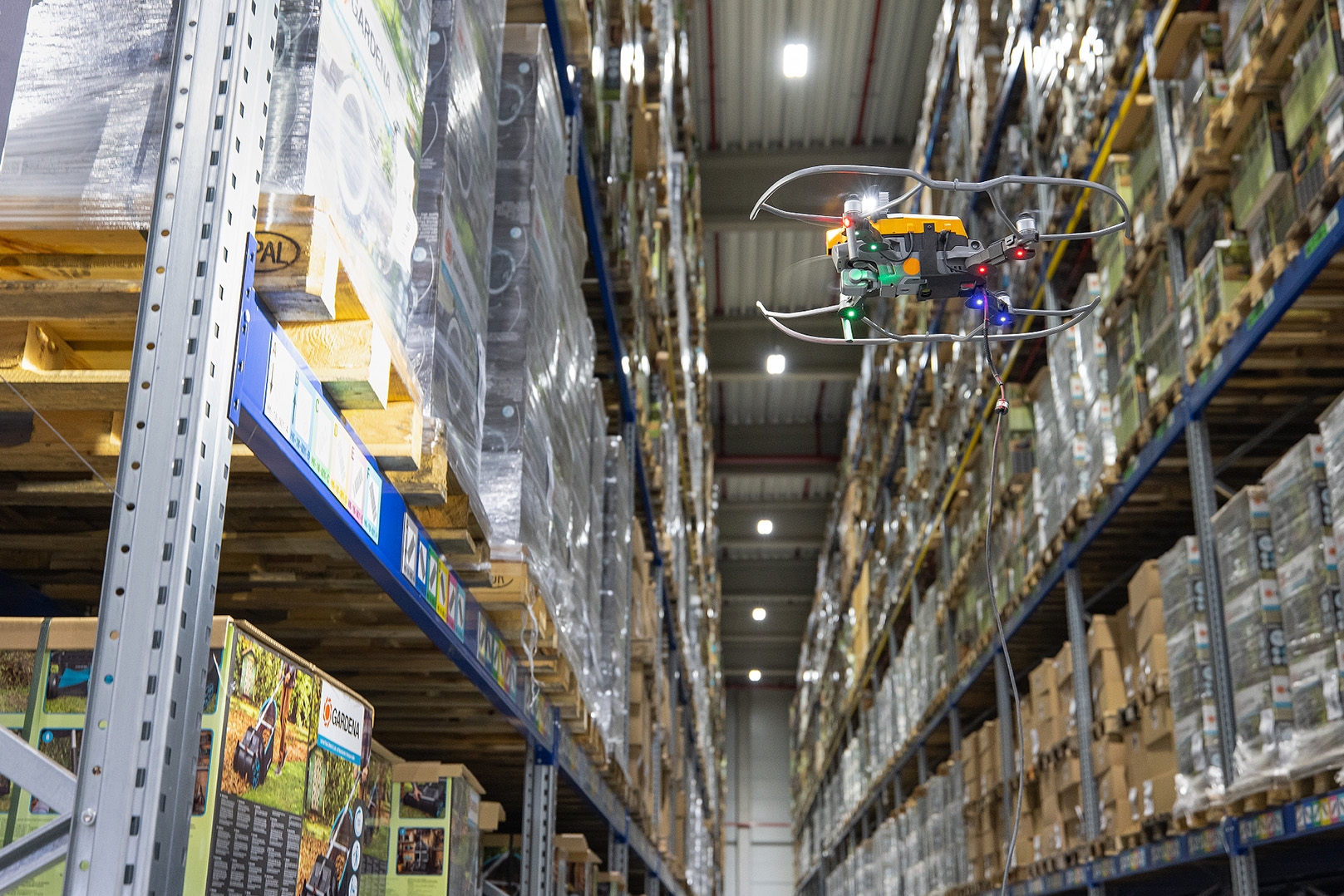
A robot instead of a forklift driver, self-tinting glazing in the office area, a terrace designed with employee wellbeing in mind, and a water retention system? We are not just guessing! We asked experts about the trends in the logistics industry that will dominate the market in 2030.
At the forefront of European warehouse markets! That is how Poland ranked in industry statistics last year. We have plenty to be proud of! As analysts calculated, total warehouse space reached 36 million m²! And if we were to translate the leased warehouse square footage into the value of concluded transactions, we would arrive at a staggering amount of 200 million euros!
Which means an increase of approximately 50 percent compared to the same period in 2024.
– emphasize industry specialists.
What will it be like now? Or rather, what will the logistics and warehouse services market look like in a few years, say in 2030? We asked experts these difficult questions.
Stalemate at the construction site. But not at headquarters
According to Andrzej Urbański, Logistics Director at Seifert Polska, which has been operating in the transport and logistics industry on the Polish market for 27 years, the coming years will be quite stable.
Last year’s boom for new warehouse space is just ending. Now comes a time of stabilization. The market has been saturated, which has, in fact, translated into Poland’s position as a leader in this regard – emphasizes Urbański. He adds that the market in 2026 is entering a phase of conscious growth. – Companies are no longer chasing square meters, but efficiency.
– notes the specialist from Seifert.
This does not mean that new warehouse space will not be added in the coming years. However, tenants will focus on the largest locations. Mainly Warsaw and Wrocław.
A warehouse made of glass
And although there will be fewer construction projects, they will be much more… spectacular. An example? Developers are already boasting visualizations of warehouses with floor-to-ceiling self-tinting glazing (inspired by A+ class office buildings), where the office space looks deceptively like a display of designer items.
Such a premium warehouse is powered by certified renewable energy, has rainwater retention systems, and advanced photovoltaic installations on the roof. Moreover, its future employees have at their disposal… a terrace, serving for a moment of relaxation, in accordance with the employee wellbeing philosophy that has been fashionable in recent months.
However, this is just the beginning. Premium warehouse space is highly automated. At many workstations, robots have replaced humans. Unmanned forklifts transport goods and place them in designated spots. Stock is monitored automatically, and modern scanners simultaneously take, for example, photos of stored products and immediately place them “in the cloud.”
Automation? Yes, if the power allows
Such modern logistics centers will be a rarity in the coming years, however, because they are built for specific projects. Currently, the market shows that logistics operators are more likely to extend leases than to move to new facilities.
It is a different story if we take a closer look at the interior of the warehouse hall itself. – It will be automated, and AI solutions will be implemented. Some tasks, the most repetitive ones, will start to be performed by robots. In fact, this is already happening/
– says Szymon Szczepanik, member of the board at Seifert Polska.
He notes, however, that the more advanced the forms of warehouse automation, the higher the technical requirements.
Full warehouse automation, despite sincere intentions, can be very difficult. The warehouse must have the appropriate technical infrastructure, proper power supply, capacity, etc. An older warehouse may simply not meet such standards.
– points out the board member of Seifert Polska.
At the same time, he does not hide the fact that completely closing oneself off to AI will have dire consequences.
Instead of giving up entirely, it is better to reach for cheap solutions that, step by step, will give the logistics operator greater efficiency while reducing operating costs. Plug and Play solutions, i.e., ready-to-use technologies or devices that can be connected and started immediately, without complicated implementations, IT integrations, or long installation processes.
– emphasizes Szczepanik.
Man versus machine
Will AI be the most important “employee” of a logistics center in 2030?
No. Introducing robotics-based solutions is expensive, and additionally, such solutions have no chance of working on a larger scale in the case of MULTI-USER warehouses, where goods of various dimensions are stored and where every client has different requirements and needs.
– says Michał Musielak, Logistics Director at Seifert Automotive Polska, directly.
Musielak believes that human work in the warehouse will also be important and necessary in 5 years. – Robotics will work in logistics, but in contract logistics – he emphasizes.
Since – despite increasingly widespread automation – the logistics industry will still need warehouse workers, what will operators do when foreigners return to their home countries?
There will be no choice. Agencies will reach for workers from far away. It is possible that in a moment we will see, for example, residents from South Asia in a yellow helmet in the warehouse.
– labor market specialists believe.
And although they will not immediately be the employee we want to have (many representatives from distant destinations will see a logistics center for the first time), over time they will gain experience and acclimatize to the new place.
Warehouse rental costs in our country are rising sharply, and it is still the low labor costs – compared to other Western European countries – that give us an advantage in the logistics market.
– notes Szymon Szczepanik.
He notes, however, that the employment structure in the warehouse will also change from another perspective. – New professions will emerge, for example, a technician for AI-related technology will be needed.
Source: Seifert Group