









This has not been a dream year for the TSL and retail sectors in Poland. Hopes were pinned on the final quarter, especially since Poles’ holiday spending was expected to be higher than last year’s. The problem is that the announced nominal increases do not translate into cargo volumes, as inflation is largely responsible for the larger Christmas budgets. E-commerce also disappointed throughout the year, but there are areas where operators can still count on solid profit.
Current analyses do not provide a definitive answer regarding the pre-holiday spending, preferences, and shopping models of Poles, and the final results of logistics operators handling orders, both online and offline, depend largely on them. However, some forecasts are already available, although they suggest moderate optimism at best.
According to the Mastercard SpendingPulse study, which measures retail sales in brick-and-mortar stores and online, Polish consumers will break away from the virtual world for a moment this year and direct more attention toward traditional shopping. Between November 1 and December 24, they will spend 1.5% more in physical stores than a year ago. In Mastercard’s view, the dominant shopping model will be a sales hybrid, combining traditional retail and e-commerce. In general, Poles are expected to spend 7.3% less on basic holiday products this year, including groceries, but slightly more on certain gift categories, such as jewelry, the sales of which are expected to grow by 4.3%. In December, Mastercard also published another analysis, which shows that 55% of Poles will not spend more than 1,000 PLN on the holidays.
This year’s holiday spending in Poland was also forecast by Provident in its cyclical barometer, according to which as many as 58% of Poles are planning a modest holiday, but budgets for preparations, i.e., food or home decor, will increase compared to the previous year and will amount to an average of 969 PLN. We intend to spend an average of 747 PLN on gifts. That is a total of 1,716 PLN and an increase of 36.3% compared to last year’s budget of 1,259 PLN on average. Some of this money has already been spent and allocated to gifts, because as 18.4% of consumers surveyed by Provident indicate, purchases are made even several months before Christmas. In turn, 37% declare that they do it a few weeks before December 24.
This last time buffer in particular suggests that a significant fraction of the declared pool was spent during Black Friday and Cyber Monday. This is also confirmed by PwC’s November estimates, according to which Poles were expected to spend an average of 1,000 PLN on these days, which is 5% more than a year ago. As many as 64% of respondents declared shopping during this time, and 52% wanted to purchase at least half of their holiday gifts on sale. At the same time, 32% intended to buy more things than a year ago, mainly due to looking for bargains and savings. Digital offers still enjoyed greater interest (53%), but a significant percentage of respondents still announced a visit to traditional stores (37%).
What does this mean for logistics operators?
The announced nominal increases in holiday spending do not at all mean an adequate increase in cargo volumes, because inflation is largely responsible for the larger declared Christmas budgets. Besides, the eleven months of the current year have proven that there are simply fewer goods in trade. This can be seen, for example, in falling rates in sea, land, and air transport. Throughout the year, they were a reflection of weak current demand for transport services. At the same time, available cargo capacity was growing, and these were global phenomena. In addition to high and again rising inflation (a 0.7% m/m jump to 6.5% y/y in November), the situation in transport, warehousing, and trade was not improved by high interest rates, weak economic growth, energy prices, and geopolitical turmoil in Europe. Ultimately, 2023 is unlikely to bring spectacular growth in the TSL sector, however, the last quarter and the holiday season still remain absolutely key for both trade and logistics.
All eyes on e-commerce!
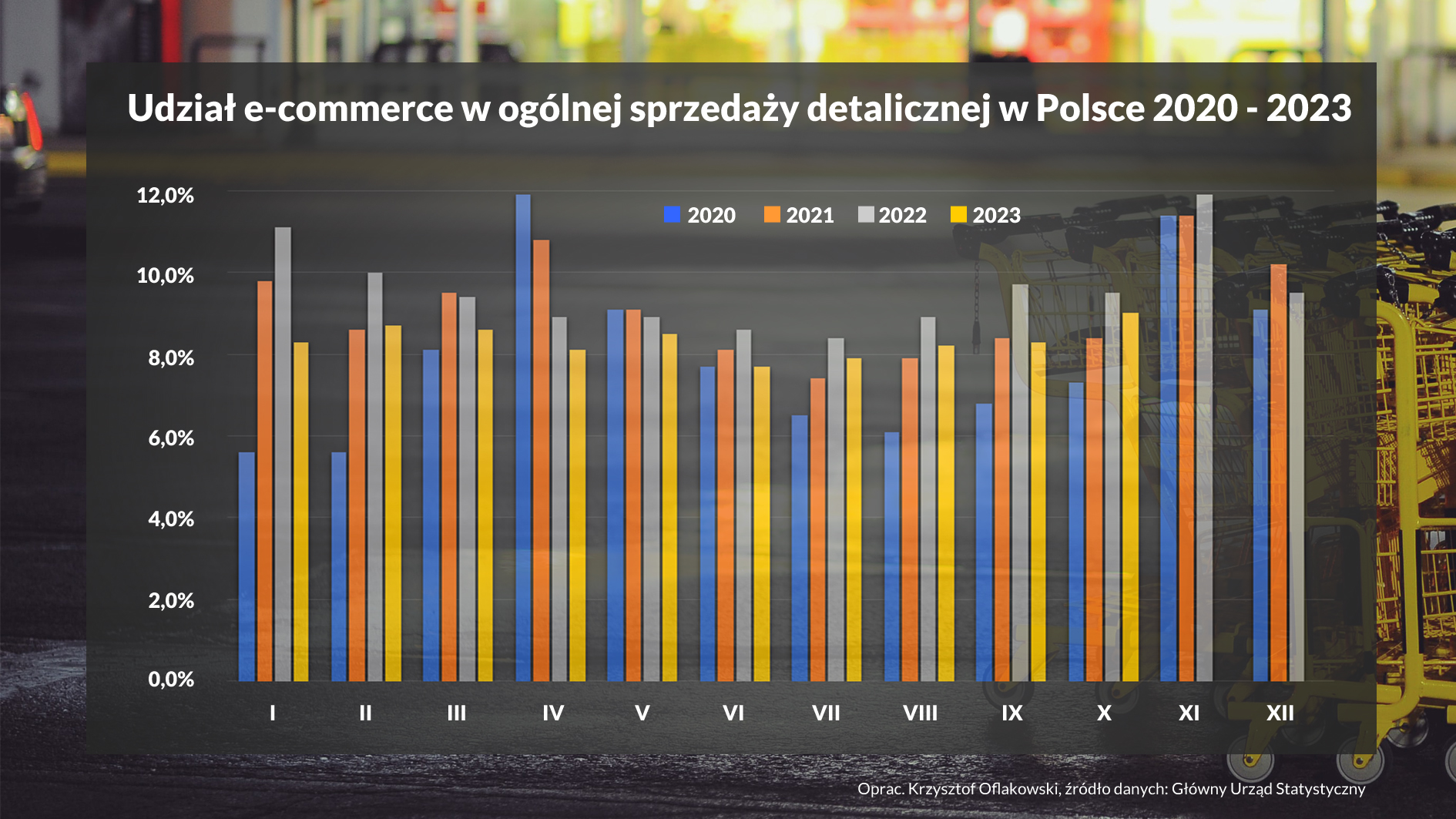
At the center of attention, as every year, remains online retail, which in recent years has played a huge role in the development of logistics in Poland, especially the warehousing and CEP (courier, express, and parcel services) sectors. These areas of the market will certainly do well, even in worse market conditions. Unfortunately, this year the overall online shopping indicators in Poland have weakened slightly, and this is bad news for all players. The share of e-commerce in total retail sales is clearly worse than in previous years. This year’s results in every month of the year, starting from January up to and including October, are worse than those in 2022, and in many cases also from the performance in 2021. For example, according to Statistics Poland (GUS), the share of e-commerce in total retail sales in October of this year was 9%, while in the same month of 2022 it was 9.5%. It was similar in September. This year it was 8.3%, and in 2022 it was 9.7%, while in 2021 it was 8.4%.
In the data of the Central Statistical Office, however, a clear trend can be seen, namely that the peak share of online retail purchases always falls in November and December of each year, with a clear dominance of November. The only exception was April 2020, when pandemic lockdowns began to apply. An unnatural increase in the share of e-commerce began to be observed then as early as March (a jump to 8.1% from 5.6% in February). In April, it was already 11.9%, and since then it has not been possible to break this barrier. It was equaled only once, in November 2022. The November promotional period and the pre-holiday shopping season are responsible for such a significant increase in interest in online shopping. Data for November 2023 will be published only in the second half of December, but there is little indication that last year’s result will be beaten.
This is partially confirmed by data on e-commerce after Black Friday in Europe. According to Signifyd, a provider of IT solutions for e-commerce platforms, online sales on this day on the Old Continent were 3% lower compared to 2022. Consumers spent about the same on average, but simply placed 3% fewer orders. Cyber Monday also turned out to be disappointing, because by late afternoon, total online sales in Europe were 2% lower than a year ago. As a consolation, e-shopping increased by 8% and 10% on Saturday and Sunday, respectively, but sales on these days account for only half of the sales made on Friday alone.
This year’s sales and logistics potential of e-commerce, however, lies in the details
Despite weaker current estimates, a more detailed analysis of last year’s trends shows that the real holiday harvest will be reaped by those sellers and the logisticians serving them who operate within the two most popular categories, both for gifts and e-commerce. These are primarily fashion (clothing, footwear, accessories) and consumer electronics/home appliances, and additionally also books and press. In the mentioned areas, the seasonal peak begins as early as October.
Last year, the share of online purchases in total retail sales in the press and books category jumped from 26% in October to 31.5% in November, then decreased to 27.5% in December. Equally high increases in shares were observed in the fashion category. The month-on-month share dynamics in the last quarter of 2022 were as follows: 22.7%, 27.2%, and 19.7%. Consumer electronics/home appliances products, in turn, were 16.6%, 21.1%, and 18.9%.
This year, the share of the mentioned groups compared to September clearly increased as early as October. Fashion increased its share in a month from 17.8% to 19.9%, consumer electronics/home appliances from 15.6% in September to 17.1% in October. Interest in this assortment range is also well reflected by the dynamics of sales value. Already in October, there was an increase in spending in fashion by 32.2%, and in consumer electronics/home appliances by 9.6%.
This is a harbinger of solid seasonal growth, which is confirmed by data from previous years, where along with the increasing share of e-commerce, the scale of spending also grew – standardly the most in November. Last year, it was a jump of over 30% in each of the mentioned categories.
– Fashion has been the most popular e-commerce product category for years, not only in Poland but also globally. A recent Gemius report analyzing the e-commerce sector in our country in 2023 shows that 80% of people shopping online buy clothing, accessories, and add-ons. Footwear is ordered by not much less, at 67%. We spend an average of 270 PLN per month on this, and in the case of shoes, it is 275 PLN. This is huge sales potential. However, these amounts clearly increase during the holiday shopping season, and with them, the volume of orders grows, because clothing, footwear, and accessories are Poles’ favorite gift category. This is confirmed not only by market analyses but also by our experience resulting from many years of serving partners originating from the fashion sector. By carrying out operations for them in both the traditional and online channels, every year we observe how the share of orders flowing from virtual platforms and brick-and-mortar stores grows in the last quarter. The market results are impressive. Even this year, which was characterized by major economic problems and a weak economic climate, almost 20% of all clothing and footwear in retail in Poland was sold online in October. We assume that the November results will be even better because last year the share of fashion in this month exceeded 27%. Multi-channel service of this assortment group constitutes a significant part of our business strategy, and at the same time provides employment security for employees, even in an economically weaker year. Also for this reason, the last quarter is of particular importance, both for our contractors and for us – says Marcin Smoła, Chief Operating Officer at ID Logistics Polska, providing comprehensive warehousing services, supply chain management, and solutions for e-commerce, including returns and transport service.
Fashionably on the gift podium
The primacy of fashion as the most popular assortment group not only in e-commerce but also in the gift category was confirmed by this year’s attempts to assess Poles’ holiday spending. Clothing and jewelry were at the top of the Mastercard SpendingPulse holiday wish list. In a follow-up study in December, Mastercard cites that as many as 45% of planned gifts will be clothing and accessories. Also, PwC, while analyzing shopping trends during Black Friday and Cyber Monday, found that the most popular near-holiday shopping plans of Poles concern clothing, footwear, and accessories – 41% of respondents declared this. Right after fashion was electronics and technology (33%). A similar thread appears in the Provident summary, where these two categories are in high positions on lists sent to Santa Claus. Although most respondents want to find money and vouchers (24%) and cosmetics (14.3%) under the tree, electronics (9.9%) and clothing and footwear (7.7%) are right behind them.
Moods and sales results in December may be improved by an additional Sunday and a better economic climate
Although standardly the peak of retail sales in the last quarter falls rather in November, this year an additional argument appeared that could increase December shopping appetites. Namely, by a decision from the end of November this year, the trading Sunday falling on Christmas Eve was moved to December 10. Thus, in the current month, it will be possible to do shopping on both December 10 and 17, i.e., long before the holidays. This is good news for those who postpone the realization of the holiday wish list to the last minute, but also for logistics operators who, in addition to e-commerce, also serve the traditional channel of their contractors.
An additional incentive, although still not very popular in Poland, will also be the Free Delivery Day for products ordered online in selected stores. This year, free delivery fell on December 12.
There are also more measurable premises indicating that December may be a better month than expected. In November, the general business climate indicator in retail trade improved. Although it stopped at the level of -0.2, it is not far from the zone of optimism. Diagnoses made by companies participating in the cyclical GUS study indicate an increase in sales and a better assessment of the economic situation than in October.
In November 2023, an improvement in both current and future consumer sentiment was also recorded. The Current Consumer Confidence Indicator (BWUK), describing individual consumption trends, was -15.1 and was 2.8% higher compared to October. The largest increases were recorded for assessments of the current possibility of making important purchases and the country’s economic situation (by 7% and 4.2%, respectively). Compared to 2022, the November value of BWUK was 28.9% higher.
The Leading Consumer Confidence Indicator (WWUK), describing individual consumption trends in the coming months, also improved by 7%. The November value ultimately amounted to -7.4% and was 26.6% higher than in 2022.
One will have to wait a little longer for the final results of holiday spending, this year’s assessment of the condition of Polish consumers, and the dynamics in trade. It is worth remembering that closing the last, even the best quarter of the year, does not at all mean the end of the sales cycle, and certainly does not close the process of logistics handling of holiday orders, especially online ones. The issue of returns of products bought online will remain, and it is this that may decide the success of the quarter. In individual categories, it looks different, but paradoxically, those sellers who can count on the largest sales in the pre-holiday period, i.e., fashion brands, will remain in the greatest uncertainty for some time. The fashion category has the largest share of returns among all product segments sold online. According to Statista analysis, the global return rate for clothing, footwear, and accessories is expected to reach as much as 17.5% of all orders placed this year, while in Poland it is 15.8%.