










Every good salesperson realizes that the key to increasing sales is proper merchandising. One of the best merchandising tools for product presentation is a planogram. Effective merchandising requires products to be presented in a way that evokes positive emotions in consumers, encouraging them to make a purchase.
By using proven merchandising methods, we have the ability to influence our customers’ purchasing decisions. The most commonly used merchandising strategies are:
– Traffic-building strategy, which focuses on attracting customers to the store and the category. It is most often used for goods characterized by high customer loyalty. We place such products at the customer’s eye level.
– Transaction-increasing strategy. Encouraging customers to buy complementary products in addition to their originally intended purchase.
– Profit-generating strategy, an example of which could be grouping complementary goods from different categories with high margins.
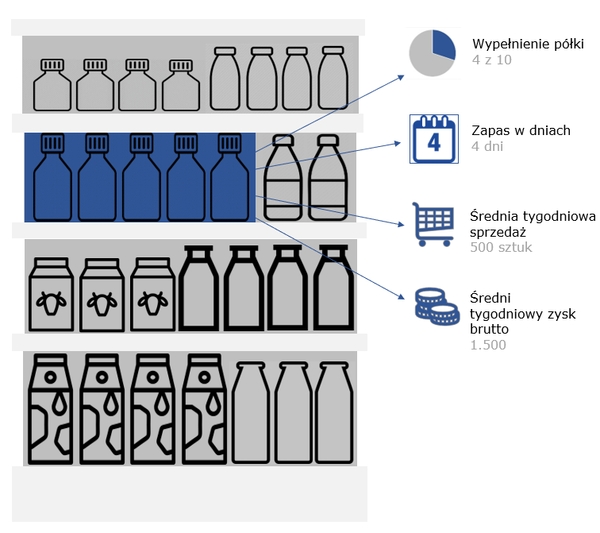
We can improve the shopping experience and financial results in our stores through proper merchandising. To do this, it is worth using planograms, as they are one of the best ways to plan, communicate, implement, and maintain a merchandising strategy. A planogram is a model or diagram describing the layout and positioning of retail products on shelves, as well as the number of facings (multiple “faces” of the same product on the shelf) assigned to each product. These data-driven visualizations provide retailers with guidance on how and where products should be placed on shelves to improve sales and profits. They are used to communicate the approved merchandising strategy for individual categories. They are generated based on the historical performance of certain products in a given category. This increases sales and profitability by ensuring product rotation on the shelves.
Who creates planograms?
First and foremost, retail chains. Planograms help plan the store layout and serve as an opportunity to ensure visual consistency in retail stores.
For manufacturers, a planogram is a vision of the brand and category. Manufacturers use planograms to offer retail chains a recommended product layout, create consistency for their categories, and ensure the proper flow of products for their brands, in accordance with their own strategy and vision. If a brand is not performing very well, planograms can be used as a solution to present new strategies that can help the category grow as a whole.
What does the planogram building process look like?
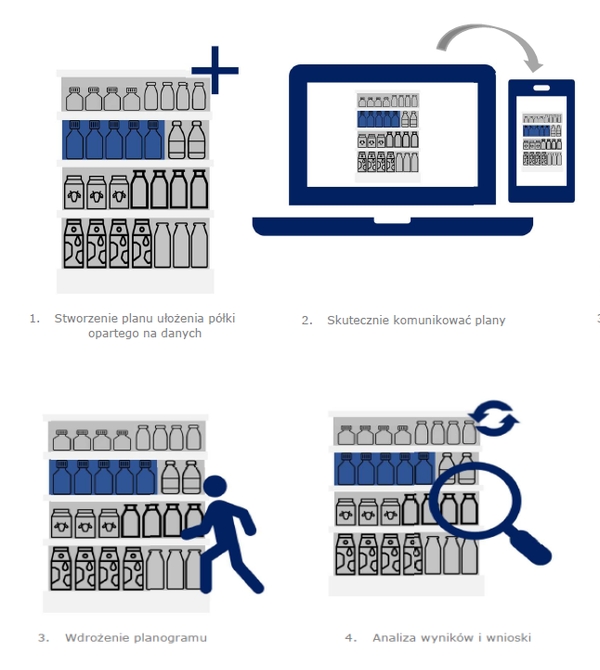
Below is an overview of the process that must be followed to implement and maintain proper planograms:
– Creating a data-driven shelf layout plan
Using space planning software, you can generate a planogram that uses sales history to ensure that the merchandising strategy is reflected in the product layout on the shelf.
– Effectively communicating plans
Planograms help store employees properly arrange products on the shelf. This reduces the margin of error and ensures greater control when implementing the merchandising strategy. Employees are more aware of where products and categories are located. This makes the replenishment cycle much easier, resulting in reduced and optimized inventory and increased control. Given the number of days needed to sell out a specific product, you can balance the shelf space for the sales of each product. If a product is slow-moving, reduce it and allocate more space for a product that sells faster.
– Performance analysis, conclusions
By analyzing product sales results, a planogram can indicate recommendations, e.g., regarding the number of facings (multiple “faces” of the same product on the shelf) that should be assigned to each product, allowing for the maintenance of proper product stock on the shelf and in the warehouse.
What data is needed to build a planogram?
To design the presentation of products on the shelf, planograms require the implementation of various product information. This data includes, among others:
– Sales data.
To create a good planogram, the planner must link everything they know about the product with sales data for a given category. Internal sales data can be supplemented with external market data.
– Product categorization.
Assigning a product assortment that fits a given category.
– Category strategy
Aligning internally with the role of the category can be very useful to understand how the consumer behaves and how this will affect the positioning of products on the shelf. There are 4 main category roles: destination category, routine category, seasonal category, and convenience category.
– SKU information
Product classifications, product photos, dimensions, brand description, product status, display structure, barcode (GTIN).
– Information about store equipment
Types of furniture (shelves, hangers, racks, refrigerators) and their dimensions (height, width, and depth, number of shelves in the rack/refrigerator).
– Product features
Brand, size, color, function, price. These attributes provide an understanding of the consumer’s decision tree, their purchasing behavior in relation to a specific category, and help in determining the strategy for a given category. For example, arranging products based on function and price.
Knowing the product and understanding the role it plays in the category allows planners to create logical product combinations (the so-called product mix) that are consistent with consumer behavior and expectations.
Product data is essential for space planning, enabling the rapid implementation of planograms and the establishment of plans for a given category. Combined with accurate sales data, a planogram is a valuable reporting tool.
Depending on the retail chain, the provision of up-to-date master data may vary. The retail chain should maintain a register of all products entering sales.
What is assortment planning?
Assortment planning is the process of selecting a group of products that will be offered in specific areas (locations) and during specific periods of time (seasonality). It involves evaluating individual product attributes, such as brand, size, flavor, color, function, price, and stock-keeping unit, during selection to meet consumer preferences and needs. The assortment plan defines the products that make up categories, subcategories, and segments.
Why is assortment planning so important?
Selecting products for shelf space planning is always a major challenge for retail chains. The reason for this is that the product assortment is crucial for generating demand and consumer satisfaction. An important factor to consider when planning the assortment is that the variety of the assortment increases inventory costs. Therefore, it is important to optimize the assortment. From the manufacturer’s point of view, assortment selection and category space allocation are equally important. Suppliers will not be able to generate sales if their products are not represented on store shelves.
Assortment plans are effective if they are based on the right data. The flow of product information between the supplier and the retail chain is ensured by, among others, GDSN, or the Global Data Synchronization Network. Retail chains need product information from their suppliers/manufacturers to manage many areas of their business, for example, introducing new products, warehousing, distribution, preparing planograms, and the store’s sales system. Currently, in most retail chains, sharing product information is done manually using product cards saved in Excel files sent via email. However, it is important that product information is consistent on the side of the manufacturer, the logistics operator, and the retail chain. The main problem associated with the exchange of product data information is the need to handle one-to-one relationships. This takes place between one manufacturer and one retail chain. Each retail chain requires product information from the manufacturer in different file formats. This means that the manufacturer must provide specific information about the same product in a specific format for one retail chain, different product information in a different format for another, etc. For the manufacturer, this is a costly and inefficient process, and in the case of a retail chain, it can easily lead to providing incomplete, inaccurate, or incorrect information.
This problem is exacerbated by the fact that product information is usually provided by the manufacturer only after a new product is introduced to the market. If changes are made during the product life cycle, updated information is usually not shared with the retail chain on time. This causes the information to become increasingly inaccurate and outdated.
The most common problems of a retail chain with data synchronization are primarily the lack of some required product information. In addition, there is the problem of obtaining the correct product information from the manufacturer, and incorrect and outdated data, which results in, for example, a mismatch of shelf space to the product.
GDSN allows product information to be shared by manufacturers for retail chains using a common catalog. This data is defined using globally agreed standards used by all parties to the exchange. This approach allows the latest product information to be shared simultaneously with all retail chains with which the manufacturer cooperates.
The Polish GDSN focuses on mapping over 130 attributes, responding to the demand for data on the domestic market. It includes, among others: GTIN, product name, dimensions (width, height, depth), net/gross weight, type of packaging, number of products in a collective package, etc.
To properly register a product, it is enough to fill in only 29 required attributes; the others are optional.
By using this system, the manufacturer enters product information only once, and all selected recipients, i.e., retail chains, can safely obtain reliable and accurate information.
More information about GDSN can be found at www.gs1pl.org