










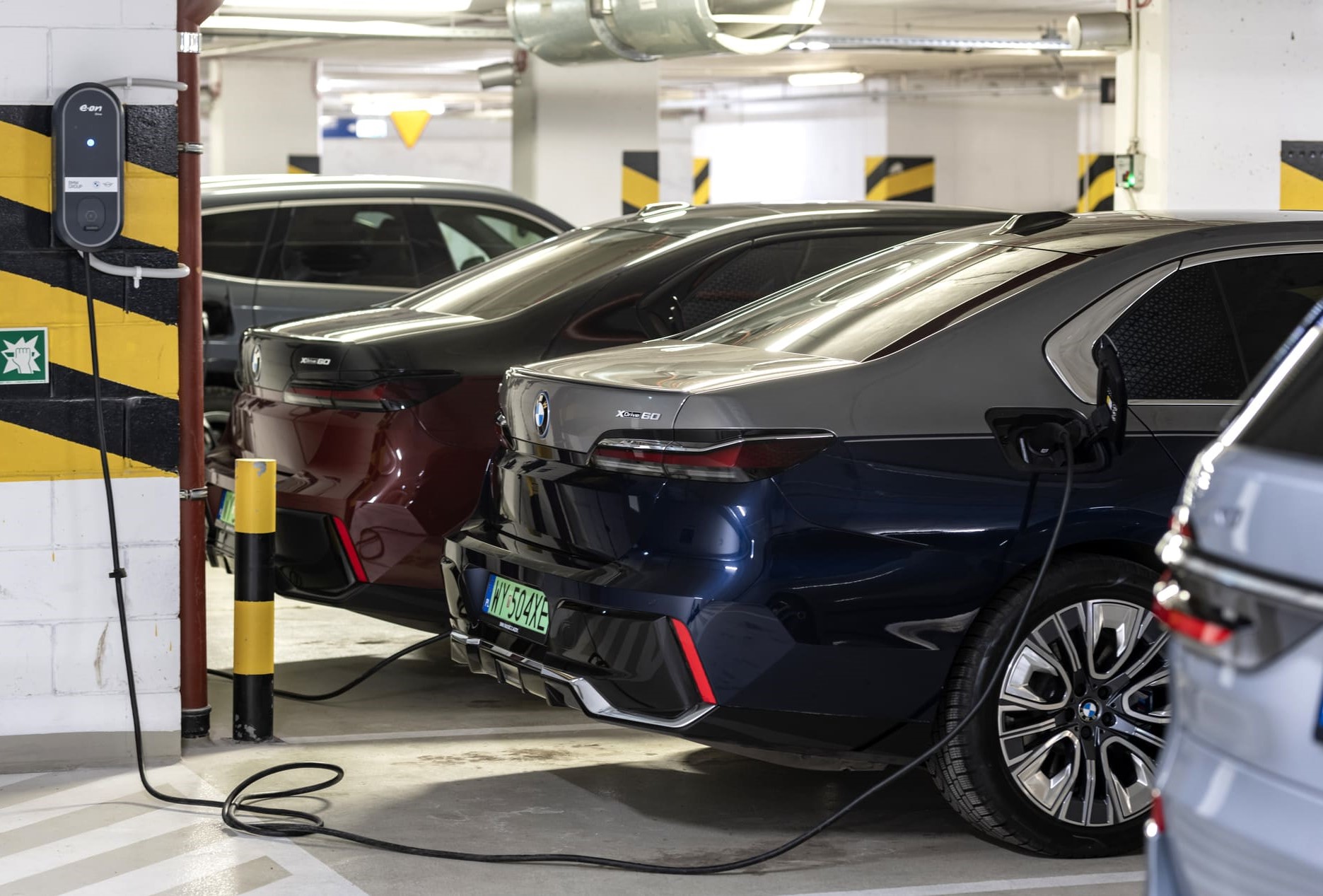
Upcoming legal changes in eMobility will bring a need for rapid electrification of parking lots in Poland. A guide to selected issues regarding current and future regulations in the field of electromobility has been created in cooperation with the Decarbonization team of the Osborne Clarke law firm and the tax advisory firm MDDP. It is aimed at owners and managers of commercial properties. It serves as a base of theoretical and practical knowledge.
At the end of last year, there was only one charging point for every ten fully electric cars in Poland[1]. At the same time, with the visible year-on-year growth in the popularity of electric vehicles and this year’s legal regulations, the need for rapid and effective electrification of parking lots is becoming clear. Consequently, managers of non-residential buildings[2] will have to meet a number of obligations.
This publication explains in detail, among other things:
- basic concepts appearing in legal regulations,
- requirements regarding infrastructure for charging electric cars,
- tax issues related to the installation of charging devices for electric vehicles in or near non-residential buildings.
– The incoming regulations will significantly accelerate the expansion of electric vehicle charging infrastructure. It is worth knowing how important this element of the entire charging ecosystem is – as much as 30% of the energy used by electric cars comes from office parking lots. This is more than three times more than from publicly accessible stations – explains Kuba Jedliński, manager of the eMobility team at E.ON Polska. – Adapting to the new regulations requires effort from the entire industry. That is why we decided to publish a comprehensive guide for managers of non-residential buildings and make it available free of charge to all interested parties.
Effective planning of parking lot electrification
When preparing for the construction or renovation of a building, it is worth not limiting oneself to the minimum required by current regulations. Planning the target charging infrastructure, which an investor can create in stages, is particularly cost-effective. Such a model of operation allows for reducing the costs of building the installation and will also increase the attractiveness of the building for potential tenants.
– The chargers themselves account for only 20-25% of the cost of the entire investment. The largest part is taken up by the electrical installation, followed by formal and design matters, such as fire safety expert opinions or inspections by the Office of Technical Inspection. For example, by designing twenty charging points at once, much better results are achieved than in the case of working on each of them separately. However, there is no need to install all charging points at once. It is important to be able to easily add them to the existing system – points out Kuba Jedliński.
EU regulations support forward-looking planning of infrastructure for eMobility. An example is the requirement for proper sizing of cables. They should enable the simultaneous and efficient use of the required number of charging points and ensure the possibility of installing a charging management system.
– E.ON uses a dynamic power management system in its projects. It allows for the installation of chargers with a nominal power often many times exceeding the building’s connection capacity. Such a solution is already widely used in Scandinavia, Great Britain, or Germany. We are glad that we are also implementing the first projects of this type in Poland. In this way, together with our clients, we can introduce innovations related to the electrification of transport to the domestic market – concludes Kuba Jedliński from E.ON Polska.
Key regulatory requirements and charging infrastructure
The starting point for national regulations related to electric car charging infrastructure is the Act on Electromobility and Alternative Fuels. According to its provisions, by the end of 2024 at the latest, every owner and manager of a non-residential building with more than 20 parking spaces will have to install at least one electric car charging point. This requirement also includes creating the appropriate ducting infrastructure.
In the case of a new building, modernization of its electrical installation, or reconstruction of an existing parking lot, one electric vehicle charging point will have to be created for every 10 parking spaces. However, this obligation will not apply to, among others, buildings owned by small or medium-sized enterprises.
EU regulations in practice
Since April 2024, regulations resulting from the regulation on the deployment of alternative fuels infrastructure, the so-called AFIR[3], have been in force in all European Union countries. Among them is the requirement to ensure the possibility of ad hoc charging at publicly accessible charging points. This means there is no need to register with a given charging point operator or enter into a specific contract with them. However, a requirement is to equip such points with devices enabling payment by card or QR code.
– In practice, a charging point located in an office building and available only to its tenants will not be a publicly accessible point. However, the situation will change if the manager enables electric car charging for third parties – explains Sylwia Uziębło-Kowalska from the Osborne Clarke law firm.
Changes to the EU EPBD directive[4] are also being prepared. As a result, it is highly probable that even greater investments in infrastructure for eMobility needs will appear. All new non-residential buildings (having more than 5 parking spaces) will have to have at least 1 charging point installed for every 5 parking spaces. It will also be mandatory to provide cabling for at least 50 percent of parking spaces, as well as ducts for electrical cables for the remaining parking spaces. Such a procedure will enable the subsequent expansion of the existing system with additional charging points. In the case of office buildings with at least 5 parking spaces, the installation of at least 1 charging point for every 2 parking spaces is to be required.
The guide from E.ON Polska is available at the link.
[1] “Polish EV Outlook, 2024”, Polish Alternative Fuels Association
[2] Office buildings, shopping malls, hotels, large-scale parking lots, underground garages, etc.
[3] Regulation (EU) 2023/1804 of the European Parliament and of the Council of 13 September 2023 on the deployment of alternative fuels infrastructure, and repealing Directive 2014/94/EU.
[4] EPBD – Energy Performance of Buildings Directive
Source: E.ON