









Managing a warehouse, regardless of its scale, involves the need for quick location of goods or raw materials required for customer orders, or for production purposes in the case of manufacturing companies. WMS-class solutions are tools that support the work of warehouse staff. These applications assist in locating goods, directing warehouse employees to the exact spots where a given item is stored. In this way, picking paths can be significantly optimized, and employees will be guided along the fastest routes between racks.
Good WMS applications support employees not only during order picking but also during the execution of other warehouse processes. The goods receipt process can be optimized, for example, by indicating to the employee where a specific delivery will fit, pointing out where another batch of the received goods is already located, or directing them to a storage location based on inventory rotation parameters, such as ABC/XYZ categories. Advanced WMS applications allow for the execution of multi-stage processes, making it possible, for example, to handle collective picking for several orders simultaneously. In such a process, the first stage is picking goods from the warehouse for all orders, the next stage might involve quality control of the collected items, and the subsequent stage could be sorting them into specific shipment documents for customers. An application for a warehouse worker should facilitate their work, for example, through voice messages, appropriate confirmation sounds, or by providing a suitable language version; especially in the current situation on the Polish labor market, the ability to work in a Ukrainian interface is highly desirable.
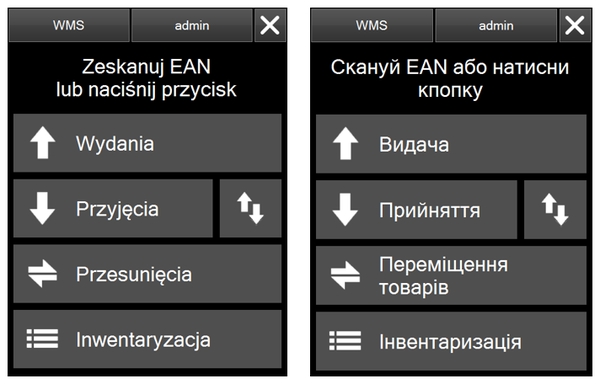
It should be remembered that a good WMS system is not just an application dedicated to warehouse workers; it is also a tool that allows for effective warehouse management. In its management module, a WMS system should, in addition to enabling the management of warehouse structure, inventory standards, multi-stage operations, and commissioning stocktakes, also provide the warehouse manager with the ability to check the progress of tasks assigned to individual employees and prepare a summary of the work they have performed. In this way, the warehouse manager receives not only a complete tool for managing their staff but also a system that supports them in analyzing the activities carried out.
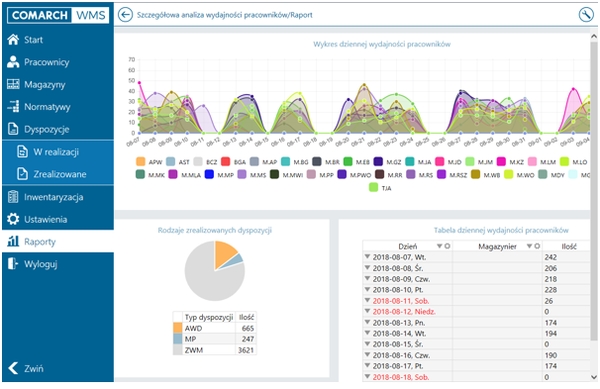 WMS system interface: Comarch WMS
Is it worth using WMS-class software regardless of the type of warehouse and the volume of goods flow?
Thanks to its advantages related to the precise execution of processes, WMS software can effectively increase the efficiency of processes carried out in warehouses. Of course, it should be remembered that the size of the warehouse matters. In very small warehouses, e.g., in the backrooms of small clothing stores in shopping malls, where there are no problems with locating goods and quick picking, the implementation of a WMS system may bring only minor benefits in terms of counting accuracy and handling receipts and shipments. As the size of the warehouse increases, the impact of implementing a WMS system on timeliness, time consumption, and process optimization grows. Modern WMS systems also allow for the simultaneous management and execution of work in several warehouses at once, thanks to which process improvements can cover several smaller warehouses for which separately launched WMS systems would not bring a noticeable result. As the size of the warehouse increases, the number of employees grows, which may lead to higher turnover, so it is important that the WMS system is intuitive and easy to operate.
Learn more about the WMS system from Comarch
