









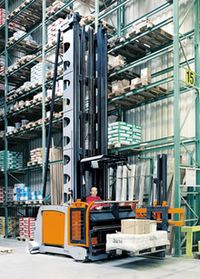
Nowadays, high-class transport equipment should be configured according to its future purpose, operating conditions, and method of use. The reason is prosaic – savings. Thanks to the specialized profiling of a given forklift, entrepreneurs can be sure that their investments in logistics systems are not wasted. This allows the company to purchase equipment adapted to individual needs.
– For my company, the most important thing is maintaining small equipment dimensions due to limited warehouse space – says Krzysztof Wróblewski, president of the local wholesaler “Smakosz” from Ustroń in the Silesian Voivodeship. – A smaller forklift, adapted to the width of the aisles, would solve many of my problems. Unfortunately, standard manufacturer offers did not provide for such solutions.
Equipment manufacturers came to the rescue, deciding to respond to the needs of companies regarding non-standard transport solutions.
– Currently, we are able to introduce improvements suitable for a given company in practically every modern forklift – explains Przemysław Wlazeł, sales advisor for strategic clients at STILL. – Reducing the design to allow for narrowing aisles by even 25 cm, or adapting it to threshold heights and warehouse layout is no longer anything unusual, even in high-reach forklifts like the MX-X type.
It is even possible to adapt the layout of pedals and the steering wheel, or the maximum lifting capacity of the forklift to the company’s needs. All this so that the equipment adapts to the work system, and not the other way around. However, the challenge arises when a company from a more demanding industry needs specialized solutions, where equipment profiling is not just a matter of savings. The search for specialists takes place not only in the labor market – specialization is also necessary at the level of equipment infrastructure. Therefore, entrepreneurs from demanding sectors of the economy want the equipment used by their companies to be prepared in a special way, resulting from the specifics of their work. A multitude of solutions are emerging, depending on the industry. Companies using cold stores in their work can count on forklifts adapted to temperature fluctuations of up to 45 degrees, the metallurgical industry receives exceptionally durable equipment with additional protection against mechanical damage, and the catering industry gets forklifts enabling the transport of goods on uneven surfaces and uphill – specialized equipment created strictly for performing its duties. A thing until recently unheard of and unusual. The time of universal solutions has passed. Effective use of equipment adapted to specific needs has become of decisive importance in running a business. Thanks to the specialization of logistics systems, the company does not waste resources while simultaneously meeting all requirements resulting from the specifics of a given industry. And it gets exactly what it needs.