









We lack a development strategy and support policy for intermodal transport. Janusz Mincewicz talks to Dariusz Stefański, CEO of PCC Intermodal.
Janusz Mincewicz: Where does this phenomenon come from – a pandemic, yet in 2020 intermodal transport in Poland grew like “mushrooms after rain”?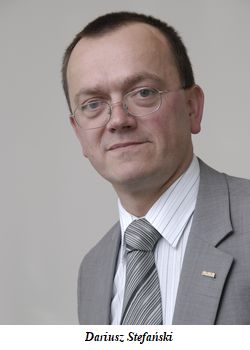 Dariusz Stefański: This is a purely statistical phenomenon, and I would not attach much importance to it. Intermodal transport in port relations fell, while intra-European and transit transport within the New Silk Road increased. Summa summarum, 2020 can hardly be considered an outstandingly successful year, but given the pandemic and the associated difficult market situation, it must be admitted that intermodal transport came out of it unscathed and proved its usefulness, as well as its resistance to such market disturbances.
J.M.: Some experts claim that it is not so much that intermodal transport is growing in Poland, but rather that rail freight transport is decreasing, and it is growing statistically, not actually in total transport. Do you share this opinion?
D.S.: American economist Aaron Levenstein said that statistics are like a bikini: what they show is suggestive, but what they hide is essential. And he probably knew exactly what he was talking about. On one hand, there is no doubt that intermodal transport is growing and will continue to grow. However, the question is about the dynamics of this growth. Since a significant decline was recorded in the bulk rail freight sector last year, the statistical share of intermodal transport in rail freight improved significantly, even though the growth dynamics in the intermodal sector definitely fell. Statistical data are therefore very useful, provided we know how to read and interpret them.
J.M.: Does Poland have a good location and conditions for the development of intermodal transport?
D.S.: Well, from the point of view of geographical location, I would even risk saying that we are in the best possible place, and thanks to this, we can, but do not have to, play a very important role in European intermodal logistics. Unfortunately, location alone is not a guarantee of success. You still have to skillfully use this location, and unfortunately, we are not doing very well with that. For years, we have not had any coherent development strategy, let alone a stable and long-term policy to support the intermodal transport sector. Intermodal transport is growing because it has to, but much slower than it should, and on top of that, it is so-called “guerrilla development,” because it is a bit chaotic, intuitive, and practically without any support or understanding from the government administration. To this day, we have not even managed to create a single-person department for the development of intermodal transport, so there is no one at the ministerial level with whom one could talk about this in a substantive and professional manner.
J.M.: Should the Polish government take advantage of last year’s EU directive, which allows for the reduction or suspension of track access charges due to the pandemic, to improve the volume and profitability of intermodal transport?
D.S.: Such decisions should be conscious and rational, not made intuitively. The costs of using rail and road infrastructure should, above all, be proportionate. This means that infrastructure charges for transporting a container by road and by rail – while ensuring the same speeds and travel times – should be similar. Today, the unit costs of using rail infrastructure are significantly higher than those of using road infrastructure, so either the rates for using rail infrastructure must be lowered, or the rates for using roads must be raised.
J.M.: Is the New Silk Road the main opportunity for the rapid development of container transport?
D.S.: It is one of the opportunities, but I would not call it the “main” one. Due to our location, we have the possibility to develop intermodal transport both in the East-West corridor, and here transport within the New Silk Road plays a significant role, as well as in the North-South corridor, i.e., to and from Polish ports. In my opinion, we should definitely put more emphasis on the development of intermodal transport within the so-called Baltic-Adriatic Corridor, thereby expanding the area of influence of Polish ports to include the Czech Republic, Slovakia, Austria, Hungary, Ukraine, and Belarus. Unfortunately, the current quality of rail infrastructure does not favor the development of this transport, and additionally, the sea terminals themselves effectively block it, such as the “handling fee” applied by DCT Gdańsk to containers delivered and collected by rail.
J.M.: What actions should be taken to get goods off the roads and into containers?
D.S.: We have been talking about this for years, and I don’t know if there is any point in repeating it again, since… no one is listening anyway. Without a government department for the development of intermodal transport, it is difficult to expect any sensible actions and decisions. Intermodal transport will develop one way or another, because so far no one has come up with a better solution than transporting goods in containers. Unfortunately, without appropriate support and a long-term strategy, this transport sector will develop much slower than it should.
J.M.: Coal and coke are already being transported in containers. How large is this transport?
D.S.: Transport of coking coal in containers is currently barely a fraction of a percent, but… Rome wasn’t built in a day.
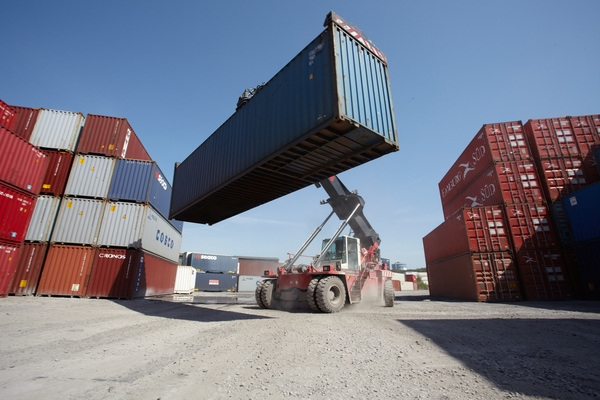
J.M.: In 2020, PCC Intermodal equipped its terminals in Kutno, Brzeg Dolny, and Gliwice with modern reachstackers for container handling. How did they influence the improvement of their work?
D.S.: We are modernizing our terminals and equipping them with better and more modern handling equipment: gantry cranes, reachstackers, to shorten times and improve the efficiency of handling operations. At the same time, we are systematically increasing their handling capacity – currently, we handle nearly 700,000 TEU annually at our terminals. In the coming years, we plan to build three more intermodal terminals and increase handling capacity to over 2 million TEU annually. We are convinced that a well-organized network of intermodal connections constitutes an effective alternative to long-distance road transport, and modern handling terminals enable the development of transport in a sustainable way, with respect for the natural environment and maintaining comfort and safety at work.