Although we have learned to function in a pandemic to some extent, the experiences with COVID-19 may prove to be a catalyst for lasting changes in the area of safety in logistics. What trends are visible at the beginning of 2021?
Experts and academics agree that the changes in warehouse operations forced by COVID-19 have become an impulse to verify safety issues in logistics – both in terms of supply chain stability and minimizing risk for individual employees. What technologies have developed under these conditions and in what direction will further progress go? Here are 3 trends that have a chance to dominate warehouse safety in 2021 and the following years.
Intelligent solutions for distancing
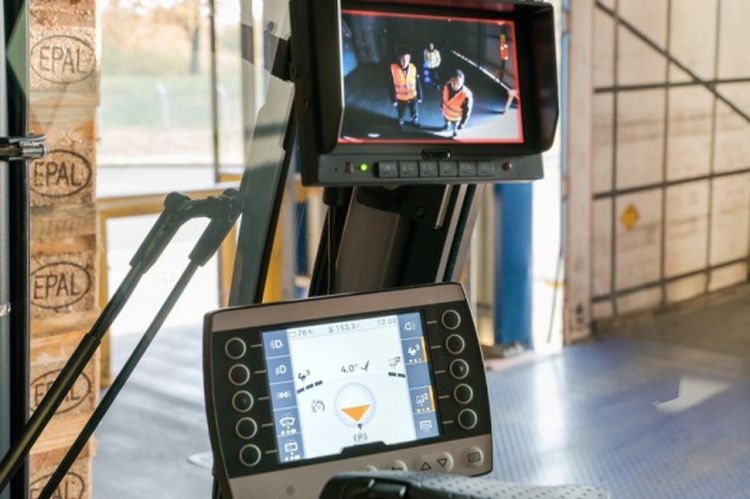
Workwear and personal protective equipment have been a constant concern for occupational health and safety professionals for years. Their function has always been to minimize risk during performed activities. Since excessive shortening of the distance between employees became a risk factor in the context of the pandemic, software and equipment designed to prevent this have appeared. In the summer of 2020, Amazon implemented a “distance assistant” system that allows measuring the distance between people in the frame using a camera and informing them on a monitor in real-time whether they are far enough apart. The company installed several hundred such systems in its warehouses and made the source code available – so that anyone could copy it for their own needs. As reported by CNBC, the e-commerce giant also tested individual personal protective equipment with the same task – a sleeve with a sensor, LED, and speaker, informing the user about not maintaining the recommended distance with blinking and sound. The solution, useful for obvious reasons in the context of the pandemic, may also find wide application when it ends – this time to prevent collisions.
– Based on a camera, a person recognition system, and an audiovisual output, the warning system for pedestrians entering a forklift safety zone is one of the novelties in the STILL additional equipment offer – says Grzegorz Kurkowski, product specialist at STILL Poland. – The Reversing Warning Plus system is worth recommending to all companies where a collision between a forklift and a pedestrian has occurred, and where the way routes and internal transport processes are organized carries the risk of such undesirable events. The signals generated by the device warn both the operator and the passerby, significantly reducing the risk of an accident as a result – he summarizes.
Artificial intelligence in the service of prevention
In an article published by Columbia Southern University, experts predict that 2021 could be a breakthrough in the popularization of predictive safety modeling systems. The artificial intelligence functioning within them would analyze data flowing from the entire enterprise to identify conditions that increase the probability of an accident and warn about the danger before it actually occurs. The key to the accuracy of these forecasts, however, is the quantity, diversity, and completeness of information collected by the system. A factor conducive to improving the quality of collected data is undoubtedly the popularization of 5G technology and the gradual increase in the saturation of warehouse infrastructure with sensors and transmitters. Fleet management systems, which are already quite popular today, work on a similar principle in the service of optimizing forklift operating costs. The tools are therefore already available. It remains to be seen whether the prices of components and programs integrating and analyzing data will be attractive enough and the awareness of the benefits great enough for predictive safety systems to have a chance to become widespread this year.
Automation, collaborative robots, and machine-to-machine communication
The experiences of 2020 showed that two seemingly mutually exclusive goals – improving safety and increasing facility throughput – can be achieved simultaneously thanks to automation solutions. Collaborative robots placed between workstations on production lines guarantee social distancing, and transferring some tasks to machines allows for improving productivity without increasing employment (thereby minimizing the number of people per unit of area).
– In the coming years, we expect an increase in interest in: picking collaborative robots such as iGo neo; comprehensive autonomous systems operating based on AGV trucks; and semi-automatic solutions that allow relieving operators, streamlining their work, and increasing its safety without radically changing the existing warehouse organization – says Dominik Jasiok, Advanced Applications Manager at STILL Poland. – The development of these technologies is supported by both the increased cost-effectiveness of components and multi-directional communication systems, as well as the need for readiness realized through the epidemic: for changes in demand and a situation in which the availability of employees is limited – he adds.
A good example of progress in the field of Industry 4.0 is the IC4F project completed at the end of 2020, in which market leaders in solutions for industry, logistics, and telecommunications collaborated with scientists to explore the possibilities of using communication between machines and infrastructure elements to improve process functioning. During the meeting summarizing the work, STILL demonstrated the “Truck-to-X Communication” system created in cooperation with Nokia, in which a forklift, for example, connects to a gate to ensure that it can safely pass through it with a given load. Experts expect that such solutions, forklift driving assistants, and full automation of selected warehouse areas will have a positive impact on work safety in warehouses, as well as the efficiency of implemented processes.
Source: Newseria
Read more about automation:
– FM Logistic invests in autonomous robots in warehouses
– Mobile Industrial Robots published the results of research on intralogistics automation
– Automation strategy
– Blaklader hires robots
We wrote more about automation in Logistyka magazine 1/2020.
The e-edition of the magazine is available in our offer!