









Summary of 2025, regional characteristics, and current trends in smaller logistics hubs.
Tri-City
Market in numbers:
- 1.8 million sqm of existing space
- 180,000 sqm under construction
- 4.20 – 5.30 – rent in EUR / sqm / month
One of the fastest-growing regional markets
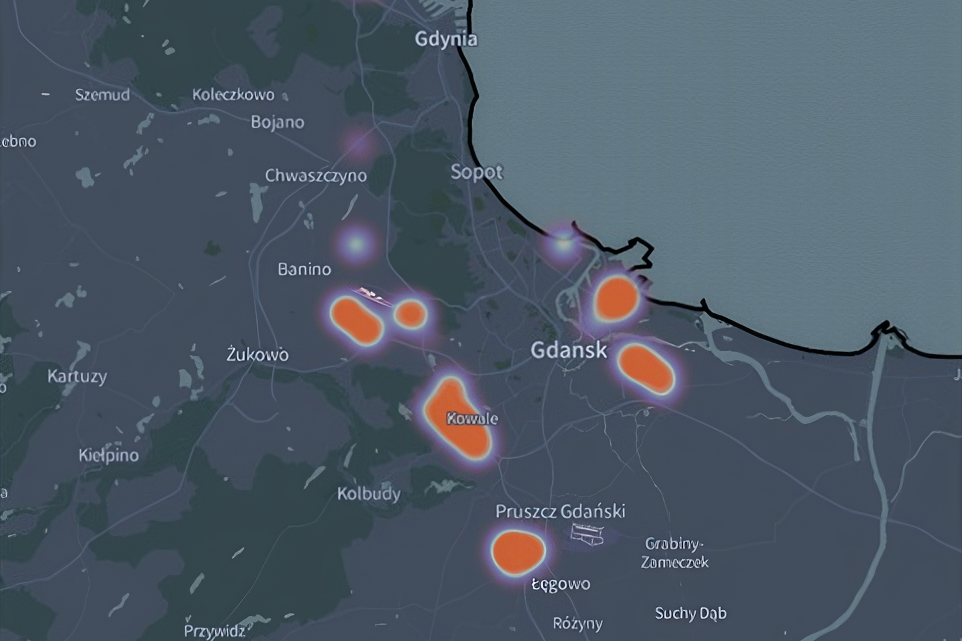
The warehouse market in the Tri-City remains one of the fastest-developing regional markets in Poland. Over the last 5 years, the market has nearly doubled in size, which demonstrates how rapidly this logistics hub is growing.
Demand driven by port logistics and e-commerce
The demand structure in the region is based primarily on logistics operators and companies from the e-commerce sector, which account for a significant portion of lease transactions in the region. Growing transshipments at the ports in Gdańsk and Gdynia, as well as the development of transport infrastructure, strengthen the role of the Tri-City as an important logistics hub serving trade in the Baltic Sea region.
Multi-level supply chains
Increasingly multi-level supply chains based on port logistics are developing in the Tri-City region. Logistics operators are more frequently splitting operations into several warehouse zones: in the immediate vicinity of ports (transshipment and short-term storage), near the bypass and main transport hubs (regional distribution), and within city limits (last-mile logistics and fulfillment).
The warehouse market in the Tri-City remains one of the fastest-growing regional markets in Poland. At the end of 2025, total modern warehouse space in the region exceeded 1.8 million sqm, with further projects in the construction or planning phase. The dynamic development of the region is supported by the growing importance of seaports and the development of transport infrastructure.
– says Dorota Koseska, Director, Industrial Agency
Western Poland
Market in numbers:
- 1.7 million sqm of existing space
- 35,000 sqm under construction
- 3.70 – 4.50 – rent in EUR / sqm / month
Stable development
In 2025, the warehouse market in the Lubuskie Voivodeship developed more stably than in previous years, while remaining one of the key logistics regions in Western Poland. At the same time, developers increasingly implemented investments in a BTS (build-to-suit) model or with a high occupancy level, limiting the risk of oversupply.
Gateway to foreign markets
In 2025, the highest number of transactions in the region fell within the 3,000 – 6,000 sqm range, although larger deals exceeding 15,000 sqm also appeared, particularly in the case of logistics operators and e-commerce companies serving foreign markets. Tenants conducting international operations had a significant share in the demand structure.
Attracting tenants
In major hubs, such as the areas around Świebodzin, Zielona Góra, or Gorzów Wielkopolski, growing competition was observed between new projects and existing warehouse parks. Owners of older facilities often responded with greater price flexibility and attractive incentive packages, which strengthened the tenants’ negotiating position.
Incentives and flexible expansion options
In negotiation processes, incentives in the form of rent-free periods and fit-out contributions dominated, especially in speculatively developed projects. An important element was also the possibility of flexibly increasing the occupied space within a single warehouse park.
The Lubuskie Voivodeship stands out with one of the highest shares of logistics operations directly linked to the German market in Poland. In many warehouse parks, even more than half of the tenants conduct international operations. The region is also one of the fastest-growing locations of the last stop before the western market type, where warehouses serve as a buffer for just-in-time deliveries to western recipients.
– says Katarzyna Burlińska, Senior Consultant, Industrial Agency
Szczecin
Market in numbers:
- 1.4 million sqm of existing space
- 75,000 sqm under construction
- 4.10 – 4.80 – rent in EUR / sqm / month
Relatively low developer competition
Compared to the largest logistics markets in Poland, the warehouse market in the Szczecin region remains relatively smaller in terms of total resources, develops more slowly but steadily, and is less competitive in terms of the number of projects. As a result, modern warehouse space in the region often finds tenants relatively quickly after commissioning.
Very low vacancy rate in the region
The West Pomeranian Voivodeship was among the regions with the lowest vacancy rates in Poland in 2025, at approximately 1-2%, which is mainly due to the relatively limited supply of modern warehouse space.
Strategic location for international logistics
The Szczecin region plays an important role on the map of the Polish warehouse market thanks to its unique location and access to seaports. Developed transport infrastructure, including the S3 expressway and the A6 motorway, favors the development of logistics serving international trade and port transport.
The Szczecin region remains an important logistics hub in northwestern Poland, benefiting from its proximity to the German border and the ports in Szczecin and Świnoujście. Developed transport infrastructure, including the S3 expressway and the A6 motorway, supports the development of logistics projects serving international trade and distribution towards Western Europe and Scandinavian countries. Total modern warehouse space in the region exceeds 1.4 million sqm, and demand is concentrated mainly in the international logistics and distribution sector. Despite the smaller market scale than in the largest logistics hubs in Poland, Szczecin remains an attractive location for companies looking for space related to port logistics and serving foreign markets. In the long term, the region’s development will be supported by infrastructure investments and the growing role of ports in handling international trade.”
– says Dorota Koseska, Director, Industrial Agency
Kraków
Market in numbers:
- 1.2 million sqm of existing space
- 12,000 sqm under construction
- 4.80 – 6.50 – rent in EUR / sqm / month
Small but stable market
The warehouse market in Kraków functioned as a relatively small but stable and specialized logistics and production hub. Its development was strongly dependent on the limited availability of land and the structure of the local economy.
Limited new supply and controlled development
Compared to Silesia or Central Poland, the scale of implemented projects was smaller, and developers approached new investments very selectively. High land prices and restrictive planning policies meant that the market developed more slowly and in a more controlled manner.
Orientation towards small and medium modules
On the demand side, stability was visible, but without spectacular new expansions. Renegotiations of existing contracts played an important role, and tenants focused on cost optimization and maintaining proven locations. The Kraków market, more so than typical big-box markets, was oriented towards smaller and medium-sized modules serving local distribution, e-commerce, and light manufacturing.
A characteristic feature of the market was the relatively low availability of large, modern spaces. Limited supply meant that the vacancy rate remained at a moderate or low level, and base rents remained stable, often higher than in the country’s largest logistics markets due to land barriers and investment realization costs. In summary, in 2025, the warehouse market in Kraków was characterized by limited supply, stable demand, selective developer activity, and a relatively high level of rents. It was a mature market, more local than a nationwide logistics hub, developing in a cautious and sustainable manner.
– Łukasz Ciepły, Director, Industrial Agency
Eastern Poland
Market in numbers:
- 1.2 million sqm of existing space
- 150,000 sqm under construction
- 3.80 – 5.50 – rent in EUR / sqm / month
Secured development
On the supply side, developers acted cautiously; projects secured by lease agreements (pre-let) or implemented in a BTS formula prevailed, and the scale of speculative investments was limited. In some locations, the vacancy rate was elevated, which increased the competitiveness of lease terms.
“Spill-over” effect
The demand structure was mainly operational. 3PL transactions, production projects, and regional distribution dominated. A “spill-over” effect from larger markets was also visible. Renegotiations of contracts also accounted for a significant share.
Diverse demand
Lublin and Rzeszów were among the most developed markets in this group, with relatively stable demand. Białystok remained a smaller market and more dependent on individual projects.
The warehouse market of Eastern Poland functions as smaller than the main hubs, but increasingly noticeable in the national structure. The region strengthened its position as a cost alternative for production projects and regional distribution. A key factor in development was the improvement of road infrastructure, including progress in the implementation of the S19 (Via Carpatia) and the development of the S17 and S7 routes. This increased the logistics accessibility of the eastern part of the country and shortened travel time to Central Poland, which translated into greater interest from tenants.
– says Łukasz Ciepły, Director, Industrial Agency
Bydgoszcz-Toruń
Market in numbers:
- 950,000 sqm of existing space
- 50,000 sqm under construction
- 3.50 – 5.30 – rent in EUR / sqm / month
Cost-competitive
The Bydgoszcz – Toruń market remains cost-competitive; base rates in 2025 remained at the level of approximately 3.50 – 5.30 EUR / sqm / month. This is a level significantly lower than in the largest logistics hubs in Poland, which is a significant argument for tenants looking for operational savings.
Strategic location
The market works best for companies from the logistics (3PL), light manufacturing, and e-commerce sectors that do not need the largest volumes of space but value cost-efficiency and a central location in northern Poland. The region serves distribution well both to Pomerania and to the central part of the country, which makes it attractive for regional operators.
Tailor-made market
The Bydgoszcz – Toruń market is characterized by a large share of build-to-suit (BTS) investments. This results from limited developer activity in the speculative segment and the relatively small scale of the market. Developers more often implement projects tailored to specific tenants, especially in the production and logistics sector, which allows companies to obtain space perfectly adapted to operational processes.
Industrial investments are concentrated primarily around the largest cities in the region, such as Toruń, Bydgoszcz, Grudziądz, and Włocławek. The region benefits from excellent transport accessibility to both western and northern markets. The Bydgoszcz – Toruń warehouse market in 2025 remained stable and cost-competitive, developing mainly based on build-to-suit (BTS) projects and moderate but consistent tenant demand. The region offers modern logistics parks providing optimal storage conditions.
– says Katarzyna Burlińska, Senior Consultant, Industrial Agency
Source: Avison Young