









The latest data from the international consulting firm Cushman & Wakefield shows that the warehouse real estate market in Central Europe is developing twice as fast as it was last year.
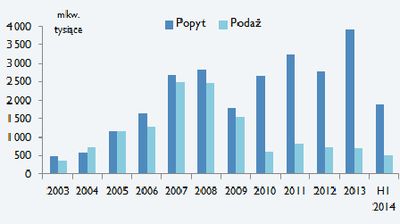
In the first half of 2014, over 500,000 sqm of warehouse space was built, compared to 260,000 sqm in the same period of 2013, and the volume of lease transactions amounted to nearly 2 million sqm, as a result of which the average vacancy rate currently does not exceed 10 percent.
Ferdinand Hlobil, Head of Industrial and Logistics for Central Europe at Cushman & Wakefield, said:
– Demand for new warehouse space is so high that almost all supply finds tenants even before construction begins, and for this reason, speculative investments are currently rare. This trend is particularly strong in Poland and the Czech Republic. The automotive sector is showing the greatest interest in warehouse space, but the importance of companies specializing in online sales is also growing in the demand structure.
Tom Listowski, Partner, Head of Industrial and Logistics in Poland and Head of Central and Eastern European Corporate Relations at Cushman & Wakefield, said:
– The warehouse real estate market in Poland is developing the fastest among Central and Eastern European countries, both in terms of new investments and transaction volume. Data on warehouse space currently under construction suggests that the amount of space delivered to the market in 2014 will reach its highest level in five years. The volume of transactions concluded in the first half of 2014 increased by 20% compared to the same period last year and is likely to remain at a high level throughout the year. It is worth noting that developers planning further development investments are also interested in small and medium-sized towns near large conurbations.
Supply
In the first half of this year, 520,000 sqm of new warehouse space was built in the region, compared to nearly 700,000 sqm in all of 2013. In Poland, 340,000 sqm of warehouse space was completed in the first half of 2014, almost as much as in the entire year 2013. Most of the new facilities in Central Europe were built by four developers: Panattoni, PointPark Properties, Prologis, and MLP Group.
Transaction volume
In the first six months of 2014, companies leased nearly 1.9 million sqm of space in modern warehouse facilities. For comparison, 1.5 million sqm was leased in the same period last year. The highest demand for warehouse space in the first half of the year was recorded in Poland (over 1 million sqm) and the Czech Republic (570,000 sqm).
Unleased space
As a result of high demand, the average vacancy rate in Central Europe decreased by 1 percent from 10 percent in January 2014 to 9 percent in June, with the largest decrease (3 percent) recorded in Hungary. Slovakia (4 percent) and the Czech Republic (6.5 percent) have the lowest share of unleased space in total stock. In Poland, a significant drop in the vacancy rate, from 10.9% at the end of last year to 8.8% at the end of June 2014, indicates the continued development of the warehouse real estate market, especially in well-established submarkets.
Forecast
According to experts from Cushman & Wakefield, the warehouse real estate market will continue to develop at its current pace. Ferdinand Hlobil said:
– For ten years, the most new warehouse facilities have been built in Poland, which will maintain its position as the market with the highest development activity not only in Central Europe but also on the scale of the entire continent. This is primarily due to the continuous growth of the Polish economy and active government policy. The Czech market will continue to develop dynamically, but it requires greater transparency and openness of politicians to foreign investors. An obstacle in the future may be the insufficient supply of land for warehouse investment purposes.
The Hungarian and Romanian markets are slowly beginning to enter a recovery phase. Meanwhile, the vacancy rate in Hungary, which remained at a very high level for a long time, has recently fallen to below 20 percent, and its further decline could be a clear signal to start new investments in the medium term.
In Slovakia, the surroundings of Bratislava have the largest share in the development of the warehouse space market, where several large investments have been completed, including Volkswagen. However, increasing investments and their diversity in the eastern part of Slovakia would certainly benefit the situation of the entire country.
Ferdinand Hlobil added: – Events in Ukraine pose a threat to the Central European market. In the event of further escalation of the conflict, one can expect an increase in investor distrust and a gradual reduction in investments. As a result, developers may partially lose sources of income. Furthermore, companies may also reduce plans to expand production activities in Ukraine.