








The coronavirus pandemic has negatively affected European economies and many segments of commercial real estate, such as retail properties or hotels. According to Eurostat data, Poland’s gross domestic product decreased by 2.7% year-on-year in 2020, compared to a 4.5% growth the year before. Nevertheless, it opened up entirely new opportunities for the warehouse space market.
The year of the pandemic was extremely successful for the warehouse logistics sector in Poland. Despite the introduction of restrictions, e-commerce began to develop, and with it, last-mile logistics, which is the final element of the supply chain where the customer receives the package directly. As a result, the demand for warehouse space within cities also increased. Developers withdrew capital from unprofitable segments, such as office or retail properties, and invested it in warehouses. Data confirms the growth of the Polish warehouse real estate sector. According to a report by the consulting firm Axi Immo, in 2020, the number of new warehouse offers on the market exceeded the 20 million sqm threshold – 10% more than a year earlier. In addition, the Polish warehouse logistics market broke another record: in 2020, the area of leased premises exceeded 5 million sqm. This was a 29% increase compared to the previous year.
– Consumers were forced to change their behavior immediately and on a massive scale. Many discovered a new way of shopping and moved online. Thanks to this, e-commerce began to outperform traditional retail. Classic retail can store some goods on shelves, while e-commerce stores its entire assortment in warehouses. Online stores, in turn, need much more warehouse space. According to some reports, there are currently over 40,000 online stores operating in Poland – commented Oleksii Mospan, Head of Product at WareTeka.
Along with the development of the e-commerce segment, the role of last-mile and warehouse logistics has also grown. Now, consumers want their orders to be delivered quickly. Therefore, it is extremely important for online stores that warehouses are located as close to the city as possible. This way, they can fulfill orders quickly and deliver goods while avoiding delays. As a result, warehouses located within city limits are gaining increasing interest in Poland. New digital solutions are also emerging, such as platforms for finding warehouses. This is a profitable solution for all market participants. Warehouse owners can place their facility on the service’s website and rent it out quickly. In turn, tenants can find a facility with the desired features in the right location in a short time. Compared to the traditional search process, finding a warehouse this way takes much less time.
– A warehouse is a key element in supply chains. To scale and expand sales markets, companies must develop warehouse infrastructure. Often, searching for information about available space is time-consuming because the market is closed and poorly represented online. As a result, companies spend months looking for warehouse space that meets their requirements. Additionally, during peak demand periods, this is an even bigger problem. If a company does not have enough warehouse space, it loses part of its profits – adds Oleksii Mospan.
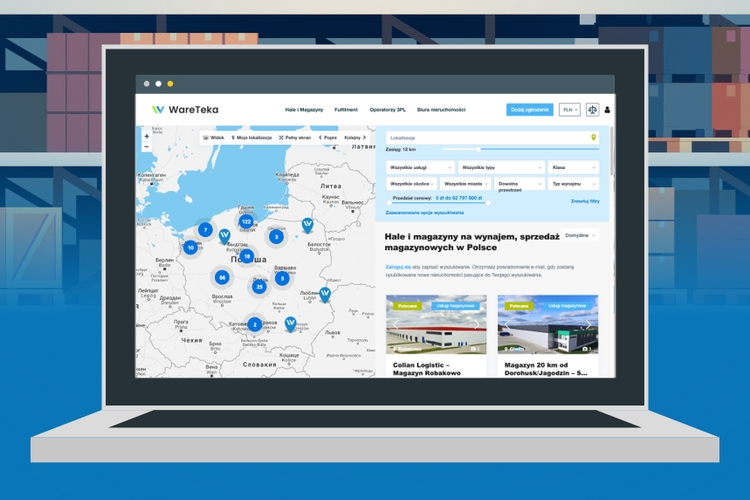
Warehouse platforms are actively developing on the Polish market. One of the active players in this segment is the Ukrainian startup WareTeka. The company creates a bridge connecting all market players: entrepreneurs who want to quickly increase their warehouse space or outsource logistics find verified partners, and those who provide such services can find new clients. Within a year, the team managed to create the largest warehouse database in the entire country. Now it is over a thousand proposals in one database with a total area of over 6 million sqm. In the autumn of 2020, WareTeka expanded its presence in European markets, and the platform was also launched in Poland.
– We started our operations from the Ukrainian market. After some time, we worked closely with major logistics service providers in Ukraine. So the time came to take a step forward, which is why we researched European markets for expansion. Poland turned out to be the most attractive. Of course, promoting a product in other countries is not easy. In this particular case, support from, among others, the Polish-Ukrainian Startup Bridge project helped us, which allowed us to prepare the ground for entering a new market – adds Oleksii Mospan.