









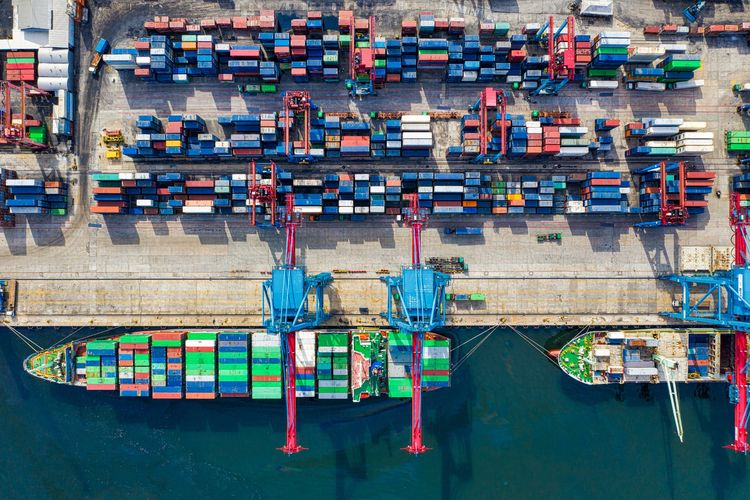
Unilever, owner of brands such as Dove, Domestos, Knorr, Cif, and Magnum, has announced the introduction of a Virtual Ocean Control Tower – a machine learning-based transport monitoring system. It is intended not only to increase logistics efficiency but also to support the company’s efforts to reduce CO2 emissions.
The blocking of the Suez Canal by a container ship operated by Evergreen Marine made both consumers and companies aware of how important maritime transport is in the supply chain. Currently, this form of transport accounts for over 80% of global trade in goods. However, the efficiency of maritime transport depends on many factors and actions. Even minor delivery delays can result in production stoppages, and consequently, significant financial losses for companies. Unilever, which has over 400 brands in its portfolio – including food products, cleaning agents, and personal care and hygiene products – has implemented the Virtual Ocean Control Tower system with its partners.
Digital innovation to solve shipping problems
The system, based on Electronic Data Interchange (EDI), enables the connection of all points in the supply chain. Data on the status of each shipment is therefore precise and available immediately – at every stage of delivery: from the factory to the retailer or store. Moreover, the Virtual Ocean Control Tower uses machine learning and predictive analytics, thanks to which notifications about possible disruptions – such as congestion in a port or on a transport route – are sent in real-time. The system uses satellite connectivity, making it possible to track over 2,000 ships, 400 ports, and hundreds of suppliers. Everything is visible on interactive Google maps, which refresh automatically every 30 minutes. Unilever itself uses over 12,000 containers and 1,500 ships in its fleet, transporting raw materials, packaging, and finished products by sea to over 2.5 billion consumers in 190 countries.
– We want to create a flexible, responsive, and comprehensive supply chain. The Virtual Ocean Control Tower is one of the pieces of this puzzle. Thanks to it, we have insight into all stages of transport in real-time. This allows us to plan better and react faster to emerging problems, or even prevent them – says Michelle Grose, Head of Logistics and Fulfillment at Unilever.
Preventing problems, not fixing their consequences
The system has changed the management of maritime transport logistics. It allows for identifying risks and reacting to them in a way that minimizes their impact. The tower automatically collects data that previously had to be generated from various sources. Importantly, the system continuously assesses the situation and implements optimal solutions.
– The Virtual Ocean Control Tower works perfectly during COVID-19. The pandemic has increased volatility and delivery delays, limited human resources, and moved a large part of work to online mode. Implementing the new system has helped us and our partners save time and maintain supply continuity – adds Grose.
Technology hand in hand with ecology
One of the challenges facing maritime transport is the reduction of greenhouse gas emissions. If this branch of the economy were a country, it would have ranked 6th on the list of countries emitting the most greenhouse gases in 2019. Unilever’s new solution is intended not only to limit the risk of disruptions but also to reduce CO2 emissions through better supply chain planning. Unilever also cooperates with business partners who are introducing their own measures to combat climate threats.
In June 2020, as part of the Climate & Nature initiative, Unilever committed to net-zero emissions for all its products by 2039 – from sourcing raw materials to sales in stores. In addition, the company declared a 50% reduction in greenhouse gas emissions associated with production (by 2030).
Source: Unilever