








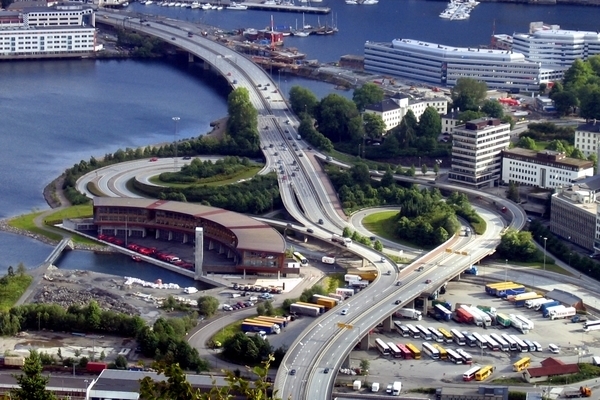
The fundamental problem in the systemic description of transport in urban areas is the characterization of the elements and relationships that make up the structure of spatial development and the structure of the transport system. This structure generates transport needs, which constitute the demand for transport, and also shapes the supply of transport in the form of the transport system and its transport capacity.
It also undergoes changes itself (mainly long-term) as a result of interactions between: changes in the quality of transport services and changes in transport accessibility, changes in the structure of demand and changes in user mobility, and changes in residents’ activities, which are also related to the availability of land for specific economic activities or residential development. Identifying these interdependencies allows for the description of the transport system, both in terms of technical-organizational aspects and functional aspects. Mathematical models, adapted to the required level of detail in representing transport phenomena, are used to describe traffic in the transport system. On one hand, these can be models used at the planning stage, which operate on global and aggregated values. On the other hand, when a very detailed description of traffic flows is required, microsimulation, deterministic, and probabilistic models are used, often employing fuzzy set theory and genetic algorithms.
Similar problems occur when modeling the demand for transport services. In this regard, models are used whose description varies from general to very detailed, corresponding to: the level of strategic planning for transport system development (in long-term horizons of 10-30 years), the feasibility study level, the tactical planning level (medium and short-term), the operational management level (short-term, e.g., traffic organization changes, day-to-day changes), and the traffic control level (e.g., on-line control systems). (…)
The article contains 54,219 characters.
Source: Logistyka Magazine