








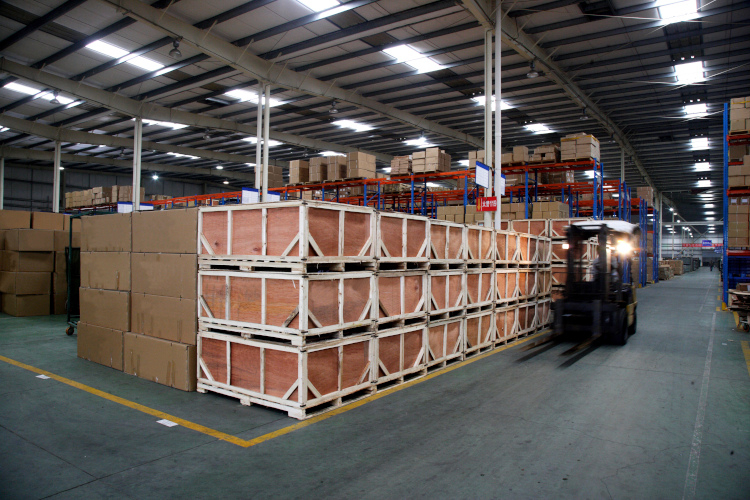
Warehouse labeling is an extremely important element for any company involved in the storage and distribution of goods. Proper warehouse labeling helps employees find products more easily, which directly impacts increased work efficiency and reduces the time needed to locate required goods.
Applying appropriate warehouse logic regarding location, numbering, and management directly affects work speed, picking, and safety. Combining proper vertical, horizontal, and product labeling translates into a reduction in errors, as its correct application allows for reading labels by both humans and warehouse computer systems.
Currently, warehouse labeling is no longer just about placing labels with product names on shelves. Companies are increasingly using various technologies and modern solutions that enable precise and effective warehouse labeling. Below we present several current solutions in warehouse labeling:
Use of QR codes
QR codes are increasingly used in warehouse labeling. Thanks to them, information about a product, such as its name, serial number, or expiration date, can be read quickly and easily. QR codes also facilitate the quick and easy location of required goods in the warehouse and are used as a supplement to markings, e.g., for zones and storage areas. This type of labeling effectively simplifies the identification of a specific product in the warehouse, speeds up picking, and minimizes the risk of errors. This type of marking is readable even if damaged.
Use of RFID technology
RFID technology allows for the automatic reading of information from products using radio tags. It enables tracking the location of products in the warehouse and controlling inventory levels. When implemented correctly, it allows for monitoring warehouse stock in real-time and its movement. The technology enables unambiguous and immediate product identification via radio waves. It is a good technology, but one that requires higher investment than, for example, traditional barcodes.
Use of vision systems
Vision systems allow for the automatic recognition and identification of products in the warehouse using cameras. The systems used operate on sets of appropriate rules, often supported by artificial intelligence. Thanks to this, they often do not need additional codes on products, and identification takes place based on comparison with a saved pattern (sometimes in several views and variants).
Use of floor marking
In addition to traditional and most commonly used vertical markings, floor markings are used. They define, for example, the boundaries of hazardous zones and traffic routes. Due to their nature and higher wear, they must be prepared from more durable materials with increased resistance to abrasion or damage. These can be specialized reflective tapes, abrasion-resistant paints, or elements embedded directly into the floor and sealed with, for example, epoxy resin.

Special cases in warehouse labeling require the use of additional safeguards and compliance with appropriate regulations, as in the case of storing hazardous products and those requiring special attention.
If hazardous products are stored in the warehouse, appropriate labeling (GHS pictograms) must be used, which informs about the risk and specifies safety requirements. Depending on the type of stored products or raw materials, they must be stored in additionally marked and sometimes secured zones, and in the case of products that may react with each other, at an appropriate distance. This may necessitate storing individual products in separate zones, sometimes in separate buildings, or even in outdoor yards.
Hazardous products
In the case of storing products requiring special attention, such as hazardous or flammable products, appropriate symbols and warning labels must be used to avoid dangerous situations for warehouse employees.
If products are categorized based on their specifics, e.g., flammable, chemical, toxic, etc., appropriate symbols, colors, or numbers should be used to enable their quick and safe identification. It is also worth ensuring that employees are trained in the handling and storage of hazardous products to avoid undesirable consequences. A properly labeled warehouse can contribute to improved work efficiency, employee safety, and faster access to required goods.
Storage of large-sized products
If large-sized products are stored in the warehouse, labeling should be used according to their specifics and placed in an appropriate location, keeping in mind their weight and considering their proper placement relative to other products and transport routes.
Warehouse labeling is extremely important for any company involved in the storage and distribution of goods. Today, thanks to modern technologies, it is possible to label warehouses even more precisely and effectively, which positively impacts work efficiency and reduces the time needed to find required goods. It is also important to remember to include special cases, such as the storage of hazardous products or changes in warehouse organization, so that the labeling is comprehensive and safe for employees.