










Movement of goods
In order to ensure food supplies, a chain of 37 special draft animal exchange stations was organized in the Middle Ages between what was then China and Karakorum. Each section of the route between the stations was protected by a mingan of soldiers.
Additionally, grain warehouses were built along the main communication routes. According to the order of the Great Khan Ogedei (1229-1241), 500 large carts with food and wine, each pulled by 8 oxen, were to travel along this route daily. Goods transported in this way were collected in warehouses and only then taken from there to meet current needs.
Movement of shipments and messages
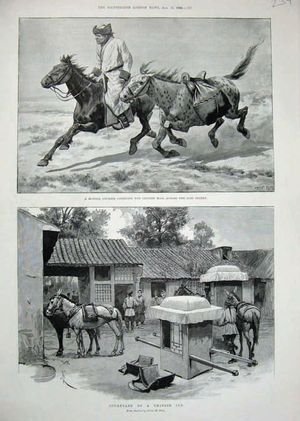
For a long time, mounted couriers carried information, orders, and reports. This must have been an extremely important task if, immediately after being elected Khan, Genghis appointed 4 men at his court (which was still small at the time) to carry it out, whom he often used. In case of the need to change mounts, couriers received them from the Khan’s subjects or vassals. Over time, the number of messengers grew, but according to existing customs, the population of the areas they passed through continued to provide them with food, horses, and other means of transport.
The territorial development of the empire, long military expeditions, and the increasing intensity of contacts meant that the number of people traveling across the vast lands was growing at an incredible rate. On more frequented routes, couriers could not move fast enough due to increasing supply difficulties, a shortage of interchangeable means of transport, etc. In this situation, Ogedei, under the influence of Chinese advisors, decided to organize a system of courier stations, which were to bring a reduction in burdens to the subjects and facilitate service for the couriers. The lengths of the routes were measured, they were divided into sections, and courier stations were located at specific points. From individual mingans located throughout the country, heads of courier stations were selected, along with 20 grooms each to handle the courier horses at each station.
In order to keep the means of transport in proper working order, the Khan ordered – “If a short rope is missing from the courier horses, draft oxen, and carts to the measure we have set, the culprits shall be subject to the punishment of having half their lip cut off! If a spoon or an axle is missing from a cart, the culprits shall be subject to the punishment of having half their nose cut off!”.
The stations covered a huge territory in the 13th century, stretching from Manchuria to Cambodia and from Korea to Eastern Europe.
The article comes from the magazine “Logistyka” 1/2012.