








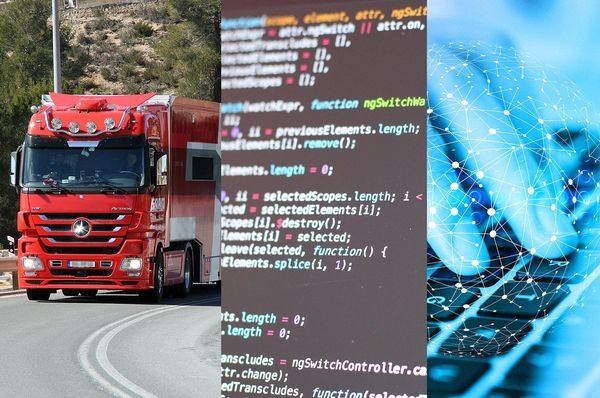
Process automation, blockchain, VRP algorithms, hyperloop, mobile applications, Big Data, sensors, Internet of Things – this is the new reality of the TSL market. The future of transport is now technology, with a capital T.
The algorithm of change – then and now
The days when forwarders or logistics specialists used landline phones and printed maps are gone forever. The route plans and travel schedules created back then required a lot of preparation. And although the TSL sector is now eager to use innovative solutions, as recently as the mid-90s, technologies that are considered obvious today did not exist in common use: mobile phones, GPS, the Internet, transport exchanges, email inboxes. Thus, access to information was significantly limited. How, then, did the TSL specialists of the past manage?
– The foundation was landline phones and faxes based on single telephone lines. The main aspect of the cooperation had to be mutual trust, and the potential quality of a newly established business relationship was verified only in practice. These are times that many industry specialists do not even remember anymore – comments Łukasz Wojciechowski, CEO of ENPIRE. – Currently, the ability to acquire and analyze information fosters business development. Operational work is supported by intelligent technologies that facilitate communication between the driver, the forwarder, and the client. Telematics is changing the face of the TSL sector to such an extent that the industry may undergo a complete transformation over the next ten years.
Technological boom
In the era of digitalization, modern data flow systems have taken on a key role. In recent years, they have generated higher economic value than global trade in physical goods. Data can be collected in various ways, including GPS systems, IoT sensors, email, social media, mobile applications, etc. Big Data allows for their analysis, and the results obtained provide the opportunity to implement better solutions. Modern technologies enable the automation of many functions essential in the transport process. This can be both the control of information and document flow, as well as regulating the temperature in a refrigerated truck or determining the location of a vehicle. There is a lot of talk about using VRP (Vehicle Routing Problem) algorithms, which is a tool that enables automatic transport planning. It takes into account various parameters, e.g., route optimization in terms of distance, vehicle specifics, or driver availability. The system allows for reducing returns, limiting mileage, and saving fuel. The e-map function can react in real-time, providing the driver with information about road difficulties or the dispatcher with information about a probable delay.
The topic of distributed databases, i.e., blockchains, also attracts attention. What is their task? BCs accumulate data from many sources (e.g., they can collect information regarding the origin, composition, expiration date of products, the route they have traveled, invoice data) and then send them to virtual databases that are stored in the network and encrypted using special cryptographic algorithms. Importantly, blockchains do not need central computers or a controlling unit.
The dynamic development of e-commerce also has a major impact on the current situation of the transport market. The increase in the number of transactions places TSL as a component of this market in terms of both courier shipments, on-demand delivery, and B2C services. The industry faces the challenge of implementing innovations that will satisfy the needs of virtual consumers, i.e., ensure fast delivery at relatively low service costs.
The new is coming
With the rapid development of technology, the current shape of markets is changing. New transport solutions are being tested, the dimension of which goes far beyond the phase of previous imaginings. In recent years, there has been much talk about the hyperloop project, which is a prototype of a new form of passenger and freight transport. The venture is called Hyperloop One and is funded by billionaire Elon Musk, who plans to build an innovative transport system based on the idea of capsule movement in a vacuum.
The Internet of Things (IoT) is gaining popularity – its concept assumes the creation of a global network of connections between various types of devices, the goal of which is communication and the collection and mutual transfer of information. In the TSL sector, this boils down to, for example, real-time vehicle monitoring or “communication” between an intelligent warehouse and a truck.
Soon, on the threshold of entering the market, are autonomous AV vehicles, which are a hot topic at many industry conferences. Cars straight from the future have just left the science fiction section and are entering reality. Designers are conducting advanced tests of unmanned trucks – remotely controlled, but with plans to gain complete independence from operators in the future. Intelligent trailers are being constructed, containing separate GPS sensors and collecting data on routes taken, loading, and unloading. Warehouse facilities can gain automatic identification of products and raw materials based on barcode and DataMatrix reading, electronic data interchange (EDI), radio frequency identification (RFID), and support from intelligent software using mathematical algorithms. All this creates a new, technologically advanced face of the transport of the future.