









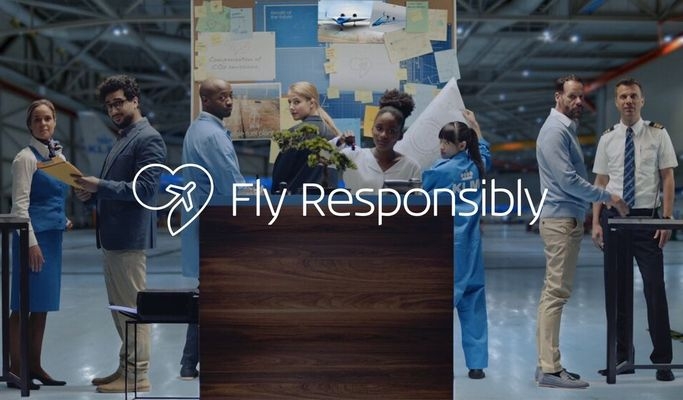
KLM Royal Dutch Airlines will replace one of its daily flights on the route from Brussels to Amsterdam (Schiphol Airport) with the Thalys high-speed train. From March 29, 2020, some KLM passengers will travel by train instead of flying. This is the first step in a long-term plan to reduce the number of short-haul flights, which KLM is implementing together with rail operators – Thalys (the operator providing rail connections between the Netherlands, Belgium, France, and Germany using TGV trains) and NS Dutch Railways. Since June this year, KLM has been calling on customers and the entire aviation industry to travel responsibly (“Fly Responsibly”) with the impact on our planet in mind. The decision to replace the aircraft with a train is proof of how the airline is putting its mission into practice.
KLM has begun implementing the principles of its eco-friendly “Fly Responsibly” strategy, within which it encourages its customers to carefully choose their mode of transport depending on the travel distance. The carrier advocates replacing short-haul flights with rail services, provided that the train meets the requirements of air passengers in terms of speed, reliability, and travel comfort.
The first step is the decision to reduce the frequency of KLM flights from five to four per day on the Brussels – Amsterdam Schiphol route in favor of an improved rail journey on board Thalys and the integration of rail and air services – “Air & Rail”. KLM intends to gradually reduce the number of flights between Brussels and Schiphol Airport in order to replace them with the train. The Brussels – Amsterdam Schiphol route is most often used by passengers who transfer in Amsterdam to KLM’s intercontinental flights.
– Intermodal transport, i.e., transport involving several modes of transport, which in our case is a combination of train and aircraft, is a complex and demanding activity. Speed is of key importance, not only of the train journey itself but also the entire transfer process at the airport. Our goal is maximum progress in both areas. Reducing the frequency of flights between Brussels and Amsterdam from five to four per day in favor of the train is an opportunity for us to gain experience and continuously improve our Air & Rail services – said Pieter Elbers, President and CEO of KLM.
KLM’s decision is dictated by several important reasons and conditions. Firstly, the gradual replacement of air travel with rail on short distances is an action towards creating a sustainable future for air transport, to which the carrier committed in June this year by announcing the “Fly Responsibly” strategy. Secondly, this step reflects KLM’s commitment to the industry’s “Smart and Sustainable” plan, under which the entire Dutch aviation sector aims to reduce CO2 emissions by 35% by 2030. Thirdly, the carrier must face the limited capacity of its base airport, Schiphol in Amsterdam. Restrictions on takeoff and landing permits (so-called slots) mean that airlines must carefully manage their flight network. By replacing short-haul flights with rail services, KLM will be able to allocate the available pool of permits to intercontinental flights. Railways will act as a “feeder” to the Amsterdam Schiphol transit airport, and KLM’s global flight offer will continue to be enriched with a wider choice of intercontinental destinations.
The “Air & Rail” service can be booked via KLM.com and travel agencies. To ensure smoother transport integration, KLM, Thalys, Dutch Railways, and Schiphol Airport are working to improve baggage handling and other services. A special “Air & Rail” check-in desk will also be created at Amsterdam Airport.
About the “Fly Responsibly” program
“Fly Responsibly” is a long-term initiative that KLM announced in June this year – exactly 100 days before its centenary. Under the “Fly Responsibly” banner, KLM wants to act at the forefront of the entire industry to revolutionize the aviation of the future in the context of its impact on the natural environment. Feeling responsible for the industry, as the oldest airline in the world, the carrier has set its mission as a leader of change towards sustainable aviation of the future, inviting other airlines, customers, shareholders, and the entire industry to cooperate. The program includes all of KLM’s existing and planned actions to minimize the impact of aviation on the natural environment – work on reducing CO2 emissions, investments in sustainable fuels, CO2 compensation programs for individual and corporate customers, and even the V-Flying aircraft of the future project. More importantly, it assumes the exchange of know-how and broad cooperation of the transport industry, because real progress can only be achieved if the entire sector works together.