








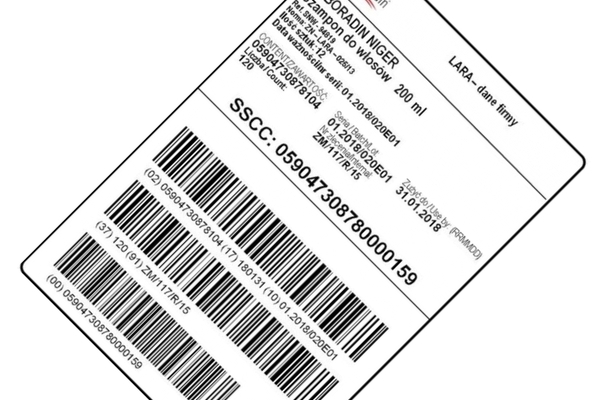
The requirement for traceability has been known to companies in the food and nutrition sector for many years. Since July 2013, the cosmetics industry has also been obliged to collect information for traceability purposes. This article describes how a cosmetics company can manage traceability in the context of the entire flow process from raw material to finished product.
Traceability is the ability to track (reconstruct the history of) the flow of goods in supply chains and networks, along with the registration of parameters identifying these goods and all locations involved in the flow. Ensuring the safety of products placed on the market involves recording and collecting data about them at every stage of the supply chain, i.e., at the level of each enterprise participating in that chain. The most important legal requirements for supply chains in the cosmetics industry result from Regulation (EC) No 1223/2009.
Case study
In the second half of 2015, the company LARA Edyta Pawluśkiewicz, owner of the Seboradin brand, obtained funding for the implementation of an Innovation Voucher. The voucher concerned improving the company’s production process through the use of innovative product identification, and the project implementation was supported by the Institute of Logistics and Warehousing. The primary goal of the project was to develop a concept for managing traceability from production to the distribution of finished products, taking into account the use of GS1 standards and automatic identification. The reasons for implementing solutions related to traceability management using GS1 standards in the case of the described company were as follows:
– the need to change the existing method of entering and collecting information regarding production batches – manual data entry on invoices
– improving control and automating data flow between the company office and production located elsewhere
– lack of automation in warehouse operations
– improving the entire traceability process using funds from the innovation voucher.
Project implementation description
The area subjected to design work concerned the flow: from raw materials to finished products and the information associated with them. The flow of information occurs from the moment of entry into the production process, through production output, warehousing, to the picking and release of finished products. Conducting a process analysis made it possible to compare the current efficiency of selected processes with the efficiency after the introduction of changes. Thanks to this, based on the results of the study, the company was able to estimate the benefits of the introduced changes even before their implementation. In addition, the results of the process analysis enabled the development of a dedicated concept for handling the traceability process. The research carried out at the company was based on the use of the BPMN 2.0 standard described by the ISO/IEC 19510 standard. The BPMN (Business Process Model and Notation) standard is currently the most popular tool for describing business processes, applicable in any industry.
The article contains 9870 characters.
Source: Logistyka Magazine