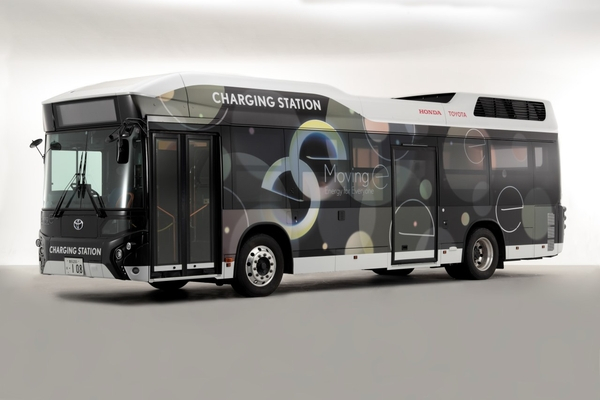
Traveling by bus? Not only… The Toyota FC Bus hydrogen bus, equipped with additional hydrogen tanks and a set of portable energy storage units and chargers, will be used to power evacuation centers during natural disasters.
Japan is a high-risk country – earthquakes and typhoons are a constant threat here. During such disasters, a common problem is the lack of electricity resulting from damage to the transmission network, which affects residents, crisis response centers, evacuation centers, and emergency services alike. 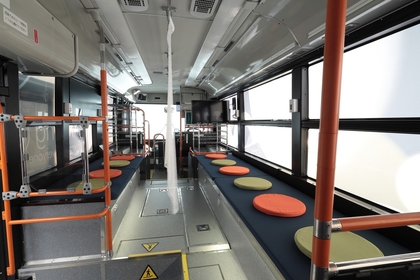 Toyota and Honda, wanting to address this, have combined their technologies and jointly developed the Moving e mobile emergency power generation and supply system, which can provide a power source wherever aid is organized during an emergency.
The system is based on a fuel cell electric bus called the Charging Station, which is a kind of charging station on wheels. It is equipped with a large supply of hydrogen as well as portable chargers and batteries that can be taken into a room requiring emergency power. Electricity for charging the batteries is generated in the vehicle’s fuel cells.
Toyota and Honda are just beginning tests of the system to see if it can provide a convenient source of emergency power anywhere and at any time. The bus has two portable external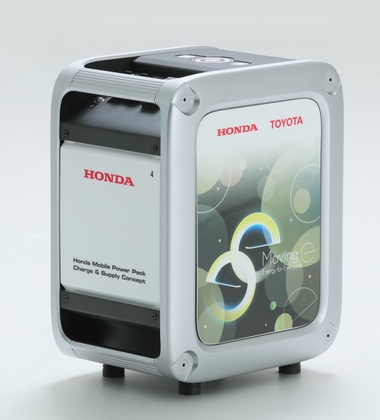 Honda Power Exporter 9000 output devices, 56 portable Honda batteries, including 20 LiB-AID E500 units and 36 Mobile Power Pack (MPP) batteries, as well as 36 Honda Mobile Power Pack Charge & Supply Concept bidirectional chargers for MPP batteries. The Charging Station was developed based on the Toyota FC Bus city bus, which went on sale in 2016. Its second generation, called Toyota SORA, hit the market in 2018.
In the Moving e program, the vehicle has been equipped with twice as many hydrogen tanks, which have increased its energy generation capacity to 454 kWh and the power of the system for external loads to 18 kW. The high power and energy capacity mean that the Moving e system can serve as a power source for evacuation centers and as storage for energy generated by the fuel cells, which are the main component of the vehicle’s powertrain. The Charging Station will operate within a 100 km radius of the hydrogen bus refueling station, providing between 240 and 490 kWh of energy, depending on the distance traveled to and from the hydrogen refueling point. It is not just a mobile generator – it can also provide shelter and a place to sleep for evacuated people.
Source: Toyota
Read more about the use of hydrogen:
– Toyota and PGNiG implement a hydrogen program
– HYFLEXPOWER – energy storage in the form of hydrogen
We write more about the transport of the future in the magazine Logistyka 4/2020.
The e-edition of the magazine is available in our offer!