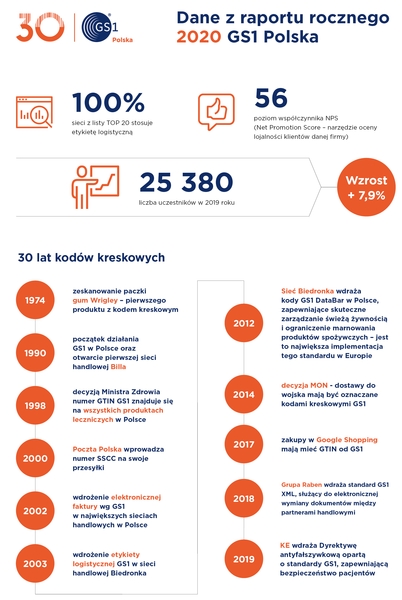
The GS1 Poland anniversary annual report summarizes 30 years of GS1’s existence in Poland. The publication describes in detail how global standards are used and presents the benefits of their application for companies – product traceability and improvements in production and logistics chains.
– GS1 standards constitute the global language of business. 2 million companies worldwide already use our solutions, and over 100,000,000 products have a GTIN number. International know-how helps, but it also obliges. The goal of GS1 is to help Polish companies implement global standards – comments Jarosław Gulowaty, Director of Contract Logistics at Fresh Logistics Poland, Chairman of the GS1 Poland Council.
Data-driven retail
In retail, the use of a unique identifier has enabled seamless, unattended omnichannel sales (e.g., at Bio Family). The GS1 system also allows for tracking individual stages of food production (e.g., at Winnica Turnau and Sushi Factory), exchanging data between suppliers on a global scale (as at Carrefour), and reducing food waste (as in the Żabka chain).
In online retail, the GTIN from GS1 makes it easier for products to be found via search engines and also allows for the detection of counterfeit products. The GTIN (EAN code) ensures a 20% increase in website conversion rates and a 40% increase in the click-through rate of offers. It is no wonder, therefore, that EAN codes have become a market standard in the most popular Polish online stores and marketplaces, such as Allegro, EMPIK, eMAG, and global ones like Amazon.
– Paraphrasing the famous quote “data is the new oil,” we – as GS1 – say that standardized data is the fuel driving the digital economy. Jointly used standards in identification and communication in supply chains have never been as important as they are today – says Dr. Eng. Elżbieta Hałas, member of the GS1 Poland board.
Codes for process efficiency and safety
The annual report describes the application of GS1 standards in the areas of: consumer goods, e-commerce, TSL, healthcare, industry, the military, and administration. The authors of the report show the significant impact that codes have on process automation and the increase in information transparency throughout the supply chain, citing specific implementations, including at PEKAES.
The use of automatic identification based on barcodes is increasingly entering state administration. From January 1, 2021, the National Bank of Poland will introduce the GS1 standard for cash transport in banks and at the Polish Post. GS1 standards are already mandatory for suppliers of orders for the Polish army.
GS1 standards support not only process efficiency but also safety. This latter aspect is particularly important in healthcare. GS1 DataMatrix is the foundation for implementing the so-called Falsified Medicines Directive.
The number of participants is still growing
Digital data improves business processes, and skillful processing of it provides a competitive advantage. Companies recognize these benefits, which is why 4,223 new companies registered in the GS1 Poland System in 2019, including 426 that decided to implement electronic data interchange.
– The role of GS1 Poland is to support Participants in increasing their competitiveness and foreign expansion through GS1 standards and knowledge about global trends. That is why the anniversary report not only presents standards and solutions but also the opportunities we give our Participants to follow these trends – concludes Joanna Redmer, President of the GS1 Poland Foundation.