









The year 2025 brought a continuation of the structural changes that have been gradually transforming the landscape of Polish rail freight for several years. Against the backdrop of dynamic passenger traffic growth, the cargo sector has found itself in a situation requiring the adjustment and redefinition of its operations. Full-year data collected by the Office of Rail Transport (UTK) clearly show that Polish rail freight has entered a transitional period in which traditional market pillars — primarily energy raw material transport — are losing importance, giving way to more diverse commodity groups related to industry, construction, chemicals, and container logistics.
In 2025, approximately 217.8 million tons of cargo were transported, representing a 2.5% decrease compared to the previous year and the lowest result since at least 2012. Transport performance also decreased, reaching 56.2 billion ton-kilometers, which is over 2 billion less than in 2024. This decline — of 3.5% — confirms that the domestic economy, based on the transport of bulk raw materials, has entered a new phase in which previously dominant commodity groups are no longer able to generate historical volumes. At the same time, the data indicate that while the market did not grow in terms of quantity, it underwent a clear qualitative transformation: carriers are increasingly participating in complex supply chains rather than in the transport of homogeneous, bulk loads such as fuels, aggregates, or ores.
The largest commodity group in 2025 consisted of energy raw materials, although their share continued to decline. Hard coal, lignite, oil, and gas reached 63.94 million tons, which is 0.3% less than the year before. Particularly noteworthy was the decline in hard coal transport volume to 29.7 million tons in the first half of the year — for the first time in UTK statistics, it fell below the 30 million ton level. On an annual basis, this decline was not sharp, but it confirmed a steady trend resulting from the energy transition and the reduction in domestic extraction. Similarly, the group of metal ores and mining products recorded a noticeable decline to 58.57 million tons, or 6.2% less year-on-year. This was the result of lower demand in the infrastructure industry and limitations related to industrial raw materials, although it remains a segment with one of the highest shares in transport performance, especially due to long-distance transport of ores and aggregates.
Segments related to construction and manufacturing behaved quite differently. Building materials — especially cement, lime, gypsum, and other non-metallic products — recorded strong growth of 13.7%. The volume of basic metals and metal products also grew, reaching 10.52 million tons, an increase of nearly 10%. The observed changes suggest that despite the economic slowdown in some branches, many companies remain stable recipients of rail transport services, and the logistics services market is beginning to reflect the diverse needs of manufacturing industries to a greater extent.
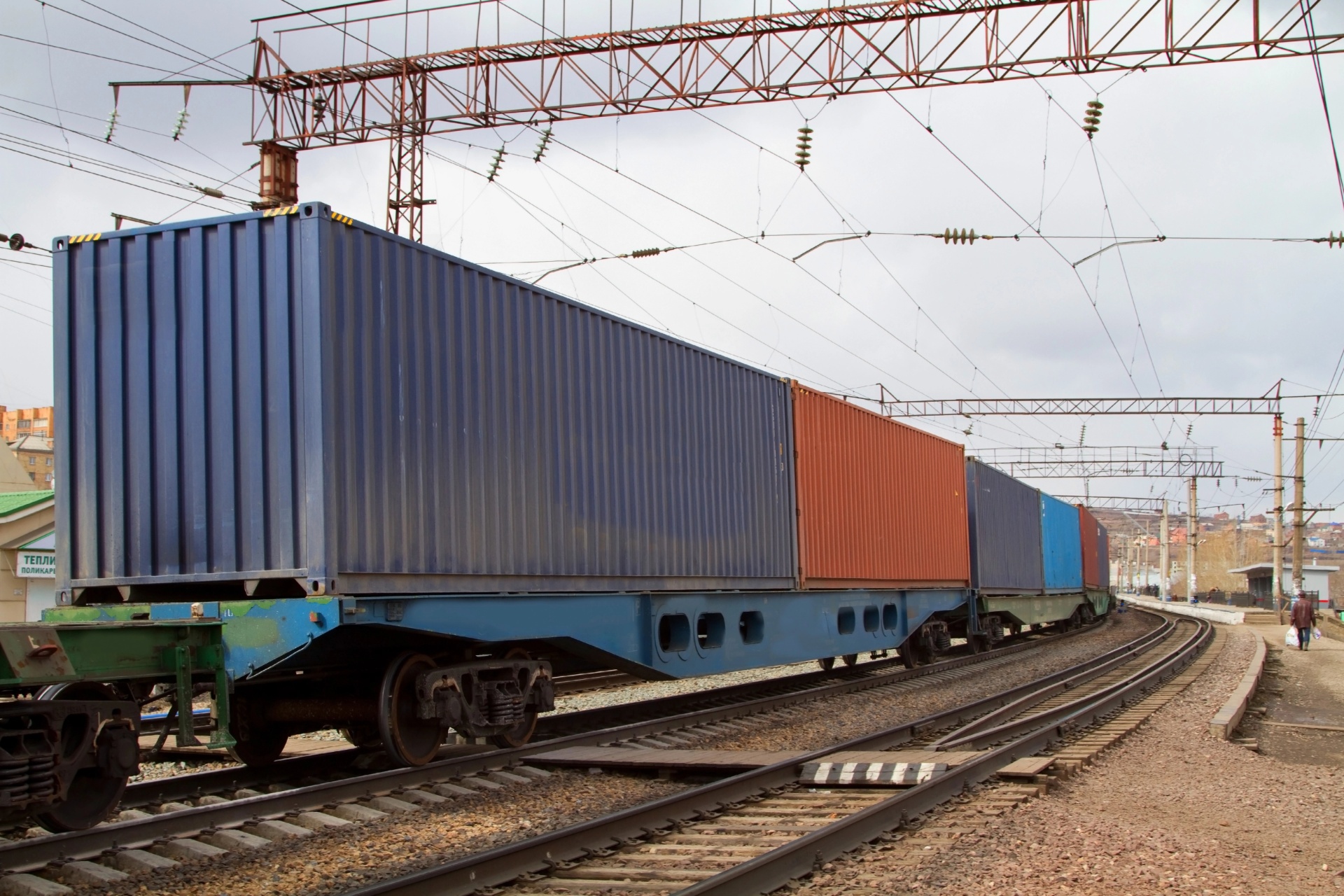
The chemicals and plastic products sector (10.66 million tons) also played an important role. One of the most dynamically developing groups remained intermodal transport, largely classified as unidentifiable goods (section 19). It maintained its high 2024 result, reaching 22.71 million tons, which translates into a more than 10% share of the total mass. Intermodal transport also remains one of the key pillars of transport performance.
Trends in change were also visible in the structure of international communication. Transport in exports, imports, and transit accounted for a total of 35.4% of the mass and as much as 45% of the entire market’s transport performance. This means that rail in Poland functions as an element of European supply chains, and the domestic logistics sector benefits from Poland’s geographical location, acting as a key transit corridor. Imports remained dominated by containerized cargo, metal ores, and fuels, while exports were dominated by oil refining products, chemicals, and containers. Transit, in turn, was characterized by a strong concentration on container transport and energy raw materials.
Polish rail freight is currently facing the necessity of adapting to new market conditions. The shrinking of raw material transport requires a redefinition of the business model, the development of logistics services, the improvement of capacity, digitalization, and greater cooperation with road, maritime, and inland waterway transport. The importance of data integration, predictability, competitiveness, and simple access to last-mile infrastructure is growing, as is the need for investment in terminals and transshipment points. Rail must become not only an ecological but, above all, an effective and convenient choice for the customer. The year 2025 shows that the direction of change is already clearly set — now its consistent implementation will be key.
– comments the President of the Office of Rail Transport, Dr. hab. Eng. Ignacy Góra.
Transport of cargo groups in the 4th quarter of 2025
The 4th quarter of 2025 proved to be clearly better for rail freight than the previous months, confirming the sector’s return to a growth path after a weaker 3rd quarter. In the last three months of the year, 57.22 million tons of cargo were transported, which means an increase of over 1.6 million tons compared to the previous quarter and a result slightly higher than in the corresponding period in 2024. At the same time, transport performance increased to 14.75 billion ton-kilometers. The average transport distance of one ton fell slightly quarter-on-quarter — to 257.8 km, which is the result of an increased share of bulk cargo transported over shorter distances.
The fuel and energy segment contributed most to the growth in the 4th quarter. Transport of coal, oil, and gas increased by as much as 1.95 million tons, reaching 17.75 million tons. This is the result of increased demand for energy raw materials and the traditionally intensive winter season. Transport of agricultural goods also grew strongly, reaching 1.39 million tons — 0.5 million tons more than in the 3rd quarter — which fits into the seasonal increase in supply and exports. Growth also continued in the segment of unidentifiable goods, which increased by another 560 thousand tons, confirming the growing role of rail in servicing logistics chains. The category of coke and oil refining products (+280 thousand tons) and metals and metal products (+75 thousand tons) also developed stably.
Conversely, the transport of metal ores and other mining and quarrying products negatively affected the result of the entire quarter. The group of metal ores and other mining and quarrying products recorded a decline of nearly 2 million tons, which was the largest regression in the commodity structure, simultaneously contributing to lowering the average transport distance — as this is a segment carried out on long routes in the case of the iron ore subgroup. Smaller volumes compared to the 3rd quarter were also recorded in the transport of building materials (–187 thousand tons) and secondary raw materials (–138 thousand tons).
In an annual perspective, the 4th quarter of 2025 was stable and slightly better than the year before. The mass of transported cargo was 218 thousand tons higher than in the 4th quarter of 2024, and transport performance increased by over 338 million ton-kilometers.
Detailed data on the transport of cargo groups are available in the study Cargo groups in 2025 and on the website dane.utk.gov.pl.
Source: Office of Rail Transport