









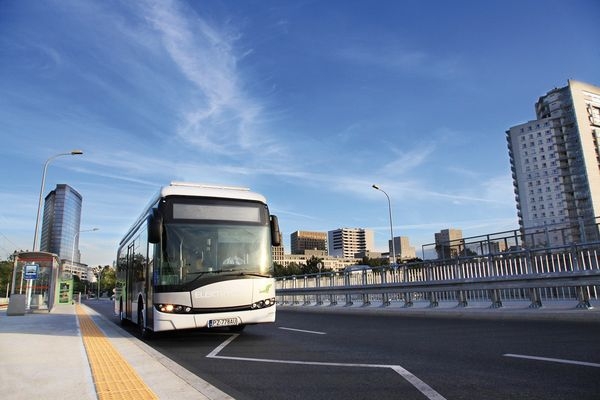
The Regional Blood Donation and Blood Treatment Center in Katowice has signed a contract with Solaris for the delivery of two mobile blood collection units based on electric Solaris Alpino 8.9 LE buses. This is the first order of its kind in the world, which will be completed by the end of 2018.
Both zero-emission ambulances for Katowice will be equipped with a 160 kW electric drive and 160 kWh batteries, which will guarantee six hours of operation while stationary with medical equipment running, as well as a range of at least 120 kilometers per day.
The interior of the buses will be arranged according to the wishes of the Regional Blood Donation and Blood Treatment Center and will be adapted to the needs of blood collection and storage. In addition to special blood donation chairs, it will include: a doctor’s office, ambulatory equipment, a reception area, and a small catering area. Blood donors will be able to use, among other things, a heated and air-conditioned passenger space, USB ports mounted by the seats, and Wi-Fi. Additionally, for the comfort of those donating blood, the vehicles will be fitted with features such as blinds, external awnings, and LED lighting. In addition to the buses, Solaris will also supply the Regional Blood Donation and Blood Treatment Center with devices for charging the energy storage systems.
The history of cooperation between Solaris and the Regional Blood Donation and Blood Treatment Center is long and has lasted for over 20 years. The first special-purpose vehicle produced in Bolechowo – a mobile blood collection station based on a tourist coach – left the factory in 1996. Subsequent contracts were carried out in 2002 and 2009. The Vacanza 13 model used for this purpose even received a special distinction at the TRANSEXPO International Fair of Public Transport. The latest contract is an excellent example of how many applications vehicles with electric drive can have. This is yet another order in Poland for emission-free buses, confirming the growing interest in electromobility in our country. They are favored not only by lower operating costs or almost complete noise reduction, but also by a drive that does not emit exhaust fumes. Such ecological qualities will be particularly important when operating mobile blood collection points, which are intended to enter strict city centers or places where festivals or mass events are held.