








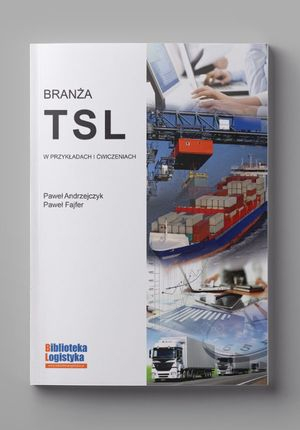
Authors: P. Andrzejczyk, P. Fajfer
Price: 49.00 PLN
Description:
“The TSL Industry in Examples and Exercises” is a comprehensive collection of examples and tasks addressed to all those who associate their professional future with the TSL (Transport-Forwarding-Logistics) industry. Each thematic block opens with a short theoretical introduction. Subsequently, the authors propose several examples illustrating a given problem. Then it is time for tasks enabling independent work. Students can create their own documents and fill in the attached forms (worksheets) containing tasks for independent solution. In this way, the teacher can assess the level of knowledge and skills. The last part of the collection consists of cross-sectional tasks. In them, you will find a description of specific situations occurring in various logistics processes. Solving the tasks will allow readers to understand the problems that both logisticians and forwarders encounter in their daily work.
Year of publication: 2016
ISBN: 978-83-63186-41-8
Volume: 260 pages
Table of Contents:
From the authors
1. Cargo formation
1.1. Cargo unit
1.2. Cargo unit – formation of homogeneous loads
1.3. Cargo unit – formation of heterogeneous loads
1.4. Formation of cargo units – cylindrical objects
1.5. Cargo formation from palletized cargo units on external means of transport
1.6. Formation of bulk cargo
1.7. Cargo formation in containers
1.8. Knowledge and skills test
2. Handling activities in transport processes
2.1. Determining the number of transshipment points and their parameters
2.2. Time of an exemplary single average forklift work cycle
2.3. Unloading time of an external means of transport using a front forklift
2.4. Determining the number of internal transport means
2.5. Cargo handling and cargo marking in transport processes
2.6. Knowledge and skills test
3. Drivers’ working time
3.1. Drivers’ working time – introduction
3.2. Drivers’ working time for a single-person crew – starting point
3.3. Drivers’ working time for a single-person crew – without extending driving time and shortening daily rest
3.4. Weekly driving time and rest
3.5. Drivers’ working time for a single-person crew – deviations from basic rules
3.6. Drivers’ working time for a two-person crew
3.7. Knowledge and skills test
4. Transport and forwarding documents
4.1. Basics of developing transport and forwarding documents
4.2. Documents accompanying forwarding – request for quotation
4.3. Documents accompanying forwarding – forwarding order and transport order
4.4. Documents accompanying forwarding – shipping instructions
4.5. Documents accompanying forwarding – forwarding contract
4.6. Documents accompanying road transport – domestic consignment note
4.7. Documents accompanying road transport – international consignment note (CMR)
4.8. Documents accompanying rail transport – domestic rail consignment note
4.9. Documents accompanying rail transport – CIM consignment note
4.10. Documents accompanying rail transport – SMGS consignment note
4.11. Documents accompanying water transport – Bill of Lading
4.12. Documents accompanying air transport – Air Waybill (AWB)
4.13. Invoice
4.14. Knowledge and skills test
5. Transport planning
5.1. Transport service costs
5.2. Calculating distance, time, speed. Online maps
5.3. Calculating capacity
5.4. Allocation methods
5.5. Knowledge and skills test
6. Cross-sectional tasks in examples
6.1. Cross-sectional task 1
6.2. Cross-sectional task 2
6.3. Cross-sectional task 3
6.4. Cross-sectional task 4
6.5. Cross-sectional task 5
6.6. Cross-sectional task 6
6.7. Cross-sectional task
7 Learning outcomes