








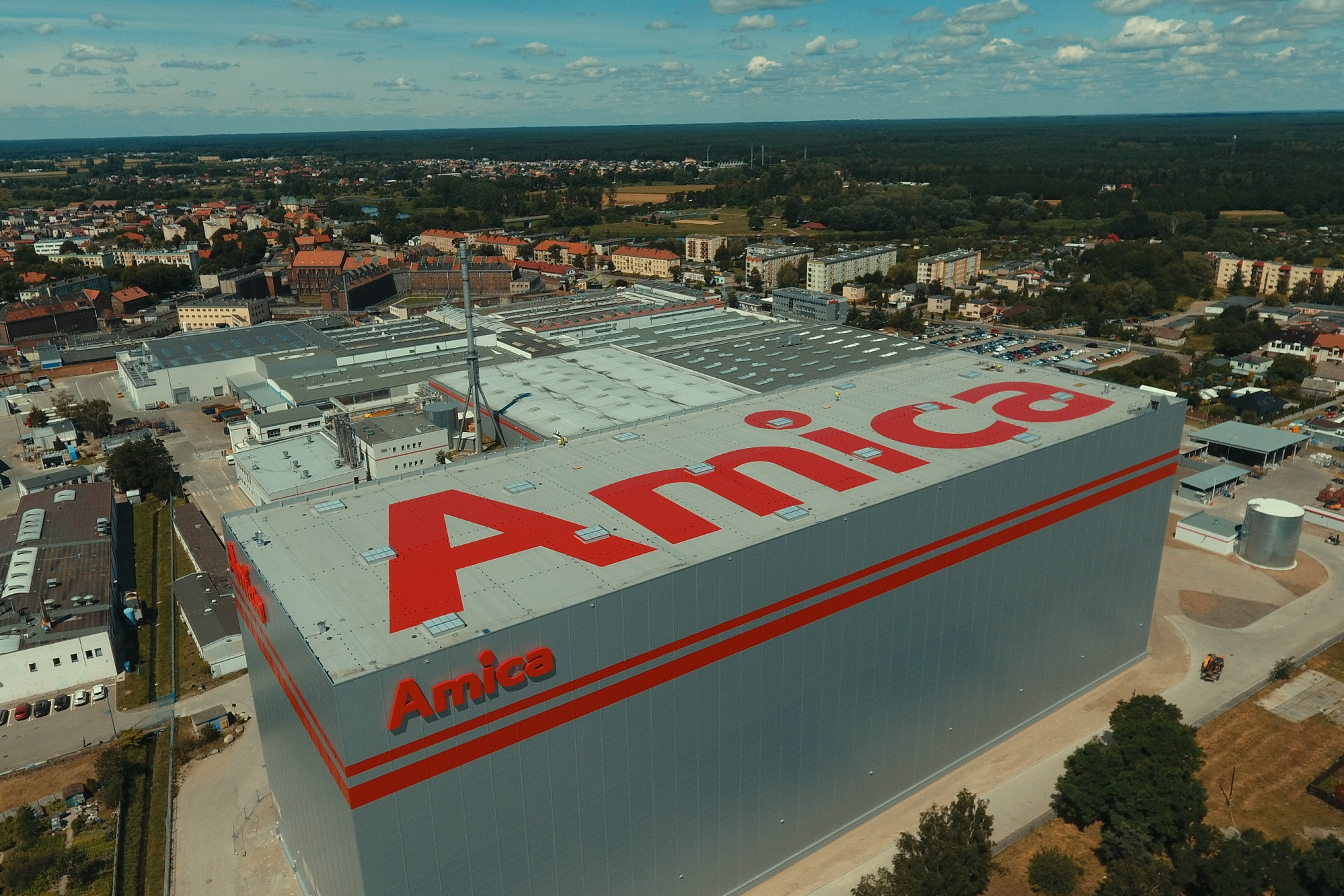
In 2023, it has been 6 years since the creation of the tallest high-bay warehouse in Poland. Compared to traditional warehouses, this investment is more ecological, safer, and requires less labor, while customers receive their orders faster. All this is supported by artificial intelligence, which ensures full automation. The warehouse is a structure over 46 meters high. It can be compared to a 15-story residential building. On 6,500 square meters, there are 26,000 pallet spaces that can hold up to 230,000 large household appliances at once.
Warehouses of this type have been used in Europe for a long time, but in the Polish household appliance industry, no one had previously applied such innovative solutions on such a massive scale. To date, no one has managed to repeat this success. A huge change is the way goods are arranged. Household appliance manufacturers store goods in blocks, and forklifts can pick up several products at once. Usually, warehouse halls cannot be too high due to the durability of the packaging. Equipment stacked on top of each other, without additional protection, could be damaged. Amica decided to introduce a completely new solution.
– The Amica warehouse stands out on the market; despite being built in 2017, it is still extremely modern. Before deciding to build it, there were practically no comparable automated warehouses in the industry, which made our solution innovative and required defining almost all processes from start to finish. Starting from stacker cranes equipped with cameras to prevent damage to racks and goods, through the MCC system that manages the operation of stacker cranes, conveyors, issuing and receiving goods, to continuous inventory management – explains Robert Stobiński, Vice President of the Management Board for Operations at the Amica Group.
The warehouse in Wronki consists of five stacker cranes, nearly 47 meters long, which place goods in the appropriate locations. They are the most important element of the warehouse, as they handle the distribution and delivery of pallets with goods at a speed of 180 meters per minute horizontally and 80 meters per minute vertically.
Full automation
The throughput of the high-bay warehouse allows for the release of over 180 pallets per hour and the receipt of approx. 120. A fully automated, self-managing control system allows for the stacking of about 1,600 items per hour. Annually, this provides the capacity to receive up to 280,000 pallets! These are millions of products that reach dozens of markets around the world. The entire high-bay warehouse is operated by only one person. The warehouse operates practically without interruption, which has also benefited customers, as delivery times have been shortened by at least 24 hours, and often even by 48 hours.
Safety and ecology
The use of machines also means that most work is done without physical human involvement, which increases the level of safety. According to the assumptions, the innovative high-bay warehouse was primarily intended to be safe. The ground was therefore reinforced with 20 km of concrete piles. Some of them reach as deep as 18 meters into the ground. High-quality materials were also used. Thanks to these measures, the warehouse is resistant to winds with speeds of up to 150 km/h. Never before in history have such strong gusts of wind been recorded in this area. The warehouse also has its own alternative energy source, and for safety, 26,000 sprinklers have been installed to protect against fire. In the event of any failure, a team of specialists with mountaineering qualifications is also present on-site, capable of performing necessary repairs at great heights.
The design of such a huge investment also took into account the comfort of the residents. The Amica Group facility does not generate noise or any kind of pollution. Even before launching the new warehouse, the company introduced transport scheduling to avoid intensifying truck traffic. An online vehicle scheduling system was launched. At least twelve hours before loading, the system automatically begins to bring down pallets with ordered products from the high-bay warehouse. In this way, it was also possible to reduce a large part of the carbon footprint by eliminating transport to an external warehouse, which protected local residents from air pollution and road congestion.
The Amica Group is a leading European manufacturer of household appliances with over 70 years of experience. Its offer includes a full range of smart large and small household appliances, distinguished by useful solutions, the latest technology, and modern design. The group’s portfolio includes the brands: Amica (Central and Western Europe), Hansa (Eastern Europe), Gram (Scandinavia), CDA (Great Britain), and Fagor (Spain). It employs over 3,000 people worldwide, thanks to whom it delivers approx. 5 million devices annually to customers in nearly 70 markets around the world.
Source: Amica, Q&A COMMS