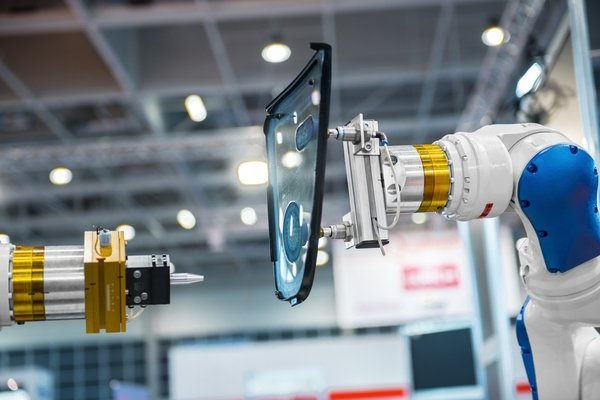
The article presents the essence of robotic solutions in logistics processes based on modern implementations in both industry and the medical sector, including hospitals. The degree of robotization and the benefits of increasing it have been analyzed.
The goal of robotization is to replace repetitive, overly difficult, or dangerous human labor with the work of robots. Robots perform their tasks with greater precision, repeatability, and strength, and what is more, they can work without breaks. Robotization increases productivity and allows for achieving results impossible to obtain by humans. This is the reason for the emergence of concepts and attempts to apply robots in logistics processes.
Directions of development
The main sphere of logistics where robots already have the greatest potential is broadly understood transport, the flow of raw materials, materials, semi-finished products, products, and their packaging. Robots take on the roles of “suppliers,” allowing employees to focus on more effective tasks than transport. Such tasks are handled by mobile robots. They must meet certain conditions:
– they must be able to receive information from the environment,
– work for a long time without human intervention,
– move in an environment allowing a certain level of variability without human help,
– avoid situations dangerous to humans, animals, things, the environment, and themselves.
Mobile robots are becoming increasingly autonomous and complex. By receiving information from the environment and processing it, robots can “learn,” adapt their actions to the changing environment, and receive commands from mobile applications or websites.
Packaging – robots in factories, warehouses, distribution centers, and sorting plants
About 15% of warehouses are mechanized, and only 5% are automated, while the remaining 80% operate without any automation. This means that humans still perform key functions in warehouse operations. In large distribution centers, logistics centers, warehouses, and factories, there can be as many as 1,000 employees whose job is to unload, load, sort, and pack items of non-standard sizes or shapes. For this reason, companies such as DHL and Wynright are working on robots capable of unpacking and packing containers and pallets of products, focusing on optimizing unloading time and the amount of space used. In 2017, DHL and the Finnish technology group Wärtsilä tested mobile, autonomous robots at the Wärtsilä distribution center in Kampen, the Netherlands. The tested mobile robots simplify point-to-point warehousing. The next stage will be looking for technologies that allow for increasing productivity, quality, and safety in the facility. Thanks to the use of modern grippers, arms, measurement methods, and advanced algorithms, the vision of unloading and loading entirely performed by robots is becoming increasingly possible.
The full article is available below in PDF format.
We wrote more about logistics in Economy 4.0 in the Logistyka 1/2018 magazine.
The e-edition of the magazine is available in our offer!