








According to data from the Central Economic Information Center, almost 600 companies went bankrupt in Poland last year [1], 5% of which were enterprises from the transport and warehousing industry. What exactly do these numbers mean and do Polish carriers really have serious reasons to worry?
Failing carriers
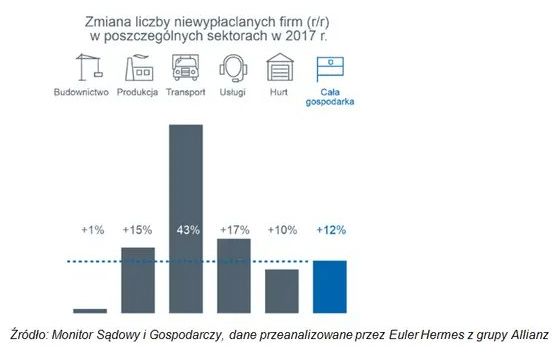
If we take into account other data, for example, information from the National Debt Register, which shows that almost one-fifth of Polish transport companies are in debt for a total amount of almost one billion PLN [2], the situation may indeed seem worrying. The Euler Hermes report [3] is also not very optimistic, showing that among all company bankruptcies, the largest increase, as much as 43% year-on-year, was recorded precisely in the transport industry. [4]
Bankruptcy? What is the problem?
There are several significant reasons for such an unfavorable situation on the market. Firstly, Polish companies, although numerous (about 34 thousand enterprises, according to the Road Transport Inspectorate at the end of 2017 [5]), are mostly small entities, possessing an average of 6 vehicles [6]. In such conditions, it is difficult for them to compete with much larger Western companies [7], if only because of the scale effect. However, other factors are also involved. Problems with the solvency of one large company mean immediate payment backlogs for its subcontractors and contractors [8], which translates into a lack of funds for innovation and fleet modernization. In an era of increasingly stringent legal regulations regarding exhaust emission standards and in connection with the need to adapt to labor laws that differ from domestic realities, this may simply mean the necessity of withdrawing from business.
Another important factor influencing the difficult conditions in the industry is its saturation, which undoubtedly contributes to intensifying competition and falling margins. This leads to a situation where companies do not earn money while constantly incurring high costs. These are generated primarily by rising driver wages, among whom every fifth already earns over 7 thousand PLN [9], although mainly employees handling international transport can count on such a salary. Interestingly, despite a significant increase in remuneration, there is still a shortage of drivers in the transport sector. According to the TransJobs.Eu report, staff shortages may amount to as many as 30 thousand people [10], which forces carriers to raise wages even further, fueling a cost spiral. The increase in fuel prices also contributes to higher operating costs – on an annual basis, the price per liter of diesel has already increased by almost one zloty. [11] A significant factor influencing the deterioration of the economic situation is also the large disparity between incoming and outgoing payment terms. Many companies have to pay “upfront”, while their contractors or subcontractors, often through no fault of their own, can delay payment for up to 120 days [12]. This also translates into difficulties in obtaining loans and funds for development, because banks treat such companies as high-risk entities [13].
Big politics in a small company
A separate category of problems that Polish carriers have to face is a derivative of big politics. For example, the Russian embargo on food products in 2014 [14] cost Polish companies fulfilling contracts beyond the eastern border about 60% of their orders and forced them to move to the west.
– A very serious challenge that our carriers will have to face in the near future is, of course, Brexit. One-quarter of road transport to the British Isles is handled by Polish trucks [15] – says Jakub Ordon, an expert from OCRK. – Divorce from the Union means almost certain customs difficulties at the borders, longer customs clearance times, and a significant increase in costs for carriers – he adds. Local policy also affects market difficulties. At the end of last year, Prime Minister Mateusz Morawiecki, as part of the implementation of the SENT program [16], announced the tightening of road transport through meticulous inspections of tankers entering our country and the elimination of the import of fuel without excise duty.
Difficult, but stable
In view of this state of affairs, one can actually conclude that the transport industry is facing hard times. However, experts do not assess the situation in a completely unambiguous way.
– The data actually show a relatively grim picture, but it should be remembered that despite the often significant problems that carriers have to face, it is still an industry currently employing about 11 million people, with a prospect of 60% growth over the next 30 years [17]. Such a long and optimistic forecast indicates that although it is indeed a difficult market, it is still stable – comments Jakub Ordon from the National Center for Driver Settlement.
[1] http://www.coig.com.pl/files/pliki/rankingi/coig_upadlosci_firm_2017.pdf[2] Economic Information Bureau, KRD according to: https://www.rp.pl/Transport-drogowy/307199850-Towary-jada-pieniedzy-nie-ma.html
[3] https://www.money.pl/gospodarka/wiadomosci/artykul/upadlosci-firm-2017-euler-hermes, 195, 0, 2396867.html
[4] Ibid.
[5] OCRK information
[6] Ibid.
[7] http://www.portalspozywczy.pl/raporty/rosnie-liczba-upadlosci-w-branzy-transportowej, 162992_0.html
[8] https://www.cargonews.pl/upadlosc-i-restrukturyzacja-firm-transportowych-co-nalezy-wiedziec/
[9] https://kadry.infor.pl/wiadomosci/2734931, Zarobki-zawodowych-kierowcow-w-2018-r.html
[10] http://inwestycje.pl/logistyka_transport/-Branza-transportowa-na-finansowej-krawedzi-Ogromny-potencjal-sektora-TSL-oslabiony-przez-klopoty-kadrowe-i-zatory-platnicze;322723;0.html
[11] https://businessinsider.com.pl/finanse/ceny-paliw-w-polsce/h6403mz
[12] https://alebank.pl/branza-tsl-na-finansowej-krawedzi/
[13] Ibid.
[14] OCRK information
[15] https://ceo.com.pl/konfederacja-lewiatan-brexit-zagrozi-polskim-firmom-transportowym-93296
[16] OCRK information
[17] Inwestycje.pl, op.cit.
Source: OCRK