









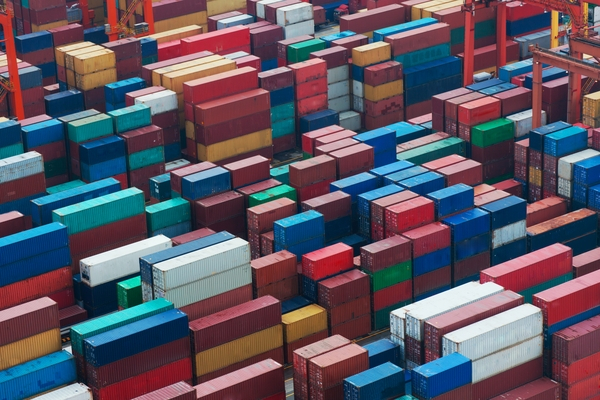
The New Silk Road is an idea to recreate trade routes connecting the Middle Kingdom with Europe and the Middle East using sea and rail transport. In the case of the latter, Poland plays a very important role, acting as a gateway for goods entering the European Union. Our country has a real chance to become a central point on the logistics map of Europe, which would mean dynamic infrastructure development, more jobs, and profits for the state budget. However, more European countries are interested in the project’s leadership position. How should Poland leverage its potential? You will find the answer to this question in the report prepared by Rohlig Suus Logistics, “Poland as a gateway for the New Silk Road – how to seize the emerging opportunity?”
The number of trains on the China-European Union line reaches record levels every year. At the end of 2019, there were 8,825, which means a 40% year-on-year increase. According to Chinese authorities, in the first half of 2020 alone, this number increased again by over 40% compared to the same period of the previous year. Since 2013, the total number of trains has increased a hundredfold!
According to data from the Centre for Economics and Business Research (CEBR), Poland’s GDP could gain as much as $48 billion by 2040 from the implementation of the New Silk Road project. Due to the potential benefits for the state treasury and the development of Polish companies, the New Silk Road should become one of the priority projects for the Polish economy.
Importantly, more and more countries neighboring Poland want to take part in the “race for the Chinese silk train.” An example is Russia, which has launched an intermodal connection to handle New Silk Road goods. Regular daily shipments connecting the Chinese border with Hamburg via Kazakhstan are transported first by rail to the port of Kaliningrad, and from there by sea to Hamburg. Lithuania has been making significant investments in rail infrastructure for years, building one of the largest intermodal terminals in the region in Kaunas. Also significant is the plan to build the largest rail intermodal terminal in Europe in the Hungarian town of Fényeslitke, allowing for rapid transshipment between different types of rail and from rail to road vehicles. Hungary is already the largest recipient of Chinese investment in Central Europe.
A key location for rail transport from China to Europe is the terminal in Małaszewicze. It is here that over 90% of goods imported from China to Europe by rail are currently transshipped. Its operational capabilities are already insufficient today. Expansion is necessary to ensure the ability to quickly handle the flow of goods from China. According to the “Logistics Performance Index” report prepared periodically by the World Bank, which takes into account, among other things, the efficiency of customs clearance, the ease of organizing competitively priced international shipments, and the ability to track and monitor deliveries, Poland is ranked 17th in Europe. Poland achieved its worst results in categories key to transport attractiveness: customs service and infrastructure quality; if the ranking evaluated only these two areas, we would be in 33rd and 35th place, respectively, behind Hungary, the Czech Republic, and Slovenia.
Unfortunately, the infrastructure of the NSR project is not just rail. To act as a logistics hub for Europe, investments in land roads or domestic ports, whose position on the international stage has been growing significantly in recent years, are necessary. It is from Gdańsk and Gdynia that goods can reach the markets of Scandinavian countries or even Great Britain. A very important and long-awaited investment is a central logistics terminal for handling (including transshipment and customs clearance) goods originating from China. Although there is much talk about its construction, it is still unknown when and where such a terminal is to be built.
The full report is available below in PDF format.
The report comes from the website: https://www.suus.com