








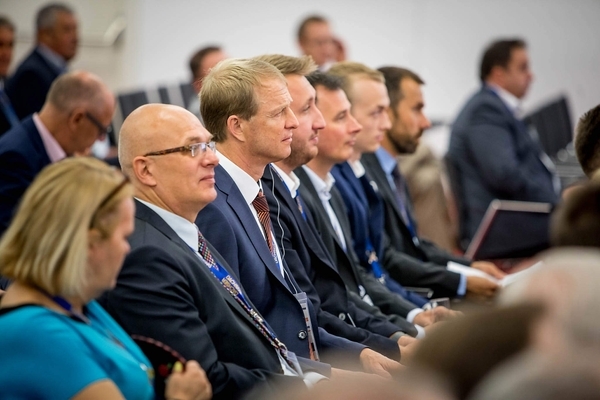
The 14th edition of the Polish Logistics Congress LOGISTICS 2018, the largest event in the logistics industry in this part of Europe, has come to an end. Over 800 participants, speakers, and exhibitors from all over the world came to Poznań to take part in lectures, workshops, business meetings, and an exhibition of logistics products and services.
The main theme of the Congress was digital supply chains, which was a natural extension and development of the topics proposed in the previous edition of the event. The ongoing fourth industrial revolution is based precisely on digitalization – from production through sales to the engagement of the end customer. As a result, not only business models are changing, but also entire supply chains and product offerings. The companies that are most successful in the digital economy are those that can combine multiple sources of value for customers, such as low cost, a positive experience, and a convenient platform for delivering products or services.
– This year’s theme of the Logistics Congress is a search for the answer to the question of what our world will look like in the future, and what changes and processes await us in the coming years – said Mariusz Jedliński, Chairman of the Polish Logistics Society. – We must keep in mind the fact that the only constant element of this future will be real material flows; everything else will move to the digital, virtual world.
Exceptional speakers talked about the future of logistics, such as Professor Hans-Christian Pfohl, representatives of GS1 Poland – Aleksander Niemczyk and Elżbieta Hałas, as well as Artur Kruczyk, General Manager of the Amazon E-Commerce Logistics Center in Poznań – a company that in just a few years has grown from a small garage into the world’s largest sales platform, possessing over 40 giant logistics centers in Europe alone.
– Modern technologies that we are starting to use in logistics, such as drones or robots, are actually the last link, the end result of innovations that begin with ensuring customer satisfaction – explains Artur Kruczyk. – And it is precisely this desire to provide the customer with the best service that is the driving force of innovation and development. But this would not be possible without accepting failures, which are an element of experimentation and are inherent in the nature of introducing state-of-the-art solutions.
Participants in the debate “How can cyber threats slow down the process of supply chain digitalization?” discussed in a similar spirit. All panelists emphasized how important it is for the development of an enterprise, increasing brand trust, and ensuring data security to implement technological innovations such as the Internet of Things, Big Data, machine learning, or the use of blockchain technology in the transport industry, but at the same time, they pointed to the contact points of individual solutions as potential points for data leakage and loss of security of the entire process.
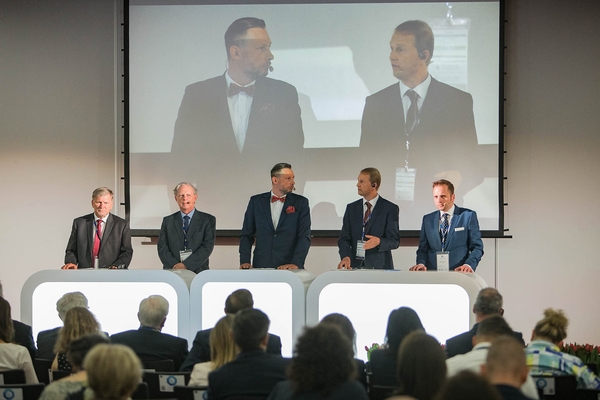
– Logistics requires the cooperation of various systems, but for these systems to be able to communicate with each other and be compatible, we are forced to remove some of the security measures from both one system and the other – and this is the perfect place for a hacker attack – explains Professor Wojciech Cellary from the Poznań University of Economics and Business. – The fear of losing data prevents many companies from entering into modern technological solutions. However, today we should not ask ourselves the question: should we give up innovation, but rather we must consider what risk is acceptable to us.
– Without implementing modern technologies, none of our companies will develop and will not be able to compete in the market. – adds Janusz Gocałek, President of the Management Board of Talex SA. – But our task is also to continuously improve adopted solutions, tighten processes, and ensure increasing security for the transactions that take place through them.
During this year’s Logistics 2018 Congress, one could listen to many inspiring speeches and learn the point of view on the subject of digital supply chains from both the business and scientific spheres. Among the speakers were names that in the world of logistics are synonymous with reliability, success, and openness to innovation, such as Grzegorz Lichocik, President of the Management Board of Dachser, Marcin Ślęzak, Director of the Motor Transport Institute, Wiktor Wysocki, President of the Management Board of Comp-Win, or Dr. hab. Arkadiusz Kawa from the Poznań University of Economics and Business.
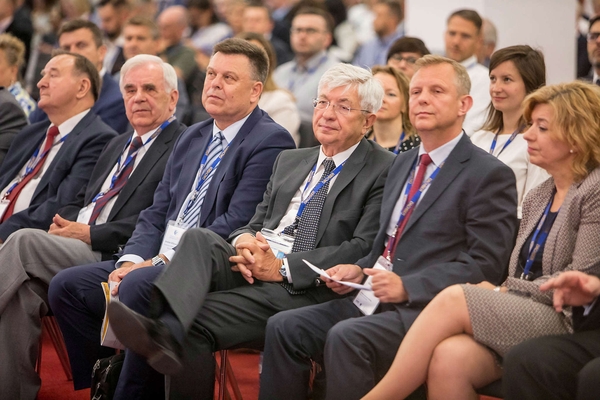
This year’s Congress, which was traditionally organized by the Institute of Logistics and Warehousing in the pavilions of the Poznań International Fair, was the fourteenth installment of this extremely popular logistics event. The event takes place every two years, starting from 1992, and in each subsequent edition, it enjoys increasing interest and engagement from speakers.
The Polish Logistics Congress is also a large logistics exhibition, numerous thematic sessions, workshops, and technical visits to partner companies. It is also a unique opportunity for discussion “across divides” with representatives of competing logistics companies and leading theorists and practitioners in the industry. It is also worth mentioning that during the congress, the report “Logistics in Poland 2017” was presented, a collective work edited by Grzegorz Szyszka, long-time director of the Institute of Logistics and Warehousing, and Ireneusz Fechner (College of Logistics, Polish Logistics Society). Over 150 pages of hard data, insightful analyses, comparisons, and conclusions make up a publication unique on the Polish market. The report has so far been made available only to Congress participants, but it will soon also be found on our portal.
Photos: Filip Furmańczak: http://furmanczak.com