








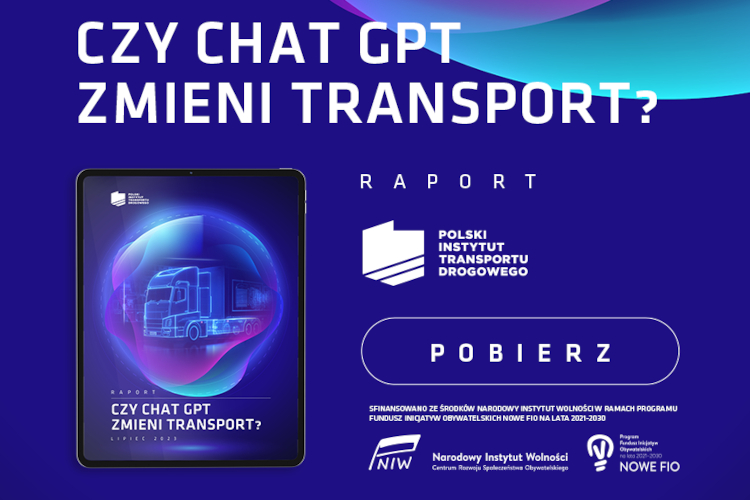
On July 20, 2023, the latest report by the Polish Road Transport Institute, “Will Chat GPT change transport?”, was premiered.
According to data from the Statista portal, 2.85 million people used Chat GPT in Poland in April 2023. The number of users has been growing systematically – since December, it has increased by nearly 2,400 percent in Poland. The range of fields in which it is applied has also expanded. In the latest report, the Polish Road Transport Institute decided to examine the prospects for using chatbots in the TSL industry. The most popular tools were compared, and processes that will be optimized thanks to them were identified. Given that the IT industry is characterized by high dynamics, the report used the most current data from renowned institutions and conducted interviews with representatives of companies that are conducting research on the implementation of artificial intelligence. What benefits and risks can the widespread implementation of Chat GPT bring? What does the implementation of chat look like in individual sectors of the TSL industry?
What will we achieve by implementing Chat GPT?
According to analyses by the European Parliament’s Think Tank, published in 2020, the implementation of artificial intelligence in the economy could significantly contribute to productivity growth of 11 percent to as much as 37 percent by 2035. Moreover, advanced artificial intelligence systems have the potential to globally reduce greenhouse gas emissions by approximately 1.5 percent to 4 percent by 2030.
Despite the benefits described above, the adoption of artificial intelligence technology could strongly affect the labor market in the future. It is estimated that as many as 14 percent of jobs in OECD countries could be largely automated, which means the potential loss of these positions. This is a challenge that societies and economies will have to solve effectively.
Application of Chat GPT in the TSL industry
An AI-based chatbot has many applications in the TSL industry. It can help verify various information regarding companies and entities in this sector. For example, a chatbot can provide information about a company’s available transport capacity, check customer reviews online, provide information about available service dates, and the timeliness of their execution. It is also important that a chatbot can build an initial relationship with a customer and provide an initial assessment of a given partner’s credibility.
In the future, a GPT-based chatbot could be integrated with various systems in the TSL industry, such as transport management systems (TMS), warehouses (WMS), SMS gateways, or even accounting software. This integration will allow for the automation of many processes, the generation of necessary documentation, shipment tracking, order processing, and even negotiations with customers. The chatbot will also be responsible for fast and efficient customer service, answering their questions in real time.
Companies in the TSL industry, by using an AI-based chatbot, can save time and costs associated with repetitive processes. Automation will allow for the streamlining of many aspects of work, enabling companies to focus on other key tasks.
More efficient processes thanks to Chat GPT
Thanks to the use of artificial intelligence and a GPT-based chatbot, it is possible to create and improve internal procedures in a company. Through data analysis, AI can help identify weak points in processes that require improvement. Algorithms can systematize actions, suggest what processes should look like, and what goals should be achieved within a specified time.
– It is a template that means we don’t have to wonder about what and how we should do something. The algorithm simply suggests it to us, and it is a great convenience, as well as a saving – says Dawid Dajczak, Program Manager of Chartering at Sennder.
The forwarder of the future
PITD experts speak unanimously in the report – the development of artificial intelligence will not cause a group of people to suddenly lose their jobs. It is predicted to be more of a long-term process of implementation and transformation, in which employees will acquire new competencies. Thanks to this, forwarders will become better specialists who will oversee the process.
– Artificial intelligence will not replace human-to-human relationships. A forwarder connects the carrier with the shipper; they are an essential intermediary. They also analyze a lot of data from various sources. Repetitive tasks are the easiest to automate. More than 20 years ago, the first freight exchanges appeared. The first version of the Trans.eu exchange still connected people using the popular Gadu-Gadu messenger. At the same time, the Timocom exchange was also operating. GPS and telematics systems, which have been with us for a long time, have facilitated and simplified the work of forwarders. Currently, it is enough to check in the system where a given vehicle or cargo is. Digital forwarding, based on artificial intelligence, also means digital document flow and constant monitoring of cargo. This allows for faster contact, optimization, and monitoring of the route in real time – explains Justyna Świeboda, President of the Polish Road Transport Institute.
Link to download the report: https://pitd.org.pl/chat/