









In Q1 2024, the Polish TSL sector forecasts a slight reduction in headcount, although no one intends to get rid of qualified staff. On the contrary, the employment of essential workers will increase. Throughout the year, companies will mainly look for warehouse workers and drivers, and shortages of the latter will cause real nightmares in Polish and European transport. It is becoming increasingly clear that human capital in TSL is a strategic resource, and its role will gain even more importance by the end of the decade.
The transport and warehousing sector in Poland, despite a decent end to the year, failed to finish the past year in high spirits. In the December surveys by Statistics Poland (GUS), the general business climate was again rated below the neutral level (-4.9), and even slightly worse than in November (-3.7) and October (-1.4). Only the largest enterprises, employing 250 or more people, maintained optimism. This group of companies has been assessing the situation positively continuously since March 2023.
The poor diagnosis of the general economic situation in the sector, which has persisted since December 2021, has clearly affected the forecasts for Q1 2024. Enterprises are cool about the coming months in all areas surveyed by GUS, including employment. The current forecast for the balance of layoffs and recruitment for the current quarter is minus 2.4 in favor of staff reductions. In December, 11.4% of directors of transport and warehousing companies declared that the indicator would deteriorate at the beginning of the year, while 9% predicted an improvement. The remaining part, i.e., almost 80% of the 850 surveyed entities, does not plan any new recruitment or layoffs at the beginning of the year.
Competencies are always valued
However, employment declarations differ significantly when it comes to assessing the importance and impact of employee competencies on the company’s functioning in the quarter opening the year. Thus, the percentage of enterprises declaring a reduction in the employment of employees who are relatively easy to replace increased to 9.7%, while 5.9% declare an increase in the recruitment of such staff. The balance at the level of minus 3.8 is therefore unfavorable for low-skilled people.
We will observe the exact opposite situation for positions that are difficult to replace, as 9.2% of enterprises declare an increase in hiring personnel with valuable skills. A reduction in Q1 is announced by 5.5% of companies, which still gives a positive employment balance of plus 3.7.
It is also worth noting that in Q1 2024, i.e., at the beginning of the announced exit from last year’s slowdown, but still operating in weak economic conditions, for the vast majority of companies, the basis for making important decisions regarding both employment and wages will be current internal and macroeconomic data. This is declared by 70.3% of directors surveyed by the Central Statistical Office. Significantly fewer declarations concern significant steps taken based on expected changes that may occur within a year (48.8%).
Employees constantly in demand – especially drivers and warehouse workers
According to data cited in last year’s report by the Transport and Logistics Poland (TLP) employers’ association, the TSL sector accounted for 7% of Poland’s GDP in 2022 and accounted for 6.5% of all employed people. According to GUS data, this is as many as 955,000 people. In turn, according to an analysis by the Polish Economic Institute (PIE), transport and warehousing employees are the third largest professional group in the service sector. It is no wonder that the Transport and Logistics category, alongside IT, engineering, and telecommunications, was at the forefront of job advertisements published on the Polish Internet last year.
This conclusion comes from data available on the Job Market Insights platform, which monitors recruitment offers appearing on websites in 19 countries around the world, including Poland. In all of 2023, a total of 321,730 unique job offers were published in our country in the Transport and Logistics category. It is also clear that the dynamics of recruitment processes reflected the moods prevailing in the industry. The number of advertisements grew quite steadily from the beginning of the year until May. In June, it fell into stagnation and began to oscillate at a constant level of about 29,000 offers per month. A clear drop below the 24,000 threshold occurred in November, while in December the number of offers dived to 18,000, which is a much weaker result than in December 2022, when 20,051 recruitments were opened. This is a decrease of 11.5% year-on-year.
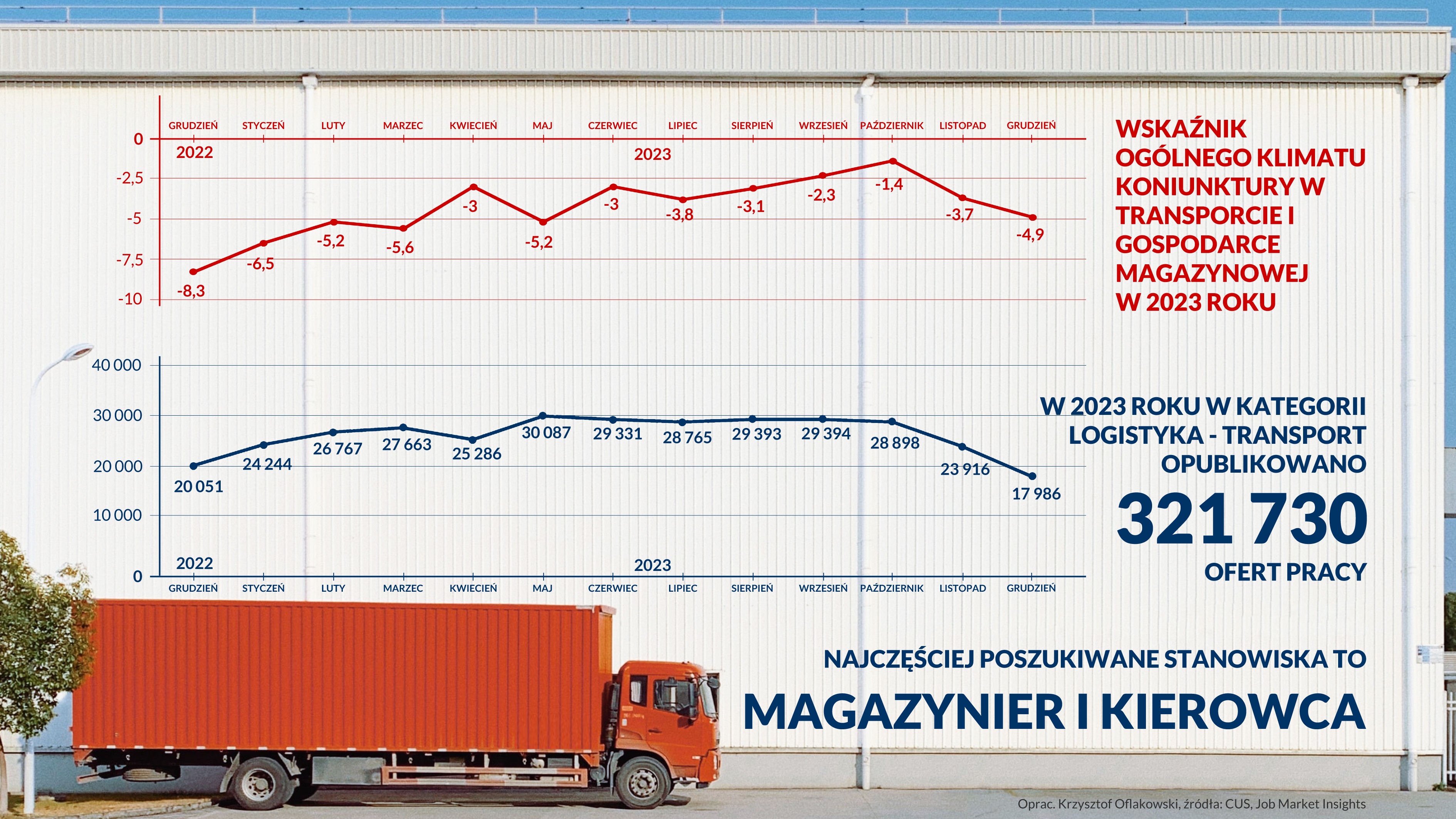
GUS business climate and job offers in TSL in 2023
Throughout the past year, the most sought-after employees were definitely warehouse workers and drivers, which, due to the geographical parameters of the Polish transport and warehousing sector, should not be a surprise. Domestic enterprises provide over 20% of the transport work performed in road transport of goods in the European Union. We have also recently advanced to the narrow group of European countries that can boast of modern industrial and warehouse space exceeding 30 million sqm. It is therefore no surprise that the most recruitment offers concern warehouse workers and drivers and come from the vicinity of the largest cities, where logistics parks and centers are located.
Job Market Insights analyses additionally reflect the strong position of Polish TSL in terms of potential for the labor market. Even in the weakest month of the last year, i.e., in December, 17,986 advertisements were published in the Transport and Logistics category, which accounted for 9.8% of offers posted in all recruitment categories. In turn, 4,705 TSL companies that were looking for employees at that time accounted for 15.4% of enterprises conducting recruitment at that time. A renewed economic recovery will likely increase these shares in the following months of 2024.
Although filling the clear recruitment dip from the end of 2023 will take some time, the dynamics of recruitment will certainly return in the second half of the year. Without meeting the recruitment needs of the TSL sector, it is difficult to imagine the efficient functioning of the economy, not only Polish but also global, which can be seen in the example of the driver market.
Is a road apocalypse coming?
S&P Global calculations show that the direct contribution of road transport to building global GDP is 3%. This is more than other transport models combined (rail accounts for 0.5%, aviation and shipping for 0.8% each). Road transport also has a majority share (56%) in the $4 trillion in revenue derived from the global movement of goods. The rest, i.e., 44%, belongs to other models combined. At the same time, according to the International Road Transport Union (IRU), globally, more than 50% of companies have serious or very serious problems with recruiting for driver positions. In Europe, as many as 62% of enterprises make such declarations. Only 17% signal minor problems or none at all, and 21% declare moderate difficulty.
According to the latest IRU study, in 2023, 7% of open positions for drivers in Europe remained unfilled. Simply put, no candidates were found, and the demand reached the level of 233,000 people.
How does this affect European companies?
For 57% of European enterprises, this means an inability to provide adequate load capacity, and consequently, an inability to expand business. As many as 60% of companies are of the opinion that market shortages result in less qualified employees, and 56% point to higher costs of maintaining jobs. Alongside these factors are also reduced productivity (49%), a decline in revenue (39%), reduced competitiveness (30%), delivery delays (27%), more accidents (23%), and other negative consequences.
To make matters worse, there will be even fewer drivers
Already this year, the driver shortage indicator in Europe may reach 11%, which means as many as 0.5 million pairs of hands needed for work. The final demand will, however, depend on the demand for transport services and the condition of the entire economy. In reality, last year’s drop in unfilled positions to 7% did not result from a higher number of candidates, but precisely from reduced demand for transport, among other things, as a result of economic slowdown, reduced consumption, high inflation, and slow wage growth, etc.
For example, in the UK, which in 2021 had a shortage close to 10%, which corresponded to massive shortages of even 80-100 thousand drivers, in 2023 the indicator decreased to 6%, which suddenly resulted in a thousand unfilled vacancies. Theoretically, the problem solved itself; in practice, nothing has changed, because it is a structurally difficult issue, and this year it will certainly intensify.
This will happen because the four-point increase in unfilled vacancies in Europe (to 11%) will be driven by rising GDP. Better economic conditions will drive demand for transport services, and the driver issue will come to light again. Proof of this is, for example, the growth in transport work performed in road freight transport in Europe forecast by Transport Intelligence, which is expected to increase from 1.92 million tkm in 2023 to 1.94 million tkm in 2024.
Nothing new – there will also be a shortage of drivers in Poland
According to IRU estimates, last year there was a shortage of about 29,000 drivers in Poland, which meant 7% of empty vacancies. Equally high shortages were declared in Germany (7% | 31,000) and Spain (7% | 30,000). However, when it comes to the percentage share of unfilled positions, countries such as Estonia (19%), Slovakia (14%), and Romania (10%) have a bigger problem than Poland.
The increase in demand for drivers in our country is certain, because forecasts of an accelerating economy are coming from every side. The World Bank predicts growth of 2.6% for Poland, and the NBP about 3%. In turn, according to PIE, Polish GDP will grow by 2.3% in 2024, and the main engine of growth will be household consumption, which is excellent news for the warehousing sector.
However, there will be no increase in drivers, also due to their age. Already 33% of drivers in Europe are over 55 and will retire in 5-10 years. At the same time, the group of initiates under 25 is only 5% of the market share. For this reason alone, i.e., retirement, it is estimated that in the period up to 10 years, there may be a shortage of even 1.2 million drivers in Europe. Extremely pessimistic in this context is the relatively close forecast for 2028, which assumes a level of unfilled positions of 17%, i.e., 745,000 open vacancies in Europe. In 4 years, up to 3.9 million drivers will be needed to serve the European economy, but according to IRU, only about 3.2 million will be professionally active.
Poland in this context has one more problem, namely not only retirement but also resignation from the profession. A study by Inelo conducted in 2023 on nearly 2,000 drivers showed that as many as 76% had thought about changing jobs in the last 6 months.
The consequences for Poland will be the same as for other economies with shortages. IRU points to, among other things, an increase in transport rates and inflation, a slowdown in GDP growth, and even a potential increase in CO2 emissions. In the longer term, also an acceleration in the field of autonomous vehicles.
The problem with this last issue, however, is that large-scale and highly capital-intensive autonomization will not be possible everywhere, both for technical, infrastructural, or even legal reasons. Self-driving trucks are only at an early stage of development; there is a lack of not only design solutions ready for mass and profitable production and use but also legal regulations and even road infrastructure, because they will most likely be units powered by alternative fuels.
In a few years, a TSL employee will be worth their weight in gold
Operators, carriers, and other entities operating in the TSL market who will not be able to implement appropriate strategies for acquiring and retaining talent will limit not only their chances for development but also for maintaining competitiveness. The challenges will concern not only road transport but also the entire logistics ecosystem. For example, while in e-commerce it is possible to almost fully automate the packing and shipping process, it is much more difficult to organize the handling of returns in this way, especially their verification and repairs. This is all the more important as we are already living in an era of sustainable business activities and responsible management of logistics cycles, to which the sector’s contractors are sensitive. There is little indication, therefore, that human capital will cease to be a strategic resource for TSL companies; on the contrary, in the future, it will play an even greater role. This can be seen in global talent shortage studies, which are reported by 75% of enterprises worldwide. Competencies related to logistics operations are currently in fourth place on the list of the most difficult skills to find among candidates – says Małgorzata Hornig, HR Director at ID Logistics Polska, which provides comprehensive logistics and transport solutions, e-commerce handling, and supply chain management in 18 countries.
The Transporeon platform also draws attention to the strategic importance of human resources. In a study from April 2023, it asked logistics and supply chain managing directors about trends and factors that will play a much more important role in supply management by 2028 than they do today. Unsurprisingly, artificial intelligence and machine learning took first place (60% of indications). However, alongside sustainable initiatives and regulations (59%), limited resources in the labor market (50%) were also at the top of the list as one of the three key factors for logistics at the end of the decade. On the podium, however, there was no room for autonomous trucks and last-mile deliveries (21% each), nearshoring (38%), cybersecurity (40%), and robots in warehouses (41%).