









For 10 years, DHL and the NYU Stern School of Business have been researching and analyzing international flows of trade, capital, information, and people. Recently, an update to the DHL Global Connectedness Index report was published, presenting a fresh perspective on the impact of the pandemic on globalization.
Global trade resilient to the crisis
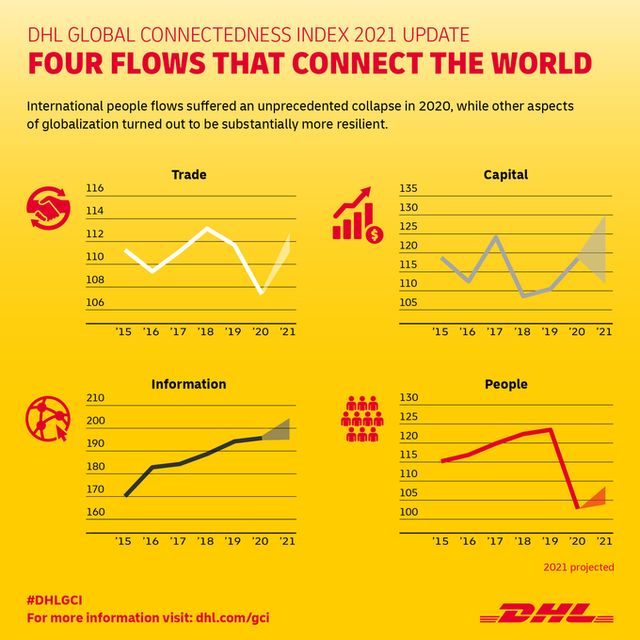
According to the report, globalization is emerging from the initial crisis – it is much stronger and more resilient than many expected. Trade in goods rebounded quite quickly in mid-2020, and by the end of the year, it even exceeded pre-pandemic levels (by 5%). At the beginning of 2021, global trade volume set new records, and forecasts indicate that trade growth (both in goods and services) will exceed GDP in 2021 and 2022.
– Many people feared that the global crisis would threaten the progress of globalization. We have been analyzing various international flows around the world for years, and after 1.5 years of the pandemic, we can assure you: the pandemic did not cause the collapse of globalization. After initial declines in 2020, the DHL Global Connectedness Index is growing again this year – says Tomasz Buraś, CEO of DHL Express Poland. – Trade has served as both a lifeline and a driver for the development of countries around the world. Meanwhile, DHL Express, fulfilling its purpose of connecting people and improving their quality of life, has played a key role by creating conditions for this development, from vaccine distribution to enabling growth for e-commerce.
Change in product mix and long-distance trade
The rapid growth in international trade since mid-2020 has significantly exceeded initial forecasts, even though the mix of goods traded has changed more than usual. Trade in goods used to fight the pandemic increased sharply (protective masks +480%, pharmaceutical products +10%), while trade in many other categories decreased significantly (clothing and auto parts down by -14%, mineral energy raw materials -31%, aircraft and spacecraft parts -36%).
In the first half of 2020, faced with lockdowns and economic shutdowns, as many as 83% of international managers indicated that their companies were considering nearshoring to regionalize supply chains. A year later, this proportion fell to 23%. Despite a significant decline, interest in shortening supply chains from the business sector is visible.
Contrary to expectations that the pandemic would cause regionalization, in 2020, trade in goods took place over longer distances on average. Data on capital, information, and people flows also show no clear evidence of a shift from globalization to regionalization.
The pandemic and international flows of capital, information, and people
Foreign direct investment flows in 2020 decreased even more than trade (a 35% decline), but they are on track for a full recovery in 2021. Global data flows doubled in 2020 as interpersonal contacts moved online. However, this did not interrupt the long-term slowdown in the globalization of information flows. Migration suffered the most due to the pandemic. In 2020, international travel fell by 73%, and in the first six months of 2021 by over 80%. Since the middle of this year, signs of recovery have been visible, but a full return to pre-pandemic levels will not happen until 2023 or 2024 at the earliest.
Strong position of the Asian market
Global trade flows and economic recovery are creating growth opportunities in the Asia-Pacific region. It is projected that exports and imports of goods in Asia in 2021 will increase by 14.7% and 9.4% respectively above 2019 levels.
– When the Regional Comprehensive Economic Partnership enters into force in January 2022, it will contribute to strengthening global connections, economic recovery, and prosperity in the region. By 2022, DHL Express will invest approximately 750 million euros to strengthen ground infrastructure and the air network in the Asia-Pacific region. We want to meet the growing demand for express logistics services and support our customers in scaling their business and growing around the world – said Edwin Osiecki, Vice President of Marketing and Sales at DHL Express Poland.
Globalization is the domain of rich and developed countries
The world’s poorest countries are still less privileged when it comes to the recovery of globalization. Even as global trade set new records at the beginning of 2021, countries with the lowest per capita income were still trading less than in 2019. Similarly, foreign direct investment in low-income countries fell during the same period, while it grew strongly in middle- and high-income countries. It is worrying that the world’s poorest countries remain cut off. Stronger connections with the rest of the world could accelerate the recovery of their economies after the COVID-19 pandemic.
Factors supporting globalization
In a special report marking the 10th anniversary of the DHL Global Connectedness Index, DHL and the NYU Stern School of Business highlight the strong links between global connectivity and prosperity. The five key areas on which the growth of countries’ connections with the world depends are: peace and security, an attractive domestic business environment, openness to international flows, regional integration, and social support.
Untapped opportunities
Both reports emphasize that despite crises, the world remains close to record-high levels of globalization. At the same time, they also show that globalization is still limited, and there are large, untapped opportunities for countries and entrepreneurs. Most business activity still takes place within national borders, and transactions going beyond those borders are concluded mainly between neighboring countries. Dominant trends still point to a future where there will be great opportunities to reap the benefits of stronger connections with the rest of the world.
About the DHL Global Connectedness Index report
The DHL Global Connectedness Index measures globalization based on flows of international trade, capital, information, and people. It tracks both the volume of countries’ international flows relative to their domestic activity (“depth”) as well as their geographic reach around the world (“breadth”). The DHL Global Connectedness Index includes over 3.5 million data points on flows between countries between 2001 and 2020.
The report in English is available on the dhl.com website.
Source: DHL Express Poland