









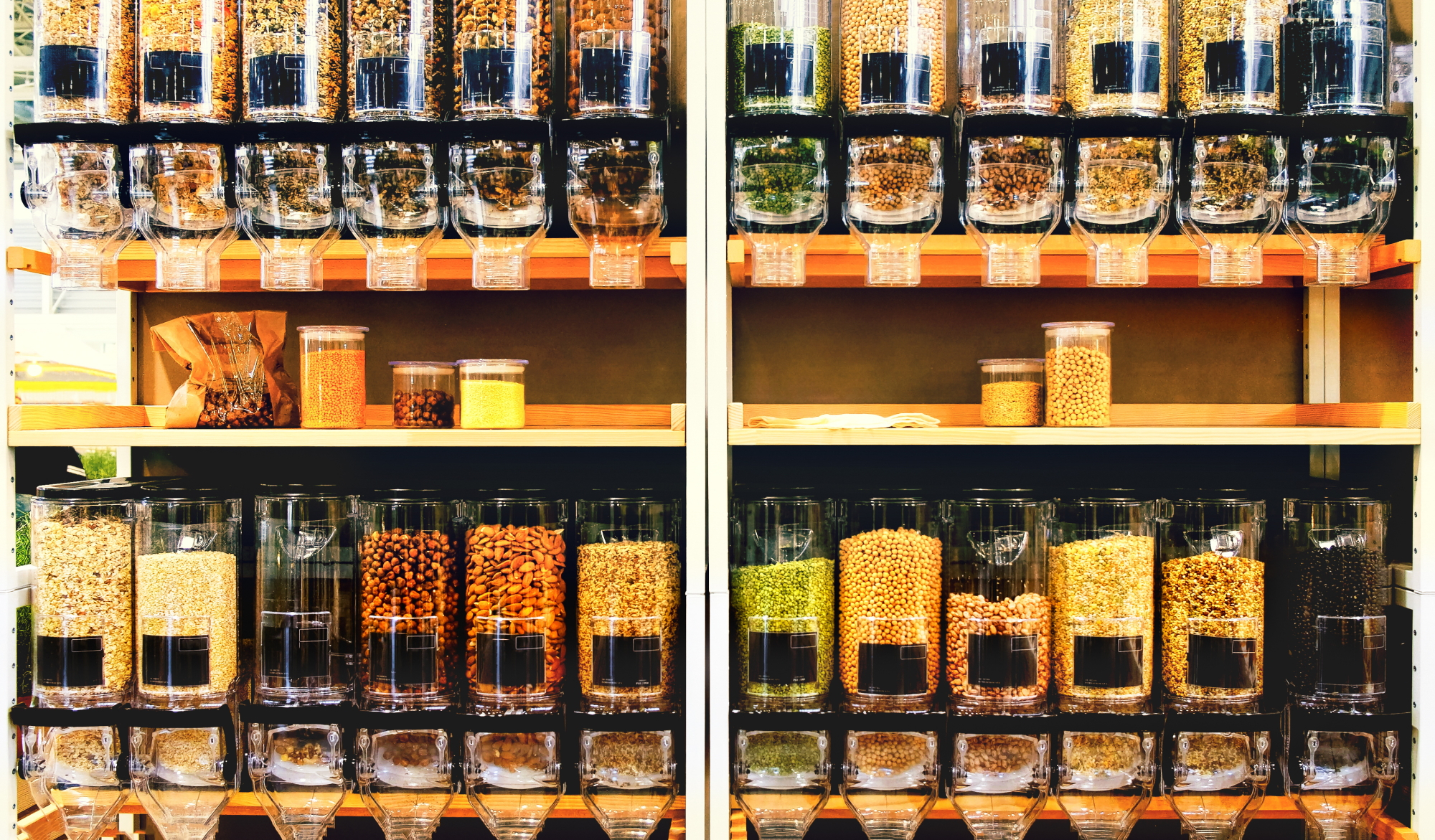
Will Poles be convinced to buy rice and pasta by weight into their own containers? According to the report “Unpacking the question of packaging-free” prepared by FM Logistic, this form of shopping is gaining popularity in many countries. Thanks to the support of logistics operators who are adapting to the specific requirements of this segment, this solution is becoming available to an increasing group of manufacturers and distributors.
As the authors of the FM Logistic report note, buying bulk products such as groats, pasta, or breakfast cereals by weight and into one’s own reusable containers is a clearly growing trend. Drugstores are also increasingly reaching for this form of sales. In Poland, such an offer is still primarily associated with small eco-shops, but in Italy, France, or the UK, for example, supermarkets also provide this option. One Italian chain specializing in the sale of reusable containers and packaging-free goods offers over 1,500 products, ranging from food and household items to body care cosmetics. According to estimates, this form of trade will allow reaching a turnover of 1.2 billion euros by 2030. – By 2023, sales into customer containers in the EU helped reduce packaging waste by 5,500 tons – we read in the report prepared by FM Logistic.
Products intended for sale without packaging require appropriate solutions in terms of logistics operations. From the very beginning, FM Logistic has been involved in the sustainable transformation of the supply chain. Under the “Supply Change” banner, it develops responsible operating models that are friendly to people and the planet. Checking the possibilities of optimizing the supply chain for packaging-free products is one of the actions that fit into this strategy. FM Logistic began work on an optimal solution for this segment as early as 2021 in France. For 9 months, the logistics operator carried out a pilot project for the comprehensive handling of packaging-free goods for the FMCG industry. These products were prepared for transport at one of FM Logistic’s platforms and then delivered to recipients in three distribution models. This allowed for a comparison of the impact of distributing a 500-gram unit of each product in conventional plastic packaging with the same quantity sold in bulk and transported in cardboard hopper bins, cardboard containers, or plastic containers.
Sustainable trade requires a sustainable supply chain
To develop truly optimal solutions, the report’s authors considered many variables. Importantly, the calculations included the impact of the entire product life cycle, in particular packaging production, transport stages, reverse logistics, and the cleaning of reusable containers, as well as food waste. Each of these elements affects the environment directly or indirectly. “The benefits of adopting a packaging-free model vary depending on the product and the type of standard packaging. For example, rice or breakfast cereals are usually packed in several layers of packaging, so the packaging-free model allows for a significant reduction in environmental impact.” – Report “Unpacking the question of packaging-free”
According to the environmental study results presented in the report, such a trade model is ecologically profitable if the supply chain is built in a sustainable way and adapted to a specific product. Environmental benefits are conditioned by the type of fuel used in logistics, the form of reverse logistics, and the number of times sustainable packaging is used.
Plastic is still more profitable, but only sometimes
The pilot project presented in the report, carried out by FM Logistic, allowed not only to assess the environmental impact of individual solutions but also to conduct an economic analysis to define an optimal model for the logistics of packaging-free goods, taking into account profitability and sustainable development. Potential economic benefits show a 46 percent reduction in packaging costs for reusable plastic containers (with the possibility of being reused 100 times) and 21 percent for cardboard packaging with a capacity of up to 20 kg. As the report’s authors state, the use of cardboard boxes or hopper bins in logistics pays off in the short term, but in the long term, plastic containers win. This is why it is so important to analyze and plan the distribution, storage, and reverse logistics process, which will take into account all variable aspects of packaging-free sales. This is possible in cooperation with experienced logistics operators.
– The pilot project required a completely new approach to the packaging-free trade model, starting from product packaging, through transport, to brand merchandising. Although the pilot and research were conducted in France, they can be replicated internationally, depending on the maturity of the packaging-free market in a given country and local regulations – says Lucie Aitsahalia, Environment and Energy Manager at FM Logistic. Anticipating the popularization of this form of distribution on the market, FM Logistic is ready to offer interested parties ready-made, proven, and economical solutions now. Solutions that are necessary so that the world does not drown in plastic.
According to the World Economic Forum, only 14 percent of plastic packaging worldwide is recycled. The remaining majority ends up in landfills, incinerators, or, worst of all, decomposes in the natural environment for hundreds of years, degrading water, soil, and the environment. Waste decomposition in landfills is also responsible for a fifth of global methane emissions. However, a huge environmental cost must be borne not only when disposing of plastic but also during its production, which requires energy, water, and non-renewable resources, while emitting greenhouse gases. Aware of the growing problem, countries are imposing further restrictions on manufacturers and consumers. Alternative forms of packaging and logistics processes prepared for them are one of those solutions that do not require major changes but have a real impact on improving the situation of our planet.
The report “Unpacking the question of packaging-free” was created thanks to the cooperation of FM Logistic, a leading logistics operator, with the consulting firm Bartle and Ilec – La voix des marques, which brings together companies from the FMCG industry.
Source: FM Logistic Central Europe, GoodOne PR