










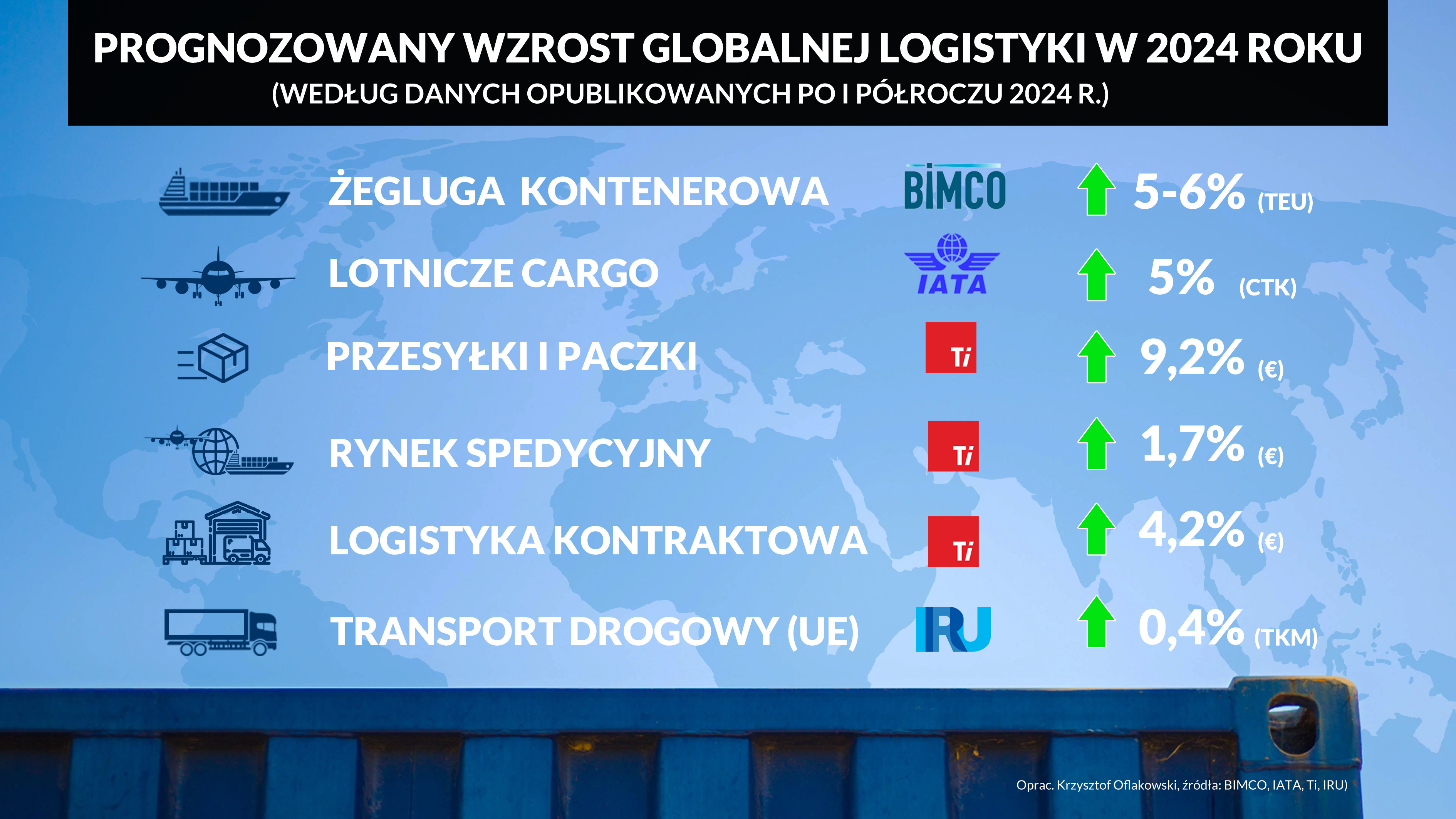
The first half of this year has shown that key sectors of global logistics are, in one way or another, dependent on developments in the Red Sea and the shift of the seasonal transport peak to the second quarter. In 2024, the recovering market will also be influenced by the improved health of the global economy and trade, especially e-commerce. Records are already being broken in container shipping from Asia to Europe, and the full-year forecast assumes a growth in transport of 5-6%. Air freight is also predicting a similar jump in volumes. Global freight forwarding and the contract market are also on an upward trend. Parcel handling and road transport in Europe, as well as rail transport from China, are gaining ground.
The half-year performance results of the largest logistics operators and data flowing in during July and August from many directions of the global freight transport sector have confirmed the assumptions made at the end of last year that 2024 could be better for the industry than 2023. Expected growth is supported by forecasts regarding global GDP and trade, which have a direct and key impact on the condition of the global TSL (Transport, Shipping, Logistics) industry. Optimism was sparked by, among other things, July data from the International Monetary Fund (IMF) on maintaining assumptions regarding global economic growth at 3.2% for the whole of 2024 and raising the forecast for next year to 3.3%. Similarly, the Organization for Economic Cooperation and Development (OECD) assessed both this year’s and next year’s economic condition, estimating GDP growth at 3.1% and 3.2% respectively. According to the IMF, the outlook for trade (in goods and services) also looks better, which will gain 3.1% this year and 3.4% next year. Last year, growth in this area was recorded at only 0.8%, which was a very painful drop from 5.6% in 2022. The logistics sector reacted well to the analysis by the World Trade Organization (WTO), according to which trade in goods alone will grow by 2.6% this year and 3.3% next year. The first quarter of this year already brought growth in trade of 3.9% year-on-year. As the WTO states, despite rising global tensions, trade in goods has proven to be remarkably resilient.
The global logistics sector in 2024 revolves around Africa
The situation in the logistics sector to date has been influenced not only by the recovery of global GDP and trade but also by a number of other factors, including stabilizing inflation and better forecasts for consumer purchasing power. There is also no doubt that since the beginning of the year, the shipping crisis in the Red Sea has been at the center of attention, especially among international operators. This topic has dominated the global logistics industry and market forecasts and strongly affects all components of the TSL sector. Terrorist attacks forcing ships to sail around Africa have significantly reduced the popularity of the most important shipping route from Asia to Europe. Already at the beginning of the year, the United Nations (UN) reported that container traffic through the Suez Canal had fallen by as much as 67%. Subsequent months did not bring much improvement, and cargo ultimately had to find another way to reach its destinations, which the global logistics sector felt positively.
Difficulties will not subside this year, but maritime transport has nothing to complain about
Already at the beginning of August, shipping giant Maersk announced that the currently adopted scenario assumes that the difficulties on the route through the Red Sea will drag on at least until the end of 2024. The operator noted at the same time, which it later confirmed in its summary of the first half of 2024, that there is a growing demand for container transport, although market volatility is higher than usual and there is a lack of certainty as to how demand will shape up in the last quarter of the year. However, the uncertainty did not prevent an increase in the forecast for volume growth in the global container market for the entire current year. The estimated growth is now 4-6% compared to previous estimates of 2.5-4.5%.
BIMCO, the world’s largest international shipping organization, representing over 2,000 members and 62% of the global fleet by tonnage, speaks in a similar tone. After the first half of 2024, BIMCO changed its mind regarding the navigability of the Suez Canal route, and new forecasts for shipping, including container transport, assume a return to normal conditions no earlier than 2025. Despite the revision of its position, the organization still estimates that the global volume of transported containers in 2024 will reach growth of 5-6%. A side effect will be, among other things, an increase in demand for container ships of 14.5 to 15.5%. Positive forecasts regarding the volume of transported containers are expected to lose speed in 2025 (estimated growth is 3-4%), but the organization points out that European imports stand out in particular against historical seasonal patterns. This is due to the fact that a large portion of the cargo for the transport peak, which traditionally falls in the third quarter, was shipped earlier than usual due to the need to sail around Africa and fear of further disruptions.

Record cargo volumes are appearing in Europe earlier than usual
Large volumes of cargo already flowing to Europe are also confirmed by analyses from Xeneta, a platform monitoring the sea and air freight market. Data from the beginning of August show that in June alone, 800,000 TEU (Twenty-foot Equivalent Unit) of goods sailed from China to Northern Europe, which is a new monthly record on this route. More cargo will also arrive earlier at US ports. While this will not be a new monthly record, the 1.36 million TEU that left Chinese ports is the best result in history for June and the seventh best result since the beginning of the analysis.
The need to sail around Africa generates other far-reaching consequences. Xeneta calculated, among other things, that in the first four months of this year alone, every container transported globally by sea traveled a distance on average 9.3% longer. This translated into an 18.3% increase in the global TEU miles indicator. A slightly smaller increase, at the level of 16%, was also predicted in February by specialists monitoring the sea freight market at Sea Intelligence. The increases are, of course, good news for shipping companies, but a significantly negative consequence for European importers and exporters is the persistently high freight rates. According to Xeneta, due to increased container ship traffic from China, spot rates to Northern Europe increased by 166% from April 30 to July 1 alone, and to the US East and West Coasts by 139% and 144% respectively.
In turn, according to the WCI (World Container Index) composite index maintained by Drewry, the average price for transporting a 40-foot container calculated from the beginning of the year to the beginning of September was $4,127, which is significantly above the ten-year average of $2,814. Compared to the beginning of September 2023, rates are 184% higher year-on-year. High prices persist especially on routes from China to Europe and the USA. A container from Shanghai to Rotterdam is 329% more expensive than a year earlier, and to Genoa 209% more expensive. The route from Shanghai to Los Angeles means an expense 168% higher, and to New York 149% higher.
Difficulties in shipping are felt by European operators, including those in Poland
The effects of disruptions in the Red Sea are felt throughout the industry and result in a significant shift in the traditional seasonality in supply chains that occurs in the third quarter of each year. The risk of logistics perturbations, observed earlier during the pandemic, prompts some importers and large retailers to stock up defensively and fill warehouses. Most of them are already prepared for the autumn volume peak and are slowly thinking about the holidays. This is particularly visible in categories such as clothing, footwear, accessories, i.e., the fashion sector, and consumer electronics. Increased traffic, especially in the first of the mentioned areas, where we serve many large clients, is already very visible. This also applies to companies selling products in the e-commerce channel. Extended supply chains caused by the crisis in the Red Sea, and as a result, changes in the delivery calendar, and thus earlier filling of warehouse space, will positively affect the sector’s results in the third quarter, which, along with the shopping peak at the end of the year, will have a very positive impact on the full-year result of the logistics sector, and especially the contract area – says Sławomir Rodak, Commercial Director at ID Logistics Polska, which provides comprehensive logistics and transport solutions, e-commerce handling, and supply chain management in 18 countries.
The entire contract logistics and parcel and express delivery market are in the black
Contract logistics is expected to perform well throughout the current year, and even in the economically weaker 2023, it grew above expectations, increasing revenues by 3.8%. A series of data collected by Transport Intelligence (Ti) indicates that this year, contract operators will achieve a growth rate reaching 4.2%, and the global market will reach a value of 296.03 billion euros. On average per year until 2028, fueled by large flows in the e-commerce sector, the contract market will grow by 4.1%, and at the end of the forecast, it will reach a value of 347.7 billion euros. A very important element, both in this and subsequent years, will be warehouse operations. This is not just about storage, but also operations supporting trade, especially online. This year alone, fulfillment, returns handling, and other services accompanying storage accounted for a total of 45% of the value of the entire contract sector. This means revenues at the level of 133.23 billion euros.
Handling the e-commerce sector will also benefit operators in the parcel and express delivery market. According to the latest Ti data, throughout 2024 we are to observe a significant global acceleration in this area. The market is expected to gain 9.2%, reaching a value of over 565.9 billion euros. This is significantly above the 6.9% average observed in 2019-2023 and last year’s growth dynamics reaching 3.8%. Thanks to the strong impact of e-commerce, not only revenues have increased, but also the volume of shipments, which grew by 6.4%. As much as 80% of this volume consisted of domestic deliveries, and in the breakdown into B2C and B2B orders, the former dominated, accounting for 59.4% of last year’s market. This proportion will continue to evolve, as by 2028, deliveries to individual customers are expected to increase to 61.3%. The entire market will then be worth over 736.6 billion euros, and in the years 2023-2028, it will achieve an average annual growth of 7.3%.
It is currently difficult to point to an area in the TSL sector that does not feel the positive impact of e-commerce. For another year in a row, online shopping results will determine growth in many areas of the global, European, and domestic logistics market. Global forecasts constantly assume growth, and in light of the latest data from the Central Statistical Office (GUS), we should not have reasons to worry in Poland either. Although retail sales in July fell short of expectations, they still grew by 4.4% compared to the same month a year earlier. Online shopping, on the other hand, gained 16.7% year-on-year, and its share in total sales was the highest for the month of July since 2020. The entire second quarter of this year also turned out much better than a year ago. We are thus entering an upward trend in trade; in the coming months, we expect further growth in this sector, to observe a sales peak in November, strongly supported by e-commerce. We hope that the good results of the last 4 months, which are also better than last year, may even exceed the record value of November last year and April 2021, when the e-commerce share reached 11.9%. This will, of course, be associated with the holiday shopping peak, and thus a very demanding period in the logistics sector, which for several years has been driven not only by traditional shopping but also online – adds Sławomir Rodak from ID Logistics.
There is no shortage of evidence for the importance of the condition of trade, including online, in the freight forwarding market
After shrinking in real terms by 1.3% in 2023, the global freight forwarding market, which is strictly dependent on macroeconomic conditions, and especially the condition of international trade in goods, is returning to the game for growth. Last year, revenues were lost both in air freight (by 2.1%) and sea freight (by 0.6%). According to Ti analyses, however, improving economic conditions mean that the global freight forwarding market (sea and air) will grow in real terms this year by 1.7%, reaching a value of over 196 billion euros. It is estimated that sea freight will perform significantly better, which by the end of the year is expected to gain 2.5% and reach revenues of nearly 110.1 billion euros. Here, growth will be strongly dependent on consumer spending and global and regional macroeconomic conditions, but the ongoing crisis in the Red Sea, which increases the demand for transport to Europe, helps the growth dynamics in this case.
The potential of air freight is assessed slightly lower, for which a jump in revenue is predicted at the level of 0.7%. According to Ti, e-commerce trade, especially between Asia and Europe, is expected to help with this, which will be visible in the increased demand for air transport in this direction.
This is not an isolated opinion, as the authors of the Freightos Air Index have already spoken in this tone, claiming that shipment volumes generated by the largest Chinese e-commerce platforms are currently the main factor driving strong demand, lower capacity availability, and high rates for air freight from China, both to Europe and North America. This is also confirmed by specialists from Upply, who, while pointing in August of this year to the downward trend in rates on major global routes, noted that while freight prices are generally falling, this does not apply to routes from Asia to Europe. Here, in June, an increase of 16.3% year-on-year and a monthly jump of 1.4% compared to May were observed.

Air cargo has nothing to complain about
In its half-year forecast for the global aviation sector, the International Air Transport Association (IATA) pointed to a very interesting sequence of events that ultimately had a positive contribution to this year’s development of air cargo, especially its condition in the first half of the year. Namely, the disruptions in container shipping that have been ongoing since the end of 2023, caused simultaneously by the limited navigability of the Suez Canal, the drought in the Panama Canal, and the blocking of the port in Baltimore at the end of March, led to a significant fluctuation in rates and a radical increase in the competitiveness of air transport in the first quarter of this year.
Through their long-term impact, the mentioned events are constantly working in favor of air cargo, but air freight in the holds of aircraft, as indicated by the IATA forecast, is also supported by dynamically developing online trade and cyclical factors that promise further improvement in conditions until the end of the year. It is therefore expected that global air transport work (cargo ton-kilometers, CTK) will grow by 5% this year. However, the June analysis of the aviation market shows a more optimistic scenario, indicating that in the first half of this year, the demand for air freight was 13.4% higher compared to 2023 and 4.3% higher compared to 2022. This is even better dynamics than in the record first half of 2021 (by 0.02%), but it should be remembered that the estimated growth this year is based on a low base from last year, when the sector was not doing well and recorded a CTK drop of 1.8%, although due to high rates it earned more than the current estimates for 2024.
Either way, the forecasts and results to date look quite good, especially since in August, i.e., after the publication of data on expected growth, another event took place at a very important point on the map of global container shipping, i.e., an explosion occurred in the Chinese port of Ningbo. This led, among other things, to the redirection of many units to other ports, reduced the port’s handling capacity, affected rates related to this location, and seriously made life difficult for manufacturers and retailers associated with Ningbo, leading to potential warehouse shortages and supply interruptions. Troubles in the Chinese port may therefore become a catalyst increasing cargo flows in aviation, but also in rail transport to Europe.
Rail to Europe has been gaining since the beginning of the year
Difficulties in shipping have already significantly contributed to the improvement of results on the rail route connecting China with Europe, and data from the State Council Information Office (SCIO) of the PRC shows that the Chinese national carrier, i.e., China State Railway Group, sent 11,403 trains to Europe in the first seven months of 2024, which transported nearly 1.23 million TEU. This is a year-on-year increase of 11%. In July alone, 1,776 trains carrying 185,000 TEU were handled, and this was the third consecutive month in which more than 1.7 thousand were handled. Data to date also show that the Chinese economy will significantly contribute to the revival of the global logistics sector in many of its areas. This conclusion is suggested by data from the General Administration of Customs (GAC), which reported in mid-July that the Middle Kingdom had just set a new half-year record in foreign trade. In the January-June period, the volume of trade in goods grew by 6.1% year-on-year, reaching a value of approx. 2.97 trillion dollars, with exports gaining 6.9% and imports 5.2%.
A handful of optimistic data and better moods have finally reached Europe
After a very demanding 2023, a bit more optimism flows from data regarding European road transport. A joint report published by IRU, Upply, and Ti, analyzing the situation in EU road transport after the second quarter of this year, estimates the growth in the volume of transported goods in the entire 2024 at 0.4% year-on-year, which means transport work on European roads reaching 1.91 trillion tkm. Noticeably better results are expected to come with the new year, when the demand for transport services will grow by 1.6% year-on-year, reaching 1.94 trillion tkm and breaking the result from 2022. The transport exchange Timocom reports, in turn, that despite the weak economic situation in Europe in the second quarter of this year, 101% more cargo was offered than in the second quarter of 2023 and 53% more than in the first quarter of this year.