








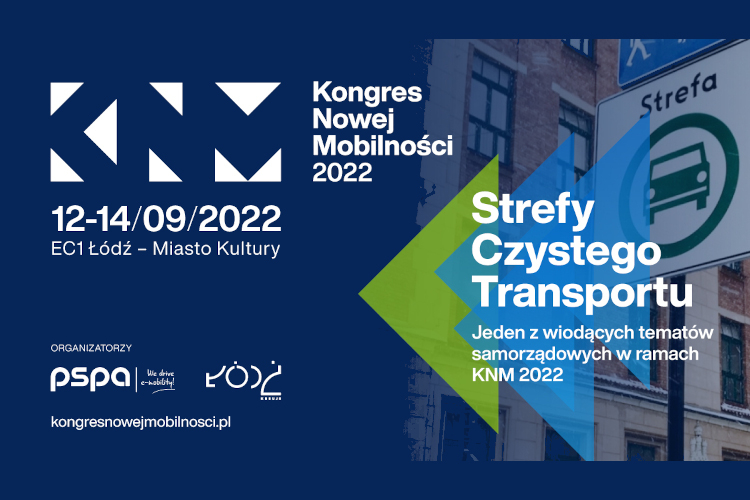
Signatories of the declaration for the development of Clean Transport Zones, including city mayors and representatives of industry and social organizations, will develop proposals for further regulatory changes to accelerate the implementation of low- and zero-emission areas in Poland. They will all meet for this purpose at the New Mobility Congress in Łódź.
Clean Transport Zones (CTZs) operate in over 300 European cities, providing measurable benefits in the area of air protection. An example is the zone introduced in Berlin at the beginning of 2008, which resulted in a 50% reduction in particulate matter emissions from vehicles (173 tons per year) and a 20% reduction in nitrogen oxides (1,500 tons/year). Furthermore, thanks to the zone, the number of passenger car registrations that did not meet the Euro 2 emission standard was reduced by 70% in the German capital, and by 55% for trucks. In turn, the expansion of the CTZ in Rotterdam (since 2016) resulted in a 20-30% reduction in PM emissions from transport, while in London it also noticeably reduced nitrogen dioxide emissions by 32 micrograms per cubic meter and nitrogen oxides by 31%. It should also be emphasized that in Europe, the Zones have a progressive character. Examples of this are Antwerp and London. It is in these cities that the introduction of their zero-emission variants has been announced. In Poland, although CTZs are only just beginning to be created, the discussion about them is gaining momentum, partly due to the involvement of the Polish Alternative Fuels Association (PSPA), the largest industry organization shaping the sustainable transport market. The zones will therefore be one of the leading topics of this year’s New Mobility Congress, which will take place on September 12-14 at the EC1 Łódź – City of Culture facility.
– Our goal is to popularize zero-emission transport and promote good practices that contribute to improving air quality and, consequently, protecting the climate. That is why, together with the Union of Polish Metropolises and the Upper Silesian-Zagłębie Metropolis, we have signed a declaration for the development of Clean Transport Zones. We support local governments in the transport decarbonization process at every possible stage. Together, we are identifying key postulates defining the directions of changes in regulations that will enable the socially acceptable and effective creation of zones in Polish cities – says Maciej Mazur, Managing Director of PSPA.
The topic of zones during KNM 2022 will be addressed on the very first day of the Congress, as part of the Mayoral Debate “Coalition of Cities for the development of Clean Transport Zones,” in which the mayors of the largest local governments in Poland have announced their participation. As part of further workshops (“Model CTZ. Key factors determining successful implementation – experiences and recommendations”), report premieres (“Compendium of creating Clean Transport Zones – best practices”), and substantive sessions (“LEZ problems and solutions – CEE Green Transport Initiative Summit”), experiences gathered from meetings with foreign representatives of cities where CTZs successfully operate will be shared.
– Local governments have done a great job over the last year to reduce various types of air emissions. The bus fleet in public transport and vehicles used by the institutions themselves, such as offices, have been electrified. In addition, there is intensive action in the development of infrastructure for charging electric vehicles. The pace of this development is still not satisfactory for local governments, but supporting this process is no longer within the competence of local authorities. We, local government officials and local communities, have the biggest project ahead of us – the implementation of Clean Transport Zones. We have united within the Local Government Committee at the Polish Alternative Fuels Association to work together on solutions and exchange experiences regarding the Zones. Together, we influenced the amendment of the Electromobility Act to be able to realistically implement the Zones in our cities. Now the time has come for analysis, research, and legislative work. We want Clean Transport Zones to be created in agreement with the residents of our cities and to be a kind of equivalent of their aspirations regarding the development of these cities. The next New Mobility Congress in Łódź will be a time for us to summarize the work done over the last year to reduce exhaust emissions and noise pollution. It will also be an ideal moment to set new directions of action and priorities for local governments in this area – says Adam Wieczorek, Deputy Mayor of Łódź.
The Congress will also feature topics related to recent regulatory changes covering the process of implementing Clean Transport Zones and their operation, which were introduced with the amendment to the Act on Electromobility and Alternative Fuels (December 24, 2021). Various circles, both local government and non-governmental organizations, lobbied for them. One of the more significant changes is the lifting of the size limit for municipalities authorized to implement the Zones. Before the amendment, only municipalities with a minimum of 100,000 inhabitants were authorized to create traffic restrictions in the form of a zone. Currently, this restriction has been lifted, thus enabling smaller units to take the initiative as well. Significantly greater interference by authorities at the municipal level has also been enabled – both in terms of individual entry permits and decisions on operating rules, which will be made by way of a resolution.
– There is no single model of low-emission zones in Europe. They were implemented at different times, according to different rules, and with different effectiveness. The material for learning is therefore very rich, and we should choose the best examples and formulate regulations at the national and local level in such a way that their implementation here is possible – says Tomasz Stefanicki from the Office of Sustainable Mobility of the Wrocław City Hall, one of the participants of the study visit organized by PSPA.
– We have more and more experience. We are monitoring the topic of zones in Poland and Europe very carefully. We are active. Together with UMP, GZM, and the Polish Smog Alert, we have prepared, for example, a universal sticker template for vehicles authorized to enter a Clean Transport Zone. Our next step was to organize a study visit for Polish local government officials to selected Western European cities in order to build competence and knowledge in the area of zones. We also support local governments in preparations for creating the Zones and their responsible introduction – adds Maria Majewska, coordinator of the PSPA Local Government Committee.
The New Mobility Congress 2022 will take place on September 12-14 at EC1 Łódź – CITY OF CULTURE. Parallel to it, accompanying events will be held: Polish Battery Day, CEE Green Transport Initiative Summit, KNM Fleet Forum – dedicated to the most important challenges of the sector, including, among others, Poland’s role in the global and European lithium-ion battery supply chain, or issues related to the mass electrification of corporate fleets. KNM is a unique meeting on a European scale, a place for the exchange of ideas and expert knowledge at the highest substantive level. Every year, it gathers about 1,000 participants professionally associated with the e-mobility industry in Poland and Europe, including over 200 speakers and about 400 experts and journalists. This year’s edition is also the official prelude to the celebrations of the European Mobility Week. The organizers of the event are the Polish Alternative Fuels Association (PSPA) and the City of Łódź. A detailed program of the New Mobility Congress and the possibility of registration can be found on the website: https://kongresnowejmobilnosci.pl/program-knm/.