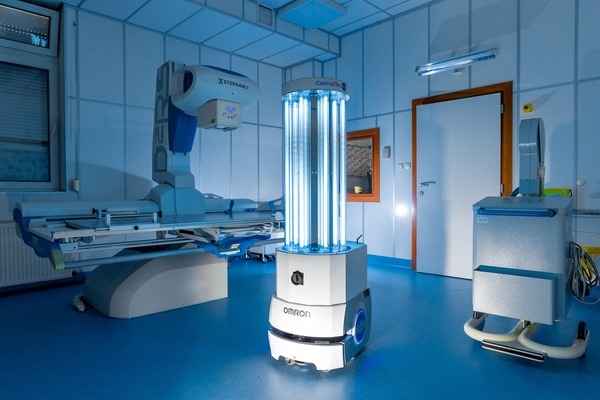
It drives autonomously, avoids obstacles, and disinfects – the J. Gromkowski Provincial Specialist Hospital in Wrocław is now using the first Polish mobile UV-C robot, designed by engineers from the Wrocław-based company ControlTec, which safely supports the disinfection of rooms.
The autonomous device allows for comprehensive disinfection of rooms from bacteria and viruses, including the SARS-CoV-2 coronavirus. This is the first such domestically produced robot in service at a Polish hospital.
– Because we perform imaging examinations on patients with COVID-19, it obviously increases the safety level of our work, and the device operates remotely during times when we are not working with patients. It gives us the invaluable ability to easily and quickly decontaminate surfaces, equipment, and rooms: both diagnostic areas and communication routes – assesses Magdalena Śliwińska, a specialist in Radiology and Diagnostic Imaging and head of the Diagnostic Imaging Department at the J. Gromkowski Provincial Specialist Hospital.
Hospitals have long used UV-C radiation for decontamination and sterilization. This type of radiation neutralizes the coronavirus within a few seconds and completely eliminates it within a few minutes. Unfortunately, using stationary UV-C devices, such as free-standing lamps, is dangerous for staff due to the need to be in the so-called “dirty zone” and exposure to ultraviolet light. This makes the Polish mobile robot all the more noteworthy.
– We combined a mobile platform with a system of sixteen UV-C lamps. We created proprietary application software for it. A robot made this way has many advantages: primarily effectiveness, ease of use, and remote control – lists Grzegorz Góral, vice president and founder of ControlTec.
Staff do not need to be in the contaminated room while the robot is working, thus they are not exposed to radiation. The programmed robot will perform the task on its own. You just need to open the door for it, although it can even do that itself if the facility integrates it with its own network. In that case, it can even call an elevator. The room being decontaminated can be closed. Once inside, the robot will automatically turn on the lamps, disinfect the interior, and notify when the work is finished.
One of the robot’s main features is the ability to create maps of rooms and zones for decontamination. Once maps are created and routes are designated, they are sent to the cloud, from where they can be transferred to other robots, which can operate in a fleet system if necessary. The device is managed via an included mobile application or through a website – practically from anywhere in the world. Modern software allows for personalizing the robot and adjusting its operation to individual needs and special tasks. The robot works well not only in hospital rooms and corridors without the presence of staff and patients. It can be used for automatic, fast, precise, and effective decontamination of schools, offices, industrial halls, hotel rooms, restaurants, shopping malls, airports, and all other places where people gather.
We wrote more about robotization in the Logistyka 1/2020 magazine.
The e-edition of the magazine is available in our offer!