









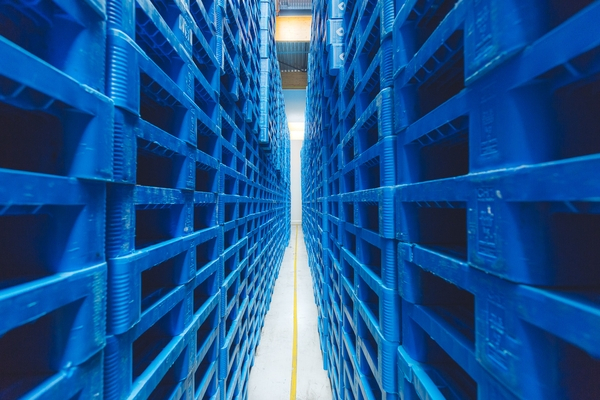
Nestlé is replacing white wooden pallets with reusable CHEP plastic Euro pallets. This is intended to ensure the safety of semi-finished products.
Food and beverage manufacturer Nestlé is introducing CHEP plastic Euro pallets for the first mile of the supply chain (First Mile Solutions) at its factory in Kargowa. The new pooling solution, implemented first by Nestlé and now by suppliers in Kargowa, will allow raw materials to be transferred directly into the production process, i.e., to the so-called “white zone.” Nestlé’s suppliers deliver cereal flakes used for the production of Lion bars to the factory. The semi-finished products are transported on large 1200 mm x 1000 mm CHEP pallets and packed in so-called “Big Bags” with a capacity of 200 kg.
Replacing white wooden pallets with modern CHEP plastic pallets allows raw materials to be transported directly to the “white zone” while maintaining supply chain compliance with food standards such as International Featured Standards (IFS), British Retail Consortium (BRC), and Good Manufacturing Practices (GMP), as indicated by the World Health Organization (WHO).
– In our industry, special care is taken for consumer safety during the production process. That is why we proposed to our suppliers that they deliver our key raw material on plastic pallets instead of wooden ones. We wanted to be sure that the product would be free of foreign bodies that could come from a wooden pallet – says Iwona Barczyńska, Logistics Manager at Nestlé Polska. – Such a solution provides certainty that no contaminants or foreign bodies from the pallet will get into the raw materials, and indirectly into the finished products. In our industry, this is of fundamental importance.
The “white zone” is the area where production takes place, so it must meet rigorous requirements regarding hygiene and production safety standards.
– CHEP plastic Euro pallets perform excellently in environments strictly regulated by hygiene standards. They are characterized by a non-porous surface, do not absorb odors, and are quick and easy to clean. They also do not corrode or deteriorate, which is why they are the preferred solution for the first mile of the supply chain, i.e., from suppliers to manufacturers – explains Izabella Maczkowska-Ciborowska, Country General Manager Poland & Baltics at CHEP Polska.
In the case of white wooden pallets, manufacturers were not sure whether they were paying for the raw material itself or also for the pallet.
– The weight of a white wooden pallet is not constant, for example, due to the moisture it absorbs. A CHEP plastic pallet always has a constant weight, so the manufacturer knows they are paying only for the raw material itself – emphasizes Izabella Maczkowska-Ciborowska from CHEP Polska.
On Western European markets, plastic pallets have been present for 10 years, and interest in them is constantly growing. In Poland, they are also becoming increasingly popular. According to CHEP data, the use of plastic pallets in Poland increased by a full 50 percent in 2018.
Source: CHEP