








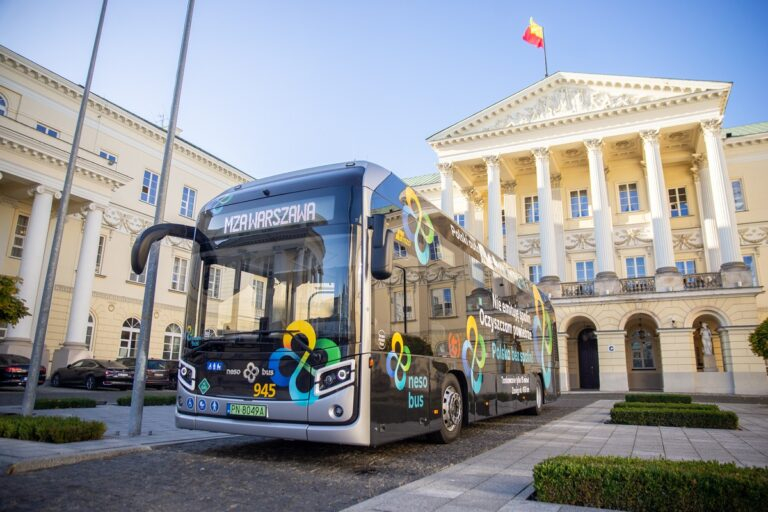
From Thursday, November 3, 2022, Warsaw residents can use a hydrogen-powered bus. NesoBus, as the vehicle is called, will run on two popular capital routes until November 15.
– The NesoBus set off on its first journey from in front of the Warsaw City Hall. The test ride was attended by, among others, the Mayor of Warsaw, Rafał Trzaskowski. – We invite residents to join us in testing the first hydrogen-powered bus on Warsaw’s streets. We would like to purchase such vehicles because our priority in the development of public transport is the health of residents and environmental protection. We are fighting the effects of climate change, but we also care about the comfort of our residents. Without EU funds, however, investments such as hydrogen buses will not be possible – said the Mayor of Warsaw, Rafał Trzaskowski.
It emits no exhaust fumes and cleans the air
The NesoBus is 12 meters long and can accommodate up to 93 passengers, including up to 37 seated. The vehicle, manufactured in Świdnik, is zero-emission because the only byproduct of its operation is water vapor.
– I am glad that a Polish hydrogen bus will be driving on the streets of Warsaw. The name of our bus, “NesoBus,” comes from the first letters of the Polish phrase “Nie Emituje Spalin, Oczyszcza” (It Emits No Exhaust, It Cleans). A hydrogen bus is an ideal solution for city residents – it does not emit CO2, nitrogen oxides, or particulate matter, especially the fine PM 2.5 particles that are harmful to health. The bus has a range of up to 450 km, which means it can be used for 2 days without refueling. Refueling with hydrogen itself takes only 15 minutes – said Maciej Stec, Member of the Supervisory Board of ZE PAK and Vice President of the Polsat Plus Group, the manufacturers of the bus.
Want to take a ride on the hydrogen bus?
The new bus has been assigned to serve lines that run through historic, tourist-attractive areas of the city and central districts with dense development. In such conditions, the effect of using low- and zero-emission power sources is greater.
The NesoBus will run on line 106 (until November 8), and then on line 178 (November 9-16; except for November 11 and 15). On Friday, November 11, it will appear on line 220. The “106” runs from Powiśle through Nowy Świat and Krakowskie Przedmieście, and then along Królewska and Grzybowska streets to Wola. The 178 buses run along the Royal Route and reach residential areas in Ursus. Line 220 connects Okęcie with Ursus and Bemowo.
Eco-transformation
Bus transport is the most popular way to get around the city – in 2021, buses carried 400 million passengers in Warsaw. Today, there are over 300 bus lines (day, night, suburban, and local) in the Warsaw metropolitan area. That is why Warsaw is focusing on the development of ecological transport and is successively modernizing its bus fleet by investing in low- and zero-emission transport. Currently, Warsaw residents and visitors can use 162 electric buses and 70 hybrid buses.
– The first hydrogen-powered bus has hit the streets of Warsaw. For now, it is part of tests, but we can already say that zero-emission transport is the future – said the Mayor of Warsaw, Rafał Trzaskowski. – Zero-emission transport is a natural direction for city development, but it requires huge outlays. Billions of zlotys are waiting in the National Recovery Plan for green transport. Without money from the European Union, we will not have the funds to transform public transport into a more ecological one. That is why I am appealing to the government to release the KPO funds as soon as possible – adds Mayor Rafał Trzaskowski.
A greener Warsaw
Moving away from hydrocarbons and focusing on green energy is a priority for the city – hence other ecological investments related to public transport.
In recent years, photovoltaic panels have appeared on the roofs of bus and tram shelters. The energy collected by them is used to illuminate timetable displays after dark. The number of green tracks is also increasing, and vegetation is being planted on the roofs of shelters. In the near future, green walls will be built at park-and-ride facilities, e.g., at the Karolin station.
More Warsaw “Park & Ride” facilities are creating spaces for electric car owners. There are currently 36 charging points at 17 P+R parking lots (they will be built at all subsequent parking lots). An ecological revolution awaits the P+R parking lot on Połczyńska Street. Rainwater will be drained here into retention tanks, and the street furniture will be illuminated with energy from solar panels.