








As many as 70% of logistics managers in Europe claim that they will be able to respond to new supply chain disruptions within 72 hours. At the same time, 92% agree that trade costs will rise, and 68% expect greater volatility in the business environment. A massive wave of forecast downgrades has already swept through the global economy, but logistics is still performing surprisingly well, as confirmed by numerous data for Q1 of this year. This does not mean, however, that the downturn will not eventually catch up with the sector, as there is a consensus on this in the market. The only question remains: what should we prepare for, and what will ensure further growth in unpredictable times?
Trade war destabilizes global growth and trade
It is not yet known what lasting effects the current 90-day agreement freezing the economic conflict between China and the USA will have on the global economy and the logistics sector. However, it is known that the restrictions introduced so far, which in practice reached a level close to an embargo on bilateral trade, have caused such far-reaching damage that the whole world is feeling it. The dismantling of the international economic order, which the USA itself built for decades, has already left its mark on GDP forecasts, led to declines in trade, degradation of trust in established rules, worsening sentiment in many economic sectors, and price increases, including in logistics. All these changes occurred within just a few months, and new revelations appear almost daily, which by no means bode for stabilization, let alone the end of turbulence.
Economies tremble with anxiety looking at melting forecasts
An example is the European Union, over which the deferred threat of 50% tariffs on goods sent across the ocean still hangs. This would be a truly painful blow for many of the Community’s wealthy economies, while quite unexpectedly, rates on steel and aluminum imported into the USA have already jumped to exactly that level (50%). In just a few days, two new, extremely important threads have appeared, and yet not long ago, in April of this year, the International Monetary Fund (IMF) had already cut this year’s global GDP forecast to 2.8%. In January, it was 3.3%. The outlook for 2026 was also reduced to 3%, which three months earlier was 3.3%. The growth rate in trade, which is extremely important for the logistics sector, was also lowered, and is expected to reach 1.7% this year and 2.5% next year. In January, it was 3.2% and 3.3%, respectively. The Fund has no doubt that the main brake on growth and the source of global worries is US tariff policy, and analysts emphasize that the unpredictability with which individual tools are implemented affects not only current economic activity but also makes it increasingly difficult to formulate internally consistent and timely forecasts for the future.
Poor sentiment at the IMF is not isolated, as the World Trade Organization (WTO) has also lowered its outlook for international trade, according to which this year’s trade in goods will shrink by 0.2%. However, the WTO warns that in the event of the renewal or implementation of further restrictions, trade in goods could fall by as much as 1.5%. The Organization for Economic Cooperation and Development (OECD) also sees a degradation of macroeconomic conditions, having lowered this year’s GDP growth from 3.3% to 3.1%, and next year’s from 3.3% to 3%. In the spring, the European Commission joined the ranks of pessimists, currently estimating its own development prospects at 1.1%. It is expected to be slightly better next year, but a growth rate of 1.6% is still a result far from perfect. Against the backdrop of the weak forecasts published by the EC, Poland performs quite well, which, despite a reduction from 3.6%, is still expected to grow at a rate of 3.3% this year and 3% next year, which is a good signal for domestic operators.
Volatility and economic problems are immediately visible in logistics
The degree of influence that the galloping pace of change and the unpredictability of implemented scenarios exert on logistics can be seen, among other things, in the sector’s growing conviction about the inevitable increase in transport rates, both by air and by sea. This is well illustrated by the global sentiment index in maritime and air logistics maintained by the British analytical center Transport Intelligence (Ti). In the second week of May 2025 alone, as many as 77.8% of the hundreds of professionals surveyed who are employed in the maritime transport sector expected an increase in rates for the services they offer. In air freight, this percentage reached 56.3%. A week later, it was 53.3% and 83.1% of experts, respectively. In the last week of May, in both cases, the percentage of such predictions clearly exceeded 90%. Three days before the end of the month, as many as 94.7% of respondents predicted a continuation of price increases in air cargo, while the conviction about more expensive logistics services on the oceans was expressed by 92.8% of respondents, with the most pessimistic forecasts attributed to the route from Asia to Western and Northern Europe, where as many as 97.3% of experts were convinced of price hikes. Many of them announced that the jump on this route would be significant. The beginning of June also brought announcements of further increases. At the beginning of the month, 79.4% of declarations confirmed higher rates in air freight, and 91% in cargo handling on seas and oceans.
The conviction about the inevitable increase in rates is not everything, however, because when a whole range of unfavorable macroeconomic factors recently fell into the hands of analysts at Drewry, alongside price increases, they also predicted a global decline in container handling at ports. According to their calculations, container volume will shrink by 1% in all of 2025.
What logistics experts in Europe expect
The dynamics on the global economic stage, which change every few weeks, certainly do not inspire optimism, especially for operators providing services on both sides of the Pacific, especially in the USA, where, according to the IMF, the decline in exports could reach 12.6%. This does not mean, however, that further disruptions, crisis scenarios, and potential directions of events are not the subject of reflection by logistics experts working in Europe.
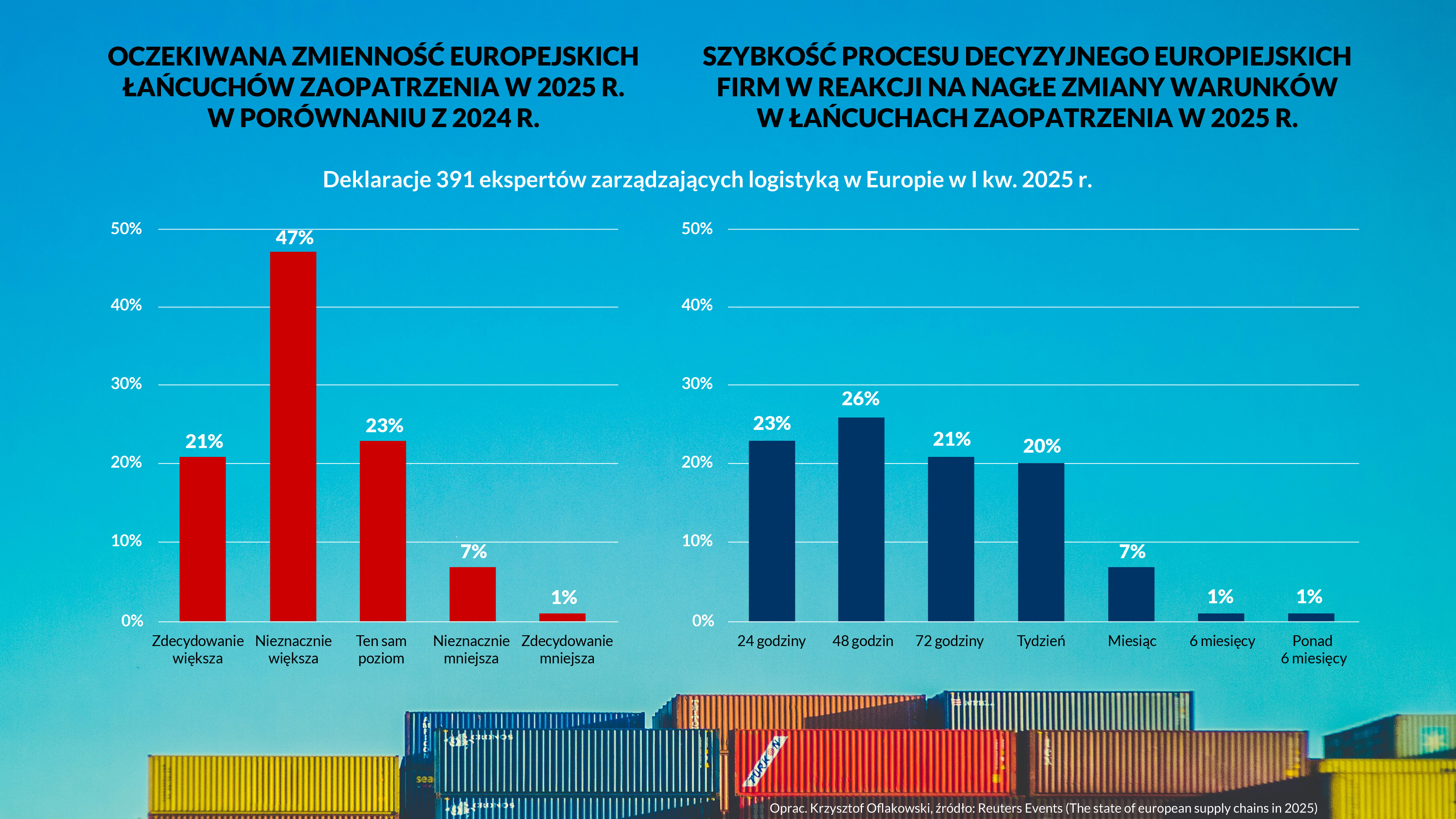
It is exactly the opposite, and the diagnoses made by international institutions have their direct reflection in the expectations and moods of professionals managing supply chains on the Old Continent. At the beginning of 2025, Maersk and Reuters Events asked 391 of them, among other things, how much more volatile the supply chain environment would be compared to the previous year? As many as 68% replied that they expect greater volatility than in 2024, of which 21% claim that the environment will be significantly volatile. Only 8% believe that volatility will weaken this year, and 28% believe it will remain at the same level. At the same time, 80% of logistics managers indicated that the greatest threat is currently the probability of sudden changes in the field of customs and tariffs. Low political stability leading to sudden regulatory changes is also expected to be an equally important element until the end of 2025. This is claimed by 64% of respondents, and slightly fewer, 54%, believe that the risk of disruptions on key trade routes is also significant. These factors pushed the threats of cyberattacks (53%) and interstate conflicts (48%) into the background.
There is consensus on rising costs
Similar to the global announcements of price increases published periodically by Ti, there is also a conviction among European experts that radical and sudden changes in the international trade landscape will lead to increased costs. This will apply to both imports and exports. The consensus on the realization of such a scenario reaches 92%, although the scale of the increases is assessed at different levels. Significant hikes are predicted by 26% of logisticians, moderate price jumps by 44%, while 22% bet on a low increase in burdens. Of the remaining 8%, no one believes that trade will be significantly cheaper this year, and 6% believe that the cost level will remain until the end of the year.
Certainty and readiness to make quick and significant decisions dominate
Despite the expected high unpredictability, European experts are confident that they will be able to make quick and significant decisions in response to further changes in regulations and conditions in supply chains. In the Maersk and Reuters analysis, as many as 23% of operations managers claim that they can take adequate and effective steps within 24 hours. 26% of respondents need two days for the decision-making process, while 21% declare that they will find a solution within 72 hours. This means that 70% of experts in Europe will be able to effectively respond to changes within a maximum of three days. If it takes a week to make a decision and implement appropriate plans, another 20% will join the aforementioned 70%, which, given the scale of potential problems, gives an impressive 90% of companies ready to deal with new challenges.
The Polish contract market sees the threats, but they differ depending on the scope of operations
The contract logistics sector – in which ID Logistics specializes – is partially protected from tensions in transcontinental trade because it is based mainly on local activity. In the long term, however, sales of contract logistics services may suffer if economic growth and the sales results of our clients weaken as a result of the recent tariff war. – says Yann Belgy, Managing Director at ID Logistics Poland, which provides comprehensive logistics and transport solutions, e-commerce support, and supply chain management.
Looking at the Polish contract logistics market, however, it is worth distinguishing between domestic logistics and European logistics centers. Domestic logistics is still feeling the effects of the slowdown in consumption in many sectors, especially in food retail. This has a direct impact on our clients’ sales and increases pressure on prices and margins. On the other hand, for several years now, Poland has become home to a center for European fulfillment operations and distribution centers – especially for the e-commerce sector and the fashion industry. More and more companies are deciding to carry out deliveries from Poland to all or a significant part of Europe, taking advantage of our cost-effectiveness, developed infrastructure, and flexibility. Despite a slight slowdown, this positive momentum is still maintained. In particular, in the western and southern regions, we are observing new projects and investments. – adds Yann Belgy.
At ID Logistics, we continue to do everything in our power to be close to our clients – to proactively respond to their needs, maintain high flexibility, and constantly invest in innovation and operational excellence. These simple principles allow us to provide our clients with the value they need from their logistics partner, and consequently, allow us to continue to develop in a dynamic and sustainable way, even in such unpredictable times. – concludes the Managing Director of ID Logistics.
Despite many adversities, the year in Polish logistics started quite well
Polish ports, among others, performed well. Gdynia increased container handling by 26.5% in the first quarter. More than 278.4 thousand TEU is primarily due to new shipping services, but Gdańsk also received a strong impulse at the beginning of the year. Over 624 thousand TEU handled means a year-on-year jump reaching 17%. Here, alongside the important role of infrastructure development, new services and connections were also a significant factor.
E-commerce also maintains a strong position in Poland, which, according to BaseLinker, increased sales by 8.2% year-on-year in April, and by 0.3% month-on-month. In annual terms, both the number of orders (by 4.9%) and their average value (+3.1% year-on-year) jumped. The low monthly growth is unfortunately burdened by a 1.9% drop in orders, but it is compensated by a 2.3% increase in the average value of purchases, which is interpreted as a signal of a saturating market and a symptom of more thoughtful purchases by consumers who, instead of fragmented transactions, decide on larger but less frequent purchases. It is important, however, that e-commerce in Poland is still growing, because this is encouraging news not only for contract logistics but also for the CEP market. It is also growing and has good prospects. A report published in the last days of May by the Office of Electronic Communications (UKE) shows, among other things, that in 2024, over 1.21 billion courier parcels were sent in Poland, which is a new record in both absolute numbers and market value and service volume. The courier market grew by 15.3% in volume and 16.1% in revenue, and this is a direct consequence of the popularity of e-commerce in Poland. It is also interesting that while in 2023 courier services accounted for 71.3% of the value of the entire postal services market, as well as 51.7% of their volume, a year ago it was already 73.3% and 56.6%, respectively. UKE predicts that the courier market will continue to grow and in the coming years may exceed the level of 1.5 billion parcels per year.
E-commerce growth is very good news for the warehouse sector
In this area, the new year also brought a handful of positive news, despite the fact that the sector fell into a slight stagnation. According to the March report by AXI IMMO, the Polish industrial and logistics sector maintains its position as one of the key segments in the commercial market both in Poland and in Europe. In 2024, 5.8 million sqm of space was leased in our country, which means an increase of 4% year-on-year. Total warehouse space amounted to 34.5 million, which in turn is an increase of 9% year-on-year. According to announcements, the current year will not bring major surprises and the domestic warehouse sector will remain one of the strongest on the Old Continent. The market, however, will face challenges driven by, among other things, limited availability of employees and high costs of adaptation and relocation, but this will favor contract renegotiations. The current forecast for demand strongly emphasizes e-commerce, which is expected to generate the greatest potential for growth. The situation in the warehouse market is assessed similarly by experts from Paribas Real Estate, pointing out that in 2024 we observed a return to a more balanced pace of development known from before the pandemic, and the group of most active tenants came from the retail sector (20% of gross demand), which overtook the previous leader, i.e., logistics (14%). E-commerce took third place (11%). The structure of tenants, however, changed with the beginning of the year. According to Colliers, in Q1 2025, the greatest interest in warehouses came from logistics operators (35%), retail was in second place (16%), followed by production (9%) and distribution and e-commerce (6% each). The entire market clearly slowed down, but gross demand still increased by approx. 15% year-on-year.
Air cargo in Poland had a weaker year
The Civil Aviation Authority (ULC) has not yet provided data for the first quarter of this year, but it is worth mentioning that the previous year ended with a decline in cargo handled at Polish airports (-0.8% year-on-year), despite the fact that the last quarter brought an increase reaching 16.6% year-on-year, mainly due to the Rzeszów Jasionka airport (+61.1% year-on-year).
In 2025, it will be difficult to expect spectacular jumps in handling, especially since the quarterly data of the International Air Transport Association (IATA) show that air cargo in Europe is developing more slowly than in the other two regions with a significant market share, which is not the best omen for domestic results, especially since cargo traffic in Poland is only a fraction of the European potential. According to IATA data, the growth of transport work (CTK) in European air freight in Q1 was only 1.7%, while in the Asia-Pacific region it was 7.3%, and in North America 2.6%. In terms of CTK, the entire market grew by 2.4%, and on international routes, which accounted for 87.3% of the final result, the growth was 3.1%.
A decent start for air freight at the global level at the beginning of Q2
Data published by IATA in the last days of May show that, taking into account the unpredictability and volatility of macroeconomic and trade conditions, April also achieved good growth in transport work (5.8% year-on-year). This was due to several overlapping factors, including increased seasonal demand generated by the fashion and consumer goods sector. Customarily, the transport peak in these industries falls precisely in the period between April and June, to guarantee the availability of goods before the start of summer. The second of the significant factors driving air cargo since the beginning of the year is, to put it mildly, the haste of importers resulting from, among other things, the long-announced elimination of the customs exemption for low-value e-commerce shipments entering the USA. Further announcements of changes in tariff rates and lower fuel prices also contributed to the increase in demand.
In summary, including April, the overall demand for cargo transport from the beginning of the year to the end of April 2025 increased by 3.4% (in Europe by 2.5%), but analysts studying this market have no illusions that air freight faces serious challenges that should be expected in the coming months and for which one must prepare. IATA also notes that changes in trade policies, especially in the USA, are already reshaping the demand for air services and clearly affecting export dynamics. Air carriers will therefore have to demonstrate great flexibility and creativity as the situation develops throughout the year.
The same applies to cargo floating on the oceans
Warnings about unpredictability and messages about new, less noticeable threats are already flowing from almost every side in maritime transport as well. Those from BIMCO, the world’s largest international shipping association, say, among other things, that the supply growth for new container units will reach 6.2% in 2025 and 3.1% in 2026. This is seemingly good news, which was included in the latest report on container shipping, but it was immediately explained that these will be deliveries 35-50% lower than in 2024. More importantly, although supply will increase, demand for container ships will fall to the 1-2% range this year and next, and these are results much worse than in 2024, when 12.1% more units were delivered, while demand reached the 19-20% level. BIMCO explains that such a disproportion will contribute to a significant weakening of the supply and demand balance in the market, and this is expected to be caused by the return of units to the trade route through the Red Sea.
Citing safety concerns for crews, vessels, and cargo, such a scenario has already been ruled out by the largest operators, including Maersk and Hapag Lloyd, emphasizing that this will certainly not happen quickly. As Xeneta points out, if such a scenario were to be realized and units returned to the Red Sea on a large scale, it would lead to flooding the market with excess capacity, as the lack of need to sail around Africa would simply require fewer ships. This, in turn, would lead to a global collapse of transport rates, and then to a 6% drop in demand for container transport (calculated in TEU miles).
In the context of declines in maritime logistics, it is worth returning to the previously cited Drewry forecast, according to which container handling volume will shrink by 1% this year. If such an estimate were actually realized, it would be a truly historic event, because since the beginning of measurements in 1979, a similar reduction has been recorded only twice. The first occurred during the financial crisis in 2009 (-8.4%), while the second during the coronavirus pandemic in 2020 (-0.9%). Now, US tariff policy also has an equally destructive potential, qualifying for being recorded in the sector’s chronicles, which only confirms the great challenges that logistics is currently facing.