









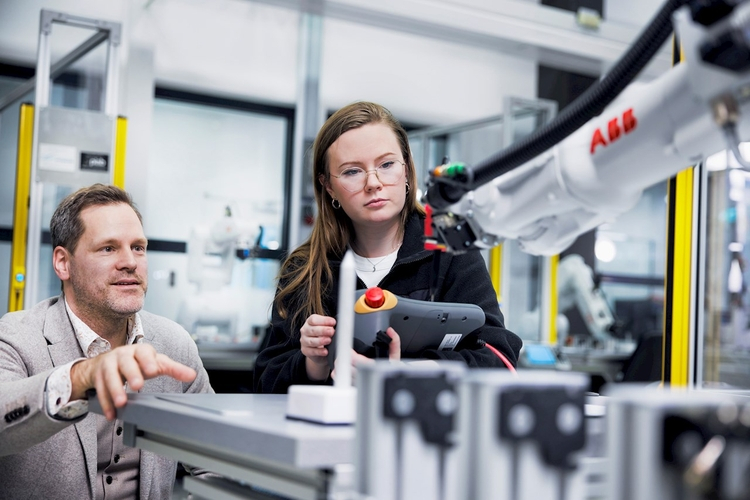
Only one in four educational institutions uses robots in their curricula, even though 70 percent of American and European companies plan to invest in robotics and automation within the next three years.
A global study by ABB has revealed a growing trend among American and European companies toward “re-shoring” or “nearshoring,” which involves moving operations back to the home country. This is intended to provide greater flexibility in the face of global challenges. At the same time, attention was drawn to a significant education gap regarding the skills necessary to effectively carry out these processes.
According to the study, 74 percent of European and 70 percent of American companies are planning to relocate or reorganize their operations to improve supply chains in response to labor shortages, the need for greater sustainability, or the general landscape of uncertainty. Most of these companies see automation as an enabler of these changes, with 75 percent of surveyed European companies and 62 percent of American ones planning to invest in robotics and automation within the next three years. Despite this demand for automation, the study found a significant gap in education and training that would provide the market with the skills needed to navigate increasingly automated workplaces in the future. 80 percent of education professionals believe that robotics and automation will shape the future of employment over the next ten years. At the same time, only one in four educational institutions currently uses robots as part of their curricula.
To help bridge this gap, ABB is currently pursuing over 100 global partnerships with schools and universities, and the company recently expanded its global robotics and automation education program. New centers have joined the program, including the company’s innovation and training campus in Austria. The new facility, along with other regional training centers in the UK, Germany, and Brazil, expands ABB’s training facilities to over 40 locations worldwide. In total, the company trains more than 30,000 students, apprentices, and employees each year. One of these locations is Poland, where ABB implements its local strategy of cooperation with the scientific community.
– The ABB study highlights the need to promote robotics and automation courses of study more broadly at every possible level of education. In Poland, ABB has been involved in educational programs for years – says Beata Syczewska, Head of the Robotics Division at ABB in Poland. – We cooperate with technical universities by organizing thematic meetings for students at our Robotics Training Center in Warsaw. Every year, we invite students to complete internships at our company, where everyone has the opportunity to deepen their knowledge in practice by working on specific robotics projects. Students also have the opportunity to work using RobotStudio, which is the world’s most widely used software for robot programming. For educational purposes, we provide the software for free, with all process add-ons, in a network version that allows 100 people at a given university to use it simultaneously.
In the report based on the aforementioned study, the industry that will undergo the most automation is transport and warehousing. The manufacturing industry takes second place, and construction is third. Interestingly, industries that might also be associated with humanities education – such as administration and support services, public administration, or finance and insurance – occupy high positions in terms of workplace automation potential.
– The change must happen now – says Sami Atiya, President of ABB’s Robotics and Discrete Automation business. – Companies are turning to automation to offset labor shortages, improve productivity, and increase resilience to market volatility. Therefore, employees need the skills to use automation to perform their tasks and expand their own roles. Enterprises must join forces, collaborating with educational institutions and governments to ensure society is prepared for the future of work. Only then can we fully leverage flexible automation and the opportunities of the ongoing reindustrialization.