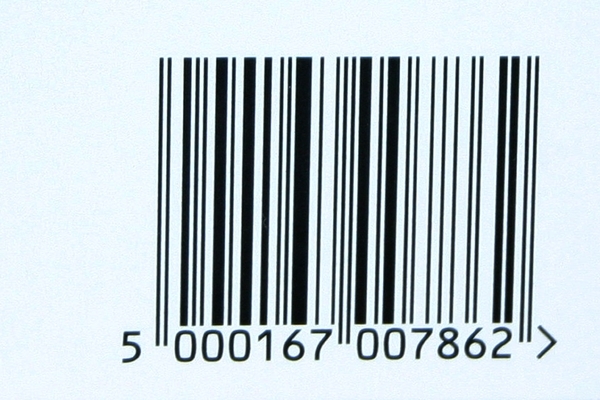
How long would the queues at checkout counters be today if a cashier still had to manually enter the price of every product? Accustomed to the current standard and the “beep” of the code at the register, we do not think about it. Meanwhile, it is precisely thanks to barcodes that ringing up a basket of fifty products takes a cashier only about three minutes. The first barcode was scanned on June 26, 1974. Forty years later, more than 5 billion products are scanned every day around the world.
Every minute of the day, all over the world, 3,472,222 barcodes are scanned. This results in an astronomical number of approx. 5 billion “beeps” per day. Such a quantity of products could provide for 4/5 of the world’s population, i.e., for example, every citizen of Asia and Europe. To illustrate the number of business operations for which the barcode is used, this number would have to be at least doubled. Shipping goods, receiving and issuing from warehouses, checking stock quantities, and many other activities would take many times longer without codes. It is truly difficult to imagine today’s trade without the lines and digits of the code, and yet its presence in business is not that long at all.
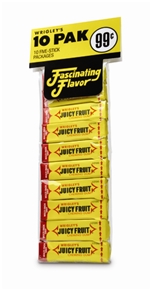 Exactly on June 26, 1974, the first barcode was scanned at a Marsh supermarket in Troy (Ohio, USA). The customer was Clyde Dawson, Marsh’s director of research and development, and the product he accidentally picked up first was a pack of Wrigley’s Juicy Fruit gum. Today, it is located in the Smithsonian National Museum of American History in Washington, D.C. Scanning the code was an extremely important part of the trade optimization process that began many years earlier and continues to this day.
Work on the barcode known today dates back to 1948. At that time, an entrepreneur approached the Drexel Institute of Technology in Philadelphia, asking for help in developing a system for automatic inventory tracking and product checkout. The topic interested two young scientists: Bob Silver and Norman Joseph Woodland. Woodland became so involved in the project that he quit his job at Drexel. He moved to Florida, and it was there, on a beach in Miami, that he came up with the idea of using Morse code and film soundtracks for product identification. The developed code consisted of concentric circles of white lines on a dark background, the so-called “bull’s eye.” Unfortunately, the technology available at the time did not allow for the widespread use of the developed code due to the lack of a reading device. The invention was definitely ahead of its time.
Only the possibility of using a scanner to read the code lines allowed for the first business use of the bull’s eye. However, difficulties, including in correctly printing cylindrical codes, meant that the project did not find widespread application. Further work on its optimization began. The idea of George J. Laurer, who worked at IBM, was considered the best. The Universal Product Code (UPC) presented by IBM was the first barcode whose symbol was widely adopted. It is assumed that this happened on April 3, 1973, when food manufacturers formally adopted the UPC as the standard barcode for product labeling. 14 months after that date, the first scan was performed. The implementation of the barcode system into business consumed huge sums. It is estimated that the total budget needed to equip manufacturers and retail outlets with new equipment supporting barcodes exceeded 200 million dollars and was close to the Pentagon’s budget. However, studies showed that the costs incurred paid for themselves within a few years.
Europe quickly followed America, and a system was created as a variation of the UPC. In 1977, the European Article Numbering Association (EAN) was established, a non-profit organization originally formed by 12 countries. Over time, the organization grew with more member countries, and in 1990, Poland also joined. Following the globalization of the market and the increasing flow of goods between continents, in 1998, the European and American organizations decided to merge the systems. A few years later, in 2005, the uniform name GS1 was adopted. Currently, the name GS1 is used by each of the more than 115 national organizations. In Poland, the role of the national GS1 organization is performed by the Institute of Logistics and Warehousing.
GS1 is now the global language of business. It is the best-known and most frequently used system of business-technical standards in the supply chain in the world. GS1 solutions are used to track and physically identify objects, trade items (products and services), assets, logistics units, shipments, and physical and logical locations. The system, originally created by manufacturers and participants in the retail industry to improve the distribution of consumer goods, is now used in various sectors by more than two million enterprises. It is also increasingly used by consumers, who have become a new recipient of information encoded in lines.
Despite such a widespread presence, questions arise as to whether the dynamic development of technology can lead to changes in the way products are labeled and displace the well-known barcode. We ask Dr. Elżbieta Hałas, the Director of the Institute of Logistics and Warehousing’s representative for the GS1 system in Poland, whether this threat is real.
– Technology has always been very important for the rapid identification of products; after all, it is thanks to it that the barcode has become the foundation of the global language of business, which is why I do not see it as a threat. Please remember that the barcode is only one, visual part of the system. The most important thing is the number itself, which is the crux of the matter. It is in this that the unambiguous identification of the product is contained. Therefore, perhaps one day the common format will change, printed lines will begin to be replaced by radio tags or some other invention, but the idea of identification will likely remain the same – says E. Hałas. – The GS1 system is present today not only in trade and distribution but in many other branches of the economy, including logistics and transport or healthcare. It is also worth realizing what a huge number of companies have adapted their business processes and IT tools to identify products through the barcode number (formerly the EAN number, now the GTIN – Global Trade Item Number). Changing this system, if only because of the gigantic costs, does not seem possible in the foreseeable future. In my opinion, however, it is worth paying attention to another fact. Today’s technology means that the barcode is gaining a completely new recipient – the consumer. Just 5 years ago, the code meant nothing to us, the end users. Today, when every third citizen has a smartphone, and thus a personal scanner, the code is also becoming a source of product data for them. There are many mobile applications that allow you to scan codes. The Polish GS1 organization has also prepared a solution (Mobit GS1), thanks to which consumers can check, for example, how a product is rated by the community and where it can be bought. In this way, we will also get information about promotions and whether the product is on the lists of dangerous products or – in the case of medicines – what substitutes it has. So it can be said that at the moment, technology is, once again, doing a favor to the proven, good barcode.