Elon Musk, a well-known visionary and entrepreneur, has revealed the price of the first electric semi-truck, which in the future may become a competitor to traditional, less eco-friendly vehicles. The vehicle is scheduled to enter production in 2019, with sales starting in 2020. Will the Tesla Semi truck truly revolutionize the road transport market?
According to the manufacturer, the vehicle will be available in three variants. The cheapest version, with a range of up to approx. 480 km on a single charge, will cost 150,000 dollars, which is over 530,000 PLN. A vehicle capable of traveling approx. 800 km on a single charge will cost 180,000 dollars, or over 637,000 PLN. The most expensive, limited Founders Series version must be paid for in advance and costs 200,000 dollars, which converts to approx. 708,000 PLN.
– For domestic transport on the Polish market, carriers typically purchase vehicles that are 8-10 years old. Therefore, it is difficult to expect a mass buying frenzy in Poland for Tesla trucks, which are expected to cost over 50% more than the currently most popular tractors purchased from a dealership, such as DAF or MAN. The purchase cost of a popular 8-10 year old vehicle is about 80,000-100,000 PLN, and in that case, Tesla is at least 5 times more expensive, not to mention the costs of importing such a vehicle to the country – says Janusz Nóżka, Fleet Director at ROHLIG SUUS Logistics.
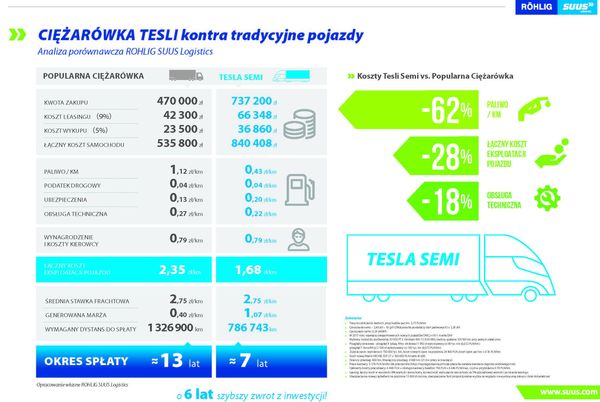
According to Tesla, the higher purchase prices of the vehicles compared to traditional ones will be offset by their low maintenance costs. The manufacturer emphasizes that the total cost of ownership for the truck is expected to be 20 percent lower in the US market compared to a diesel-powered vehicle. Although at first glance the price seems to be a significant barrier to entry into the Polish market for an electric truck, after analyzing all its operational parameters, the vehicle actually performs favorably. To check what the actual purchase and maintenance costs of an electric truck are, ROHLIG SUUS Logistics decided to conduct a comparative analysis relating to Polish realities. A situation was assumed in which the Tesla Semi has, among other things, all required type approvals, has been adapted for transport on European roads, and can be purchased in Poland. Furthermore, it was assumed that technical service for the new vehicle and spare parts are as available on the market as in the case of popular tractor unit models. The analysis took into account factors such as: the purchase price of both vehicles, fuel/electricity consumption costs, and vehicle technical maintenance.
– The fuel consumption cost itself is particularly noteworthy, as it is significantly lower for the Tesla truck than for a traditional vehicle. Traveling a distance of 100 kilometers with an electric truck is over 60% cheaper and amounts to 42.50 PLN, while for a regular vehicle it is 112 PLN – points out Piotr Iwo Chmielewski, Development Director at ROHLIG SUUS Logistics.
Moreover, according to the manufacturer’s declarations, when using an electric truck, we almost completely eliminate the costs of periodic inspections (fluids, filters) and additionally reduce other technical costs, such as replacing brake discs and pads, by about 20%.
– Taking into account average freight rates for domestic transport, the payback period for purchasing popular trucks is estimated at about 11-13 years. The savings generated by the electric Tesla truck can shorten this period to less than 8 years. Even without taking into account additional tax breaks that can be expected from the government or the EU for the purchase of electric vehicles – assesses Piotr Iwo Chmielewski.
Janusz Nóżka adds that he sees a real opportunity for the electric Tesla truck in the face of expected restrictions on the movement of traditional vehicles, which will certainly force the search for alternative solutions. – Such actions are already being taken, for example by public transport companies that are starting to invest in electric buses. In Warsaw alone, there are to be 160 of them by 2020 – continues Janusz Nóżka and adds – at the moment, we assess the manufacturer’s declarations as promising. However, the real test will be Tesla’s production capabilities, which have been heavily questioned so far, as well as our transport reality and the financial capabilities of carriers.