









Agri-food products occupy an important place in Polish exports, accounting for 13.2% of all goods sold abroad.* However, their transport, especially in the fresh produce category, is a major logistical challenge, partly due to the need to meet rigorous standards. Poles from the company Blulog have developed a fully automated temperature monitoring system for the transport of goods.
The value of Polish exports in 2016 amounted to 183.6 billion euros, which means an increase of 2.3% compared to the previous period (data from the Ministry of Agriculture and Rural Development). Growth was also recorded in the category of agri-food products, whose sales abroad jumped by 1.2%, reaching a total value of 24.2 billion euros.
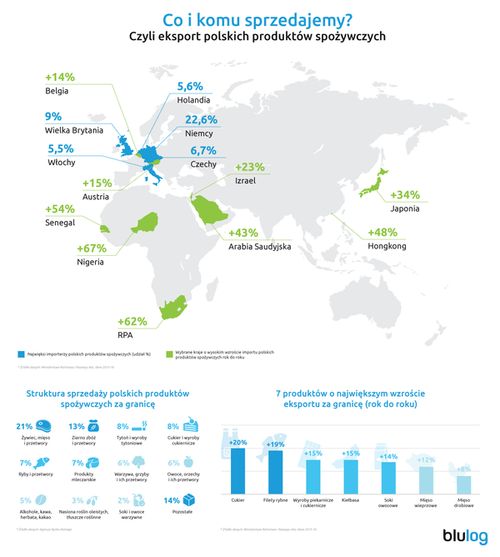
Domestic producers sell their goods not only within the European Union, but also decide to export to more exotic countries. And here, Poland is recording very large increases in many distant locations. For example, the total value of agri-food goods sold in 2016 increased in: Saudi Arabia by 43%, Hong Kong by 48%, South Africa by 62%, and Nigeria by as much as 67% compared to the previous year.
Losses can be limited
Interest in Polish products in distant corners of the world also applies to fresh products, such as: fish fillets (19% increase in sales abroad), fruit juices (+ 14%), pork (+ 12%), sausage (+ 11%), or poultry meat (+ 8%). Their transport is a great challenge for the logistics industry due to the strictly defined conditions in which the indicated goods must be transported.
For example, the recommended temperature range for fresh fish and meat is 0° to 4°C. Any increase in temperature leads to the intensive multiplication of Listeria, a dangerous bacterium that doubles its population every 6 hours at 10°C. The longer the journey, the greater the probability of irregularities, which can lead to a decrease in the quality of the goods and their spoilage. Delivery to some parts of the world, e.g., the Far East, can take up to three weeks! Every day without meticulous control of transport conditions is therefore a risk of real losses. How do Polish suppliers protect themselves against them?
Specialized solutions used in long-distance transport include: refrigerated trucks, isothermally insulated spaces, trailers equipped with so-called air ducts, and ventilation flaps. However, this is only half the success, as the transported goods – in addition to protection – should be supervised at every stage. This is to guarantee both parties – the supplier and the recipient – full information about the transport conditions when finalizing the transaction.
A Polish way to monitor temperature
The Polish-French company Blulog can boast of developing a solution that responds to the needs of the industry.
– Our system is based on machine-to-machine technology, i.e., communication between devices, which enables a fully automatic measurement process. The temperature of the transported products is under constant and strict control, the measurement itself takes place wirelessly, in real-time, and any deviations can be reacted to immediately – says Jérémy Laurens, Sales and Marketing Director at Blulog. Depending on the needs, there are two types of technology to choose from – NFC (fast, short-range data transmission) and RF (radio data transmission). – Recorders transmitting data via radio first store it in a hub connected to the network, from where it goes to the cloud, and then is automatically sent as an SMS or e-mail notification – adds Jérémy Laurens from Blulog.
The patent of the Polish company Blulog is already proving itself in local markets, both Polish and European; it is already being used by companies in France and one of the largest shipping companies in Poland.
Data source:
Ministry of Agriculture and Rural Development (data for 2016)
Agricultural Market Agency (data 2015-16)