









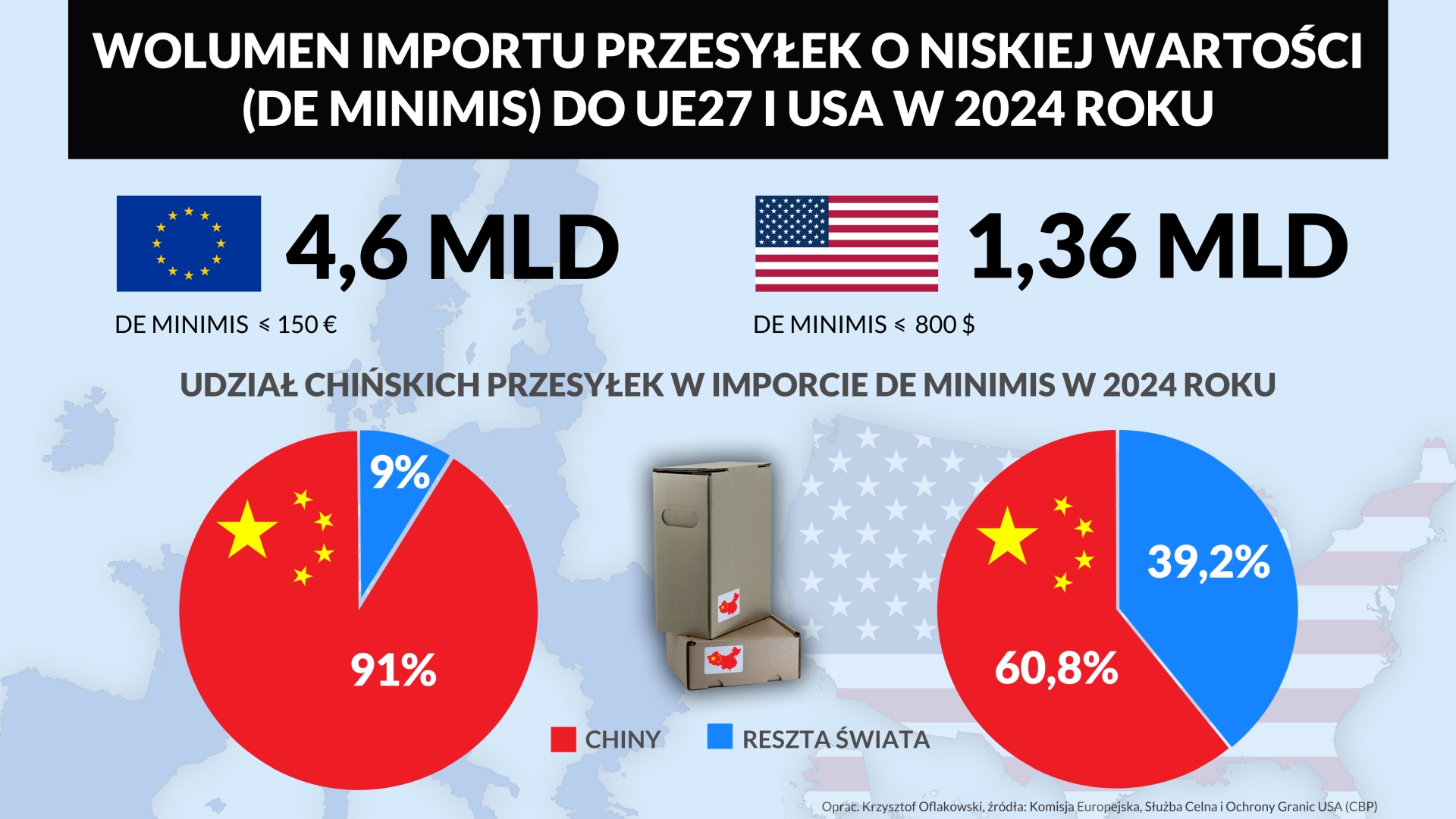
In 2024, the EU imported 4.6 billion low-value parcels exempt from customs duties. In the USA, the volume of such shipments reached 1.36 billion. Most of these are e-commerce orders from China—91% in the EU and 60.8% in the USA—but the end of the de minimis rule for imports is coming, and it will be a revolution in e-commerce and logistics. Although the balance of gains and losses is not yet precisely known, aviation will likely lose, contract logistics will gain, but e-shopping will become more expensive, by as much as 62 euros per year. This means that the expected stabilization will not occur; instead, one should prepare for dynamic plot twists and stories like the one about the victory of Chinese parcels over American customs officers.
In its January economic outlook, the World Bank assumed that in 2025 we would see global trade growth of 3.1% and 3.2% in 2026. GDP is expected to grow at a rate of 2.7% this year and next, which would confirm that we are entering a longer period of slower but stable economic growth. Stabilization, or rather the need for it, is also a keyword that appears not only in this forecast but also in documents from the International Monetary Fund and the World Economic Forum. However, alongside ensuring certainty for development and business operations, sanctions, trade wars, protectionism, geopolitical tensions, and increasing uncertainty are mentioned, and things are getting complicated.
In this context, World Bank simulations show that a 10 percentage point increase in tariffs that the new US administration would impose on all trading partners has the potential to reduce global economic growth by 0.2 percentage points. However, such a loss does not take into account retaliatory actions by partners, and if such actions were taken, global GDP would fall by 0.3 percentage points to 2.4%. This would weaken the potential of many economic sectors, and transport and logistics, which are exceptionally dependent on the dynamics of the trade they serve, would certainly suffer as well.
Tariffs have already hit Chinese imports, including the e-commerce industry, but only for a moment
Events of the last few weeks have shown that the announced US tariff policy will be implemented, as evidenced by the 25% rate on steel and aluminum, which will take effect on March 12. Tariffs of 10% have already been effectively imposed on all imports of Chinese goods. Incidentally, on February 1 of this year, the de minimis exemption for low-value parcels, i.e., those not exceeding $800, was suspended. De minimis shipments are not subject to customs duties and do not go through standard customs clearance, which significantly facilitates their processing and logistics handling. It is this loophole that Chinese e-commerce platforms have used to storm the American market, and it was precisely them that the elimination of the exclusion was aimed at. Ultimately, the level of customs duties, along with previously imposed levies and other fees, increased overnight to as much as 38%. However, it very quickly turned out that customs services were unable to process such gigantic volumes of goods, and uncleared parcels from China began to pile up at airports, paralyzing clearance. Within 4 days, Chinese e-commerce defeated American customs officers because the de minimis exemption was reactivated until operational capabilities were developed to handle the flow of shipments numbering in the millions per day.
So how many Chinese parcels are needed to paralyze customs clearance in the USA?
Calculations by the US Customs and Border Protection (CBP), which appeared in a Congressional Research Service (CRS) report updated in February of this year, indicate that between 2018 and 2021, as much as 67.4% of all imports under the de minimis exemption came from China. These are goods valued at $228.3 billion, and customs officers estimate that in 2023 alone, one billion such shipments with a total value of $54.4 billion were imported into the USA. At the same time, the Chinese side declares that in the same period, exports to the USA under the de minimis regime amounted to $18.4 billion, which is only one-third of the total imports covered by the customs relief reported by US services. Although CBP does not distinguish what percentage of these imports are online shipments, the International Trade Commission estimates that in 2022 alone, as much as 83% of total e-commerce order imports were low-value shipments. However, CBP calculates that over 10 years, the de minimis volume grew by over 600%, from 139 million in 2015 to 1.36 billion in 2024, which means goods worth $64.6 billion. As much as 60.8% of the volume came from China, and 1.1 billion items, or 80.9% of all imports of cheap shipments to the USA, were handled at airports.
Would the European Union be able to tame such a flow of Chinese e-commerce?
This question is valid because the elimination of the de minimis exemption is already written into the Community’s customs strategy. Under current regulations, parcels worth up to 150 euros sent directly from a third country to a recipient in the EU are exempt from customs duties. The elimination of de minimis is to be part of an ambitious and comprehensive customs reform proposed by the European Commission in 2023, and the exemption for imported e-commerce is to cease to apply on March 1, 2028. There are several reasons for taking such a step, including consumer safety, fighting unfair competition, and fraud. Official EU documents even cite the statistic that 65% of shipments crossing the Union’s borders are intentionally undervalued to avoid import duties. The changes are, of course, intended to benefit the Union, because according to the reform’s impact assessment, additional customs duties from imported e-commerce are estimated at about 1 billion euros per year, and in the long term, 13 billion euros over 15 years.
The abolition of the de minimis exemption may happen sooner than 2028
Such plans have already been announced by the EU Commissioner for Trade and Economic Security, for whom the reform of the Union Customs Code is to be a priority, and he will strive to implement the changes as early as 2026. Faster implementation is intended to serve European entrepreneurs and level the playing field against e-commerce platforms from third countries.
What scale of de minimis inflow to the EU are we talking about?
Information from the European Commission shows that in 2024, about 4.6 billion low-value shipments entered the EU market, and 91% of them came from China. That is over 12.6 million parcels per day, of which almost 11.5 million are from the Middle Kingdom. This is twice as much as in 2023 and three times more than the year before. At the same time, only six member states were responsible for handling 89% of imports generated by online sales last year. The EC notes that EU customs authorities are feeling increasing pressure, as e-commerce products already account for over 97% of all EU customs declarations.
The elimination of de minimis will affect the dynamics of e-commerce logistics
According to Transport Intelligence (Ti) estimates, the global value of logistics services provided for e-commerce was expected to reach 10.5% growth in 2024, from over 449.3 billion euros in 2023. This means that last year’s logistics services were valued at over 496.5 billion euros, and an average growth rate of 10% was expected to be maintained until 2028. Of course, this assumes growth in trade, GDP, and the calming of geopolitical and macroeconomic tensions. The planned, significant changes in global e-commerce flows are a contradiction of these assumptions, and as a result, they may seriously lower growth prospects for an industry operating in an atmosphere of constant uncertainty. The express delivery and parcel market has also benefited from the strong development of e-commerce so far. According to data from December, it grew by 5.1% in real terms in 2024. Such growth resulted in revenues reaching 544.7 billion euros and translated into an average annual growth of 5% since 2020. There is no doubt that the good results of last year were also due to Asian sellers and low-value products being introduced, handled, and sold in wealthy Western markets.
Changes in customs and procedures will be immediately felt by e-commerce and consumers
From the perspective of consumers and platforms, the elimination of the de minimis exemption in the Union would quickly cause four basic effects: an increase in prices and bureaucracy, an intensification of the outsourcing of customs processes, and longer delivery times. First and most obviously, if customs duties are charged, foreign e-shopping will become more expensive. The planned rates are to vary depending on the classification of the product into so-called baskets, of which there are to be five, with levies ranging from 0% to 17%. If a change regarding the so-called deemed importer also comes into force, the sales platform will be responsible for collecting and transferring fees to the customs office. For websites, this means a significant bureaucratic burden and greater responsibility, because in addition to settlements, it will be necessary to enforce and provide other information, e.g., more detailed product characteristics, environmental and safety certificates.
Greater bureaucracy is, of course, a higher cost, more delegated resources, and more workload. This, in turn, may trigger increased outsourcing of import procedures to customs agents—at least in the initial period. This is also good news for logistics operators who offer such services and have updated and specialized knowledge. Unfortunately, consumers will not be happy, because the agency service is paid, and the cost of handling, along with customs duties, will to a greater or lesser extent affect the price of their order. The last important consequence of next year’s elimination of de minimis is the probability of longer clearance times, especially during transport peaks. The paralysis observed in the USA is unlikely to occur because the EU is already preparing the appropriate IT infrastructure. On the other hand, if the end of the exemption is to happen in a year, not three, and this does not happen in parallel with the launch of the central customs database, the so-called Data Hub, the risk of chaos will clearly increase, because customs administration will be flooded with a wave of an additional 12.6 million shipments per day, which will have to be handled without the announced IT tools. In the USA, less than 4 million were enough for the system to collapse.
The structure of international e-commerce logistics will change
In a broader perspective, the elimination of the de minimis exemption in the second and third largest e-commerce markets in the world will cause profound changes in international online order logistics. There will be victims, but there will also be winners.
The biggest loser will be air freight, which is used by the vast majority of Chinese platforms sending cheap orders directly to customers in Europe and the USA. The Asia-North America and Asia-Europe connections are the two most important routes for air freight in the world. Meanwhile, last year, carriers from three regional markets—Asia-Pacific, North America, and Europe—accounted for a total of 81.5% of the transport work performed in global air freight.
Recently published data from the International Air Transport Association (IATA) show that demand for air transport, measured in cargo tonne-kilometers (CTK), grew by an impressive 11.3% in 2024, which is a new record. The CTK indicator on international routes grew even more, by 12.2%. IATA explicitly points out that this was due to two main factors, i.e., persistent difficulties in shipping and e-commerce, and especially the demand for Asian goods sent to Europe and the USA. In December 2024 alone, the share of the Asia-North America and Asia-Europe routes in the entire cargo market was 45% and grew by 8% and 10.3%, respectively.
A key growth factor may turn into a serious risk
It is because of e-commerce that interest in air shipments is so high that in the largest Chinese ports, the line between operations carried out during peak transport times and off-peak is blurring. Last year, Boeing even estimated that the continued development of Chinese e-commerce at the current level would force local carriers to increase their freighter fleet by an additional 190 machines by 2042, which will account for 20% of all aircraft of this type in the world.
However, the elimination of the customs exemption for low-value Chinese products could bury these impressive indicators and forecasts. After an exceptionally short episode with de minimis in the USA, the freight booking platform Freightos reported that withdrawing e-commerce shipments from air transport could cause rates on the route from China to the USA to drop by 30% (from $5.09 to $3.65/kg). There will be an oversupply of cargo space on the market that will have nothing to fill it, and significant price drops may spill over to other regions. This will be a very painful blow to air cargo, and in such a scenario, there is little chance of realizing the IATA forecast, which predicts market growth of 5.8% for 2025. According to the organization, however, there is no doubt that the industry will have to adapt to the coming geopolitical changes, and the beginning of the year under the new administration in the USA has already shown its strong interest in using tariffs, which may also hit cargo dynamics by increasing inflation and reducing trade.
Chinese e-commerce will go by ship, but container shipping will feel it to a small extent
It seems that a rational scenario in the event of air transport becoming unprofitable for individual online orders is to shift volumes to the sea. This would mean a noticeable retreat from express air deliveries and a return to the traditional import model, in which goods are accumulated and sent collectively to distribution centers located as close as possible to the target markets. However, transit would be significantly longer, but this would allow for maintaining lower product prices. Yes, demand for sea transport would increase, and due to the imbalance in trade between markets, there could even be a temporary imbalance in the availability of containers, but the impact on prices would be relatively small, because the volume of several million small parcels is nothing spectacular in container shipping.
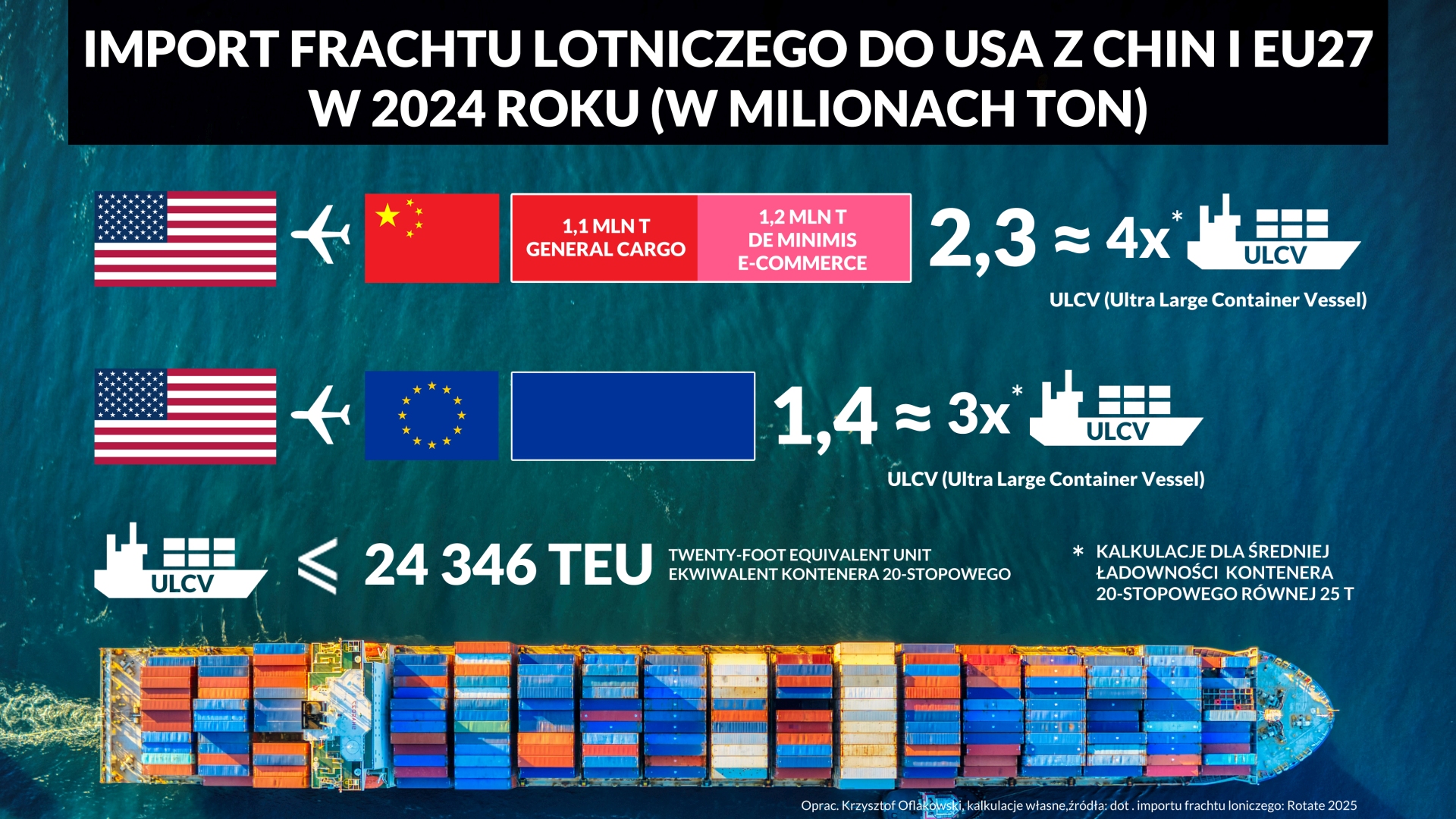
If we take as a starting point the data recently published by analysts from Rotate, speaking of 2.3 million tons of air cargo imported last year from China to the USA, of which 1.2 million tons were low-value e-commerce parcels, there is little indication that shifting even all air imports from China to the USA to ships would dramatically affect rates and conditions in ocean transport. If, in a simplified calculation, we assume an average capacity of a 20-foot container at 25 tons, this import would require 92,000 containers, which could be delivered to the US coast by just 4 ULCV (Ultra Large Container Vessel) class container ships. At one time, they are able to move as much as 24,346 TEU (TEU – 20-foot equivalent unit). On the other hand, if only Chinese low-value shipments were to hit the ocean, their mass would correspond to 48,000 TEU, which would fit on two such ships. In turn, all last year’s air imports from the European Union to the USA, which according to Rotate amounted to 1.4 million tons, would fit on 3 ULCV units. It is worth remembering, however, that in reality, the transport of goods would be spread over time, so the effects on shipping would be diluted and therefore less noticeable.
Changing the import model would open up opportunities for contract logistics and fulfillment centers
It is unlikely that Chinese e-commerce platforms will abandon the wealthy market in Europe and the USA just because the customs exemption for low-value products will cease to apply. The upcoming elimination of the de minimis rule has been talked about for a long time, both in the Union and overseas, and Asian websites indicate that they are preparing for such a scenario. For several years, we have been observing the building of logistics capabilities within target markets or in their vicinity. Many Asian e-commerce websites already have their distribution centers in Germany, but also in the Czech Republic, in Poland, or, for example, in Turkey. We predict that this process will continue, which will benefit the warehouse sector, contract logistics, and distribution centers. A return to a more standard import scheme will also help the transport sector. The real winners will be operators who can guarantee a reliable and comprehensive package of solutions, from agency services, through transport, warehousing, inventory management, fulfillment, to returns handling. This could be an exceptionally positive impulse for e-commerce logistics, especially since the growth dynamics in e-commerce have weakened, whether due to market maturity or changes in consumer sentiment. We could already observe this at the end of 2024 in Poland, where many sales forecasts were not met, and data from the Central Statistical Office (GUS) shows that the November share of e-commerce in total retail trade did not exceed 11% for the first time in the 5-year history of measurements. Usually, November is the best month of the year in terms of share. Finally, it is also worth remembering that the popularity of Chinese platforms did not come from nowhere. Retail customers are simply interested in such offers and do not want to give them up, although they will have to pay accordingly more for their purchases – says Marcin Smoła, Chief Operating Officer at ID Logistics Poland, which provides comprehensive logistics and transport solutions, e-commerce handling, and supply chain management in 18 countries.
The European consumer will pay even an additional 62 euros every year
According to last year’s estimates by analysts from Copenhagen Economics, the elimination of the de minimis customs exemption and the need for entrepreneurs, platforms, logistics operators, and customs authorities to adapt to the new regulations will mean an expenditure reaching 2.3 billion euros per year, of which 2 billion will be paid by private companies and the retail sector, and ultimately also by consumers. This amount also assumes that no other factors will change, e.g., no further tariffs on imports will be imposed. Sooner or later, however, the increases will fall on customers, which will result in a potential annual price increase of 62 euros for each individual consumer whose online purchases are imported into the Union. Average increases may range from 10.6 to 19.1 euros per inhabitant per year, and this is an amount resulting only from additional customs duties. If, however, we take into account the additional administrative costs resulting from the need for companies, operators, and trade to adapt, they increase to the range of 34.4 – 62.1 euros per year. Analysts calculate, for example, that a pair of imported shoes that previously cost the consumer 100 euros will become 17% more expensive, plus any logistics handling costs.
Customers in the USA and Europe want to buy goods from China
Proposals regarding de minimis seem not to take into account one fundamental fact: that both in Europe and in the USA, consumers making foreign purchases online do not want to give up cheap products from China, which have even dominated domestic sales platforms. This is well shown by last year’s study conducted by Jungle Scout, according to which as many as 71% of all items sold by both wholesalers and retailers on Amazon were produced in China. When asked which countries their offered goods came from, sellers most often pointed to the Middle Kingdom, and the United States came in second with a result of 30%. The podium was closed by India with a share of 14%. Goods produced in other individual countries did not exceed 10%. This clearly shows how strategic the cooperation with Chinese manufacturers and sellers is even for the American giant. Amazon is even courting Asian sellers. It has even opened an office in Shenzhen, where it organizes meetings for manufacturers, enabling them to enter the platform. It is largely thanks to products from China that the company achieved 7.1% growth in online sales in 2024 to $75.5 billion.
Exactly the same thing is happening in Europe, as evidenced by Allegro, which has also let Chinese companies onto its pages. In turn, according to analyses by the French consumer intelligence firm Foxintelligence, which monitors the e-commerce market in 10 European countries, in the first half of 2024, as much as 34% of total e-commerce sales in Spain belonged to Alibaba, Shein, and Temu. In Italy, it was 13%, in France 9%, in Germany 7%, and 6% in the UK. Other analyses by Foxintelligence also indicate that Chinese Temu is almost always on the shopping podium in these countries in the categories of home and kitchen, clothing, beauty, tools and DIY, games and toys, computers and electronics, health, and automotive.
Poles have also accepted Chinese platforms very well, and, for example, Temu is well on its way to becoming the most visited e-commerce site in Poland. December’s Mediapanel study shows that it was visited by 18.24 million people, which corresponds to 61.3% of internet users in Poland. Allegro, remaining in the leader’s position, attracted 18.96 million users, or 63.7% of internet users. A change at the top of the list is all the more likely because Temu has once again broken its own record of visits and is growing dynamically. For comparison, in December 2023, the difference between the platforms was 5.73 million users, and now they are separated by exactly 719,442 internet users.