









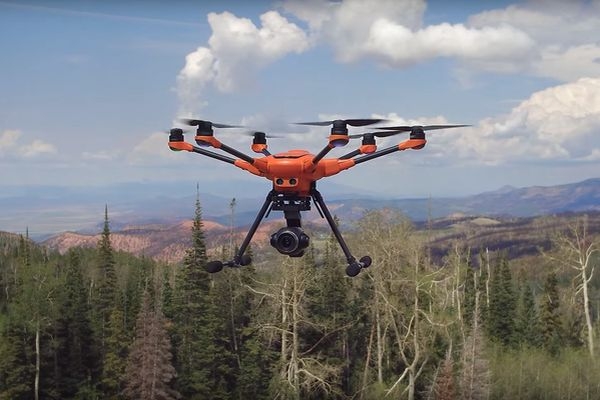
Today, many leading global corporations use drone technology for a variety of tasks. The growing demand for innovation, cost reduction, increased efficiency, and capturing the most beautiful views means that the list of their applications continues to grow. Although drones are still most commonly used for photography and filming, their commercial applications are also surprisingly diverse. So, what unusual drone applications have emerged recently?
Seals fed by a drone
Modern animal husbandry in oceanariums requires creating diverse living conditions for them. In the open sea, animals must face new challenges to access food. Therefore, caretakers in large-scale aquarium complexes are required to entrust the animals with new tasks. Since July 2018, the Wilhelmshaven Aquarium has been using a Typhoon H520 to feed three seals. Equipped with two additional hooks on the landing gear, the drone carries fresh fish. At a height of about 9 meters, the landing gear is raised, and the fish slide down into the pool. Feeding from above provides the animals with new challenges. The seals learn to cope with new and unknown situations during daily training sessions. This is an important aspect when it comes to interacting with these animals.
In search of life on another planet
Drones are used for both professional flights (e.g., Yuneec drones for emergency services) and amateur ones. But that’s not all. In the coming years, the American 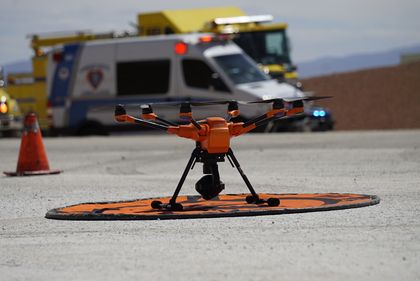 space agency NASA intends to continue exploring Saturn’s largest moon, Titan, with the help of a drone. The space mission, scheduled for 2026, aims to characterize the environment and find the building blocks of life. Thanks to many research instruments, the multi-rotor flying vehicle Dragonfly will search for chemical reactions that could lead to the development of life. Using a drone will allow for an increased range of research, which will cover subsurface reservoirs, the floor of an impact crater, and the atmosphere within Titan’s solar system.
Safety and efficiency of inspections at Ford plants
At the Ford engine plant in Dagenham, UK, high-performance drones enable more effective monitoring of production processes. To carry out fast and safe maintenance work, the car manufacturer chose the Hexacopter Typhoon H520 from Yuneec. With this drone and its remote camera, high cranes, pipelines, and roofs can be checked quickly and easily at astonishing heights. As a result, production downtime is a thing of the past, as production equipment no longer needs to be stopped during inspections. This means that maintenance work can be performed more regularly and efficiently than before. Furthermore, time-consuming assembly and disassembly of scaffolding is no longer necessary. The thermal imaging camera system that the Typhoon H520 possesses also allows for checking pipes and potential machine overheating.
A drone in medical emergencies
In the USA, the University of Maryland Medical Center used a drone for the first time to deliver an organ for transplant. Currently, in Canada, a pilot project is being conducted in Brampton emergency services, which aims to demonstrate how the arrival time of a remotely controlled drone with an automated external defibrillator (AED) to a victim is reduced. The test showed that the drone arrived at the scene first every time, while an ambulance was struggling with traffic. The few minutes gained by the unmanned aerial vehicle can save many lives.
To the rescue of young fawns and piglets
Those involved in saving wild animals are getting help from the Yuneec Typhoon H520. Used for tasks in emergency services, police, and fire departments, the drone helps assess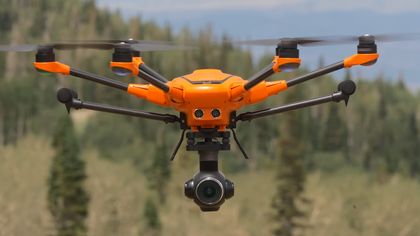 the situation, detect heat, or search for missing persons. It is a versatile and reliable piece of equipment that also supports aerial searches for young fawns and wild boars in tall grass and on farmland. An animal hidden in the grass does not run away from an approaching machine and is simultaneously invisible to a working farmer. Using the thermal imaging camera mounted on the drone, rescuers quickly locate the young, increasing their chances of being saved. While working, the drone scans a given field according to a set course and covers its entire surface. Small dots on the screen show where the animals are hidden. Those saved in this way quickly return to the herd.
The future of drones
In recent years, we have had the opportunity to learn about various types of drone applications. Unmanned Aerial Vehicles (UAVs) are widely used by commercial enterprises for property monitoring, construction project supervision, agricultural work support, creating 3D models of real objects, or air pollution research. In turn, as devices for amateur or sports flights, they bring a lot of joy to their users. They give them the opportunity to capture amazing, unique moments, as well as the chance to look at the world from a different perspective.
Continuous technological development, combined with artificial intelligence, will ensure that there will be more and more new examples of applications.