








The EU needs stricter CO2 emission standards for heavy-duty vehicles to help its lagging manufacturers compete with Tesla and BYD.
Three European truck manufacturers, along with Tesla and BYD, dominate a new global ranking of truck brands’ readiness to transition to selling only zero-emission vehicles. Mercedes-Benz Trucks, Scania, and MAN aim to offer only electric or hydrogen-powered trucks by 2040. However, the author of the ranking, the environmental organization Transport & Environment (T&E), warns that without tightening CO2 emission standards for heavy-duty vehicles at the EU level, there is a risk that the four major European truck manufacturers will fall far behind and lose market share to American and Chinese competitors.
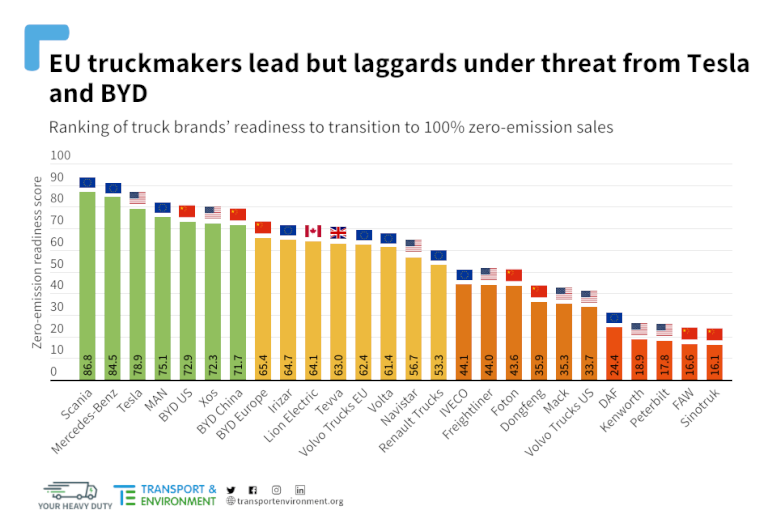
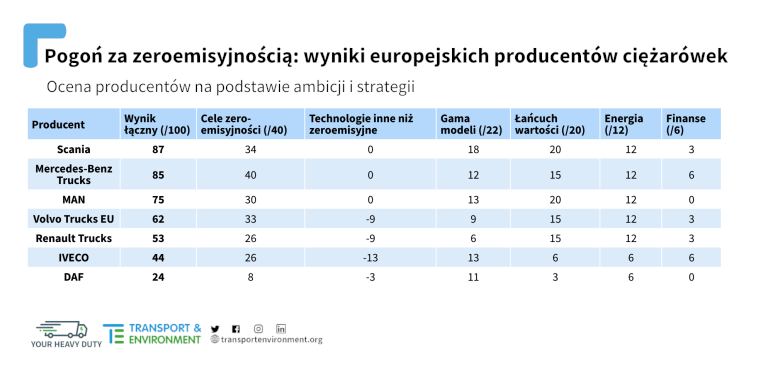
Scania leads the ranking in terms of ambition and climate strategies among truck manufacturers. Although the company has set a target of only 50% of sales from electric or hydrogen-powered vehicles by 2030, it has a well-developed industrial strategy. Second-ranked Mercedes-Benz Trucks aims for zero-emission vehicles to account for 60% of the company’s sales by 2030. However, there is some inconsistency between its announcements and industrial plans. The company has a weaker strategy for battery production and has not yet secured supplies of raw materials for them. Fourth-ranked MAN plans a smaller range of electric models and has a less ambitious zero-emission target for 2030.
Volvo Trucks, the current leader in zero-emission truck sales in Europe and the United States, ranks only in the middle of the table. Despite an ambitious public commitment to reach 70% of sales from zero-emission trucks by 2030, Volvo Trucks does not have a defined target for 100% of sales from zero-emission trucks and is investing in gas and biofuels, the combustion of which still leads to CO2 emissions. Lower in the table, Renault Trucks aims for zero-emission vehicles to account for half of its sales by 2030, but it is also hedging its bets by investing in gas and biofuels. IVECO and DAF, which have no long-term targets and have invested little in battery supply chains and charging networks, rank in the bottom half of the table.
– All European truck manufacturers claim to be green, but in reality, less than half of them are on track to reach zero emissions, and even then, these are voluntary commitments. There is a huge gap in the industry between manufacturers planning full decarbonization and those without such a plan. The European Union needs strict CO2 emission standards for heavy-duty vehicles to accelerate the modernization of the entire industry in Europe – comments Rafał Bajczuk, senior specialist at the Electric Vehicles Promotion Foundation.
European truck manufacturers face strong competition from Tesla and BYD, two companies that have already proven their ability to quickly scale up production of zero-emission passenger cars. They have also built efficient battery supply chains, including securing raw material supplies.
The report also warns that the ban on the sale of diesel-powered trucks established in California from 2036 and the US Inflation Reduction Act could cause truck manufacturers to prioritize investments in vehicle and battery production in America. This could lead to a change in the current voluntary commitments of truck manufacturers or a delay in their implementation. T&E stated that the EU must use the revision of its CO2 emission standards for heavy-duty vehicles to signal that investments in Europe are secure and to ensure that truck manufacturers’ commitments are not abandoned. A higher target for 2030 will be crucial to induce manufacturers to quickly improve their industrial strategies in the EU.
– Tesla and BYD are ready to repeat their previous successes in the truck market, and California has sent a clear signal to truck manufacturers. This should alarm European and Polish policymakers who do not want investments in production and batteries to go to other countries. This is particularly important for Poland, which is the largest market in Europe for new heavy-duty trucks and has attracted large investments in electromobility and battery production in recent years. Adopting ambitious targets for electric truck production in the European Union could be another incentive to develop zero-emission truck production in Poland – comments Rafał Bajczuk.
Earlier this month, T&E launched the Your Heavy Duty campaign aimed at raising CO2 reduction targets for European truck manufacturers to encourage investment, increase supply, and deliver zero-emission trucks. The campaign calls on EU lawmakers to:
- Establish a 65% CO2 reduction target by 2030 in line with manufacturers’ earlier declarations;
- Establish a 100% CO2 reduction target by 2035 for trucks to phase out the most polluting vehicles from European roads by 2050. By not setting a target similar to California’s 100% reduction goal by 2036, the EU risks falling behind, and major truck manufacturers will move investments outside of Europe;
- Exclude fuels from CO2 emission standards: biofuels and synthetic fuels are expensive and false climate solutions for decarbonizing new trucks. Truck manufacturers opposing the inclusion of such fuels in regulations account for over 90% of the market. Only laggards look favorably on such an approach;
Extend regulations to small trucks, commercial vehicles, and special-purpose vehicles, which are currently not covered by truck emission reduction regulations.
The report is available at this link.